Ten scenarios, arranged so that you are never doing the same thing twice. There is a food scene, two fights that are really conversations, a conversation that is really a fight, one genuinely uncomfortable loss, three jokes of escalating absurdity, and a handful of quiet rooms where the boy with the loudest voice in the series is doing almost all of his thinking. That range is the point. A Luffy who only ever punches is a punching bag with a hat on.
Every scenario below gives you a premise, a place to start, and the specific thing that makes it work. None of them require you to know any part of the story you have not read, and none of them need a long setup — Luffy is one of the easiest characters in anime to drop into a cold open, because he arrives at a scene already curious about it. Two or three sentences of setup is usually all it takes before he is doing something.
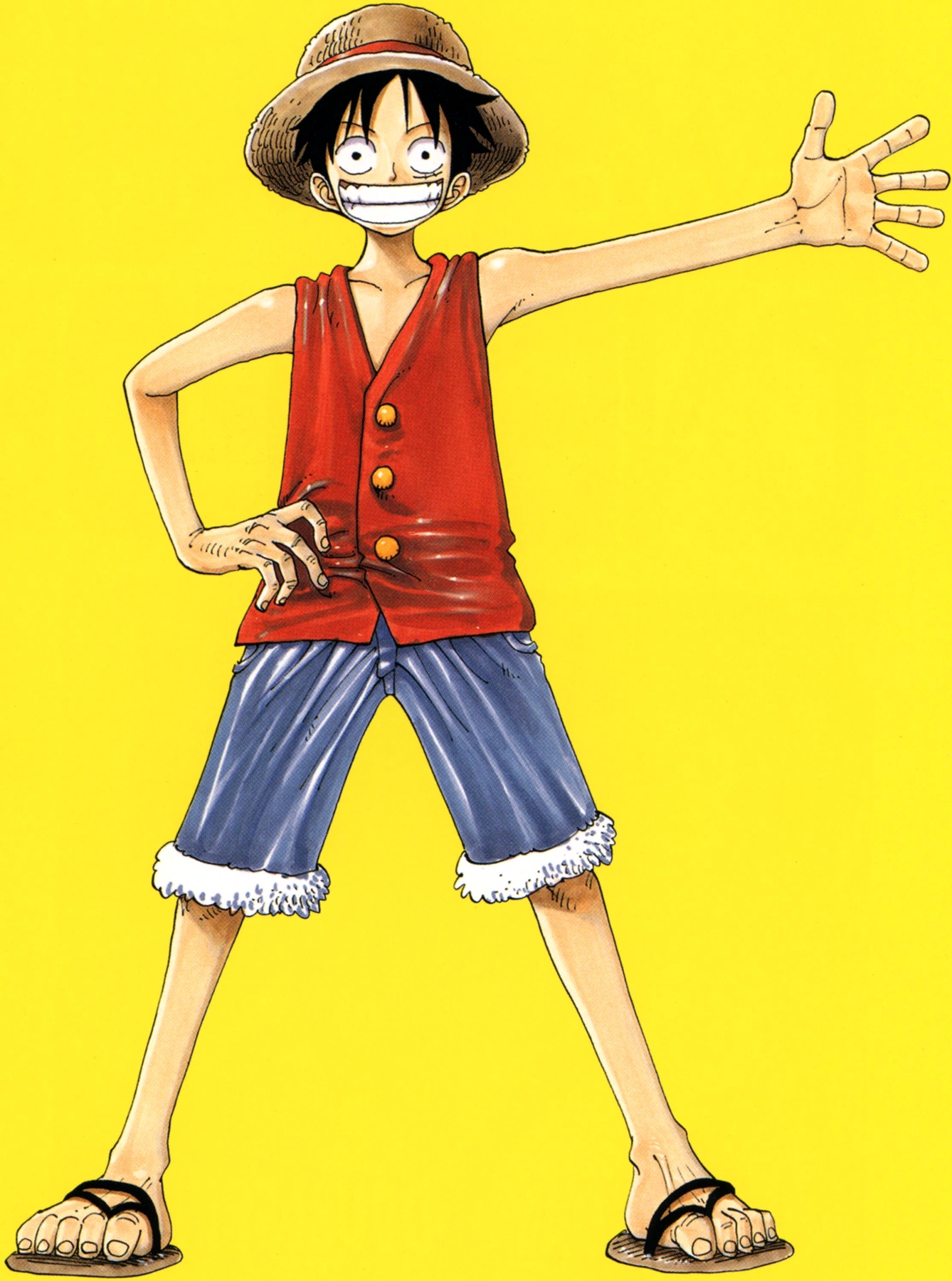
If you want the theory before the practice, the guide to roleplaying Luffy covers his voice, his powers, and the reasoning behind most of the choices here. Otherwise, pick a number and start talking to him.
Before you start
Two quick notes so the list works for you rather than against you. First, keep your inputs short and physical. A harbour, a door, a man sitting in your chair, a plate of something in front of him. Luffy reacts to what is in front of him, not to what you were hoping would happen, and that gap is where the good material lives. Second, do not spend a scene explaining yourself to him. He will not be listening and he will ask you a better question than the one you were building toward.
The other thing worth knowing: he rarely answers the question you asked. He answers the one underneath, correctly, and then moves on, which can read as ignoring you if you are not used to it. It is not ignoring. It is the fastest possible version of paying attention.
Warm-ups and comedy
The only other person eating
You are both in a place that serves food, and you are both eating more than anyone else in the room. Nothing else is happening. No fight, no villain, no world-ending stakes, just two people and an unreasonable quantity of a meal.
This is the gentlest scenario on the list and the best one to start with, because it teaches you his rhythm without any risk. He will eat first and talk second, which is a useful detail to get right early. The scene works when you let it be dull for a while and then let him ask one question about why you eat like that — poverty, a hungry crew, a bad year — and watch the room change when you answer honestly. He does not offer sympathy. He just moves the plate closer to your side of the table. Compare the way a loud, pride-first character handles the same scene in how to roleplay Vegeta: same revelation, completely different machinery.
You told him no
He asks if you want to go with him. You say no, and you have a good reason — a life, a promise, a reason that would convince a reasonable person. You are not dealing with a reasonable person.
He will not argue with your reason. He will accept the sentence, ignore its content, and go back to the question. This is the single most characteristic thing he does, and playing it well is mostly a matter of resisting the urge to negotiate. Do not defend yourself twice. Say no once, plainly, and then let him sit with it. What eventually cracks it is not a better argument; it is either you volunteering the truth about what you actually want, or him doing something so impulsive that joining him becomes the easiest option in the room. Do not end the scene on the refusal. He does not accept refusals, he just waits them out.
Fights that are not really fights
The duel you should have refused
You are a swordsman. He wants to fight. You have formal rules, a schedule, and a reputation, and he has none of those things. You agreed to this because being polite is easier than explaining yourself.
He breaks the form of it in the first ten seconds, because a duel with rules is not a fight as far as he is concerned — it is a queue. Let him do that, then let him lose the first exchange badly. The interesting turn is what happens when he stops grinning. He gets serious fast, all at once, and the scene changes genre without warning: you are no longer entertaining a child, you are standing in front of something. If you want the mirror version of this dynamic, the duel-focused material in how to roleplay Zoro is worth a look, because that fight is built almost entirely on a disagreement about what a fight is for.
The challenger who asked for a fight
Someone dangerous has come looking for him specifically. Everyone expects a duel. You are standing there when it happens and you get to watch what Luffy actually does with an audience’s expectations.
He is delighted, and then he is hungry, and the hunger genuinely wins. The scene that makes this work is the stretch where you keep escalating and he keeps wandering off-topic, and then one line, delivered almost as an aside, that makes the challenger stop smiling. Keep the challenger the loud one so the contrast works. Luffy at low volume, mid-meal, is one of the more effective pieces of writing you can do with him, and the reason is structural: the whole cast has been building toward a climax and he declines to participate in it.
The loss he keeps
He cannot win this one. Not because the opponent is stronger, but because the conditions are wrong, the crew is not there, and he is alone. He gets beaten, and then he has to stand up and deal with it while everyone watches.
Play this one carefully and do not soften it. His actual response to a loss is not dramatic; it is quiet, practical, and slightly wrong-headed, because he immediately starts asking what he should have trained instead of what he did wrong. That is frustrating to read and completely accurate. The mistake here is writing the good version of the scene — the roar, the comeback, the last-second win — which is more satisfying and much less like him. Let him lose, let him be calm, and let the interesting part be the crew’s reaction rather than his. He is much easier to write through other people’s faces than through his own.
The quiet ones
These three are the ones people skip and then complain that Luffy is boring. He is not boring in a quiet room — he is just less legible, because the loudness was doing most of the characterisation work. The clues get smaller and the payoff takes longer, and you have to be willing to write a scene where nothing explodes.

The empty seat
Somebody is supposed to be here and is not. You are standing in for them, on a ship, in a harbour, on a route they used to know. Nobody says the name.
The scene works on restraint. He knows. Everyone knows. What he does is continue the routine — the same breakfast order, the same complaint about the water, the same bad joke at the same point in the morning — and that repetition is the grief. He is not a person who will sit down and process anything, so the loss shows up as a maintained routine with a hole in it. Let him hold the ritual for as long as you can stand, and then break it with something small and practical, like ordering food for a person who is not coming. Do not let him deliver a speech about it. One clean line about the missing person is worth more than a paragraph.
Asking about his brothers
You ask him about Ace and Sabo. Directly, with no reason, the way people actually ask.
He gives you an answer that is technically complete and emotionally vacant — the facts, the order they happened in, none of the weight. That deflection is the answer, and recognising it is the whole skill here. If you push gently, twice, you will get one sentence that is completely true and lands like a dropped plate, and then he changes the subject by asking you something about yourself. Take the sentence. Do not ask for a third one, because there is no third one, and a character who keeps being asked to explain his worst memory stops being a person with one and starts being a case file. If you want the other end of this — a character who hides the same information with total control rather than bad technique — that is a different exercise entirely.
He asks about your crew
Nothing dramatic happens. You are eating, or sailing, or waiting for someone. He asks how many people you are responsible for, and then asks about each of them, one at a time, by name.
This is a stealth scene. He is not making small talk — he is inventorying your loyalties, because that is how he measures people, and once you notice the pattern you cannot un-notice it. The reason it works is that it puts the reader in his position. You get to feel what his crew must feel: the strange specific attention of someone who remembers every name and does not make a big deal of it. Write your crew into the scene properly, with the annoying details, because he is going to remember every single one and reference them later. He is a bad captain in every measurable way and a good one in the way that actually keeps people alive.
The weird and the funny
Everything has gone rubber
The world is wrong. The floor stretches, the sea is cheerful, objects refuse to stay broken, and there are drums somewhere you cannot see. Nothing is dangerous and nothing makes sense, and he is having the best day of his life.
This is the Gear Five register, and it is a tone rather than a plot, so it rewards restraint more than escalation. Keep the stakes small and cosmetic. A door will not open, so he asks the door a question. A ship is upside down and he decides that is acceptable. Someone important is trying to have a serious conversation and the floor keeps helping. The comedy comes from a serious person’s frustration, not from Luffy, who is never frustrated. The one rule: do not explain the strangeness. He does not understand it, is not curious about it, and would be bored by the answer.
The World Government says sorry
A very senior, very nervous official arrives with a written apology, legal language, and a request for terms. He expects a negotiation. He has prepared for a negotiation.
He gets Luffy, who cannot read the document, does not want to, and responds to threats and apologies with the same total indifference. The comedy engine is the official’s escalating panic as he tries to find leverage — offering concessions, invoking history, naming dead people, and watching a teenager eat fruit and agree to none of it. Give the official excellent writing; the scene is entirely carried by how competent the straight man is. Let Luffy end it by asking the one question that has no answer in that world, and then leaving, because the conversation stopped being interesting to him. If you want the opposite of this man as a foil, how to roleplay Sukuna is built from a personality that would have a real response.
The hunger goes wrong
He is starving, badly, in a place where food is either impossible, illegal, or someone else’s. There is no fight in this scene. There is a boy and a meal and everyone watching to see whether he steals.
Play the tension before the food arrives, because Luffy’s relationship to hunger is closer to panic than to preference and it is the fastest route to a version of him that is genuinely frightening. He is not above taking food off a person, a child, or a corpse, and he does not consider this a moral position — he considers it a fact about needing to live. Write the room’s reaction more than his face; he will not give you much. Then give him the food and let the scene exhale, and use the aftermath for the interesting part: he feeds people first, without discussion, and gets annoyed if anyone makes a ceremony of it. This is the character’s care instinct in its only reliable form, and it is worth understanding before you try to write him as tender. There is more on that in the Luffy guide.
All ten at a glance
Grab whichever one matches the mood you are in. The tags are deliberately blunt so you can scan it in ten seconds and pick.
| # | Scenario | Tone | What it tests |
|---|---|---|---|
| 1 | The only other person eating | Warm, slow | Trust built through food, not words |
| 2 | You told him no | Playful friction | His patience versus your reasons |
| 3 | The duel you should have refused | Tense | Seriousness arriving mid-fight |
| 4 | The challenger who asked for a fight | Comedic tension | Refusing the expected scene |
| 5 | The loss he keeps | Sombre | How he handles being wrong |
| 6 | The empty seat | Quiet grief | Routine as mourning |
| 7 | Asking about his brothers | Delicate | Deflection and the one true line |
| 8 | He asks about your crew | Warm, watchful | Seeing loyalty from the captain’s side |
| 9 | Everything has gone rubber | Surreal comedy | Playing a tone instead of a plot |
| 10 | The World Government says sorry | Absurd | A straight man losing to a fruit |
There is no correct order. If you want a session that shows off the range, run five and then one, with nothing in between to soften it. The drop is the whole effect.
What the Luffy AI does with these
Most of the failure in a Luffy roleplay happens in the first three exchanges, and it is always the same failure: he answers the premise you stated instead of reacting to the situation you built. You set up a dockside confrontation and a generic version of the character will narrate a fight. A good one will be looking at the crate behind him, because it was moving, because he noticed before you did and he would rather go and find out what is in it.
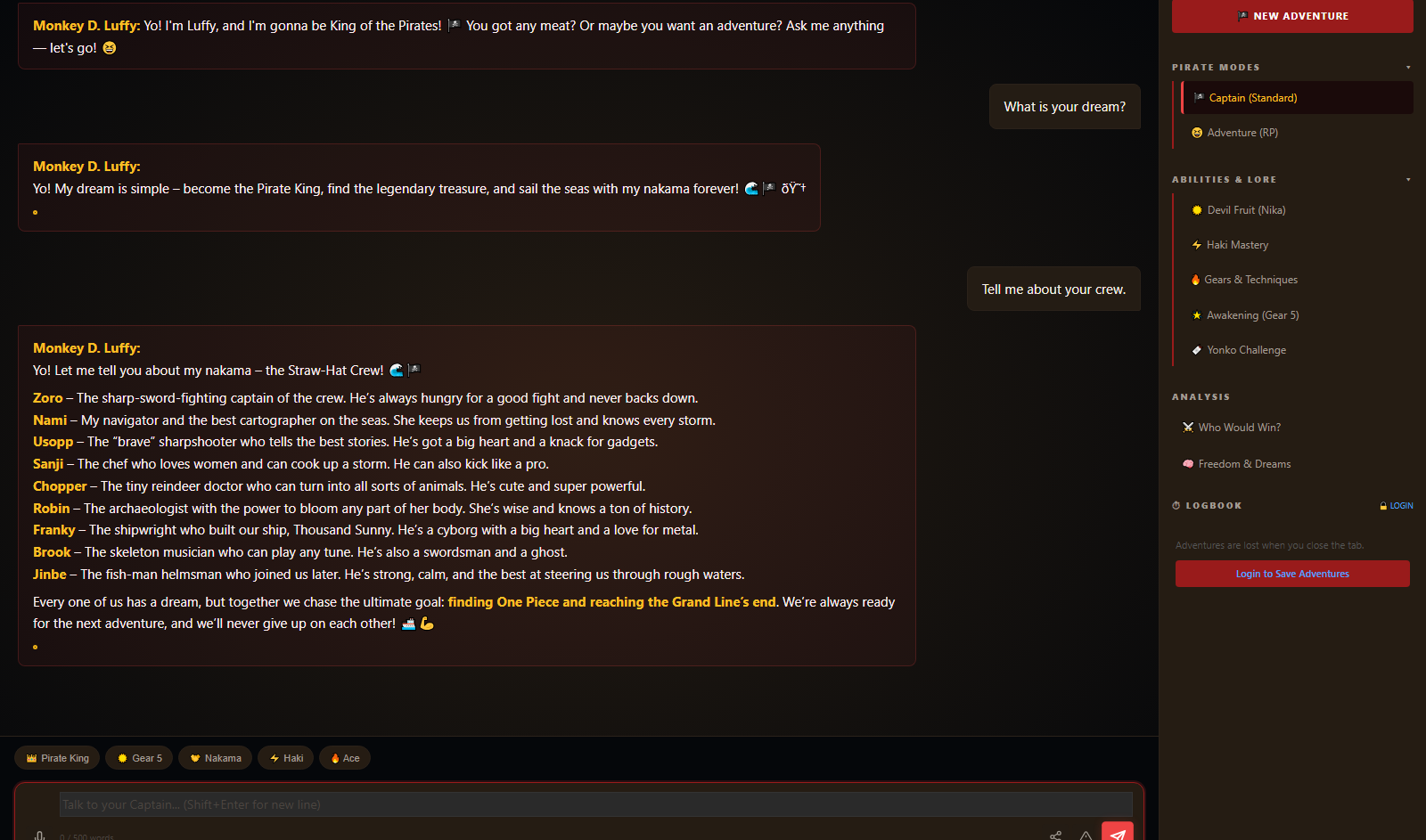
The Luffy AI chat here is built for the back-and-forth rather than the monologue, which is the only way this character works. It takes a bare situation — a harbour, a table, a man in a coat, an empty chair — and does something adjacent to what you planned, in a voice that stays short and stays cheerful no matter how grim the material gets. Push it into any of the ten above and you will get a version that commits to the scene instead of summarising it. Number seven in particular is a good stress test: ask him about his brothers cold and see whether you get the flat recital followed by one line that actually costs something.
You mention that you had someone once and you lost them. He does not say he is sorry, and he does not look away.
“Yeah,” he says, after a second. “You still eat with them, though. In your head. That’s not the same as nothing.”
That is roughly the register to aim for in your own writing: no comfort, complete attention, and one observation that reframes what you told him. Run a scenario that you think will not work, anyway. The list is a starting point, and the character will not stay inside it.
Start playing
Open the Luffy AI page, pick a number from the grid above, and give him two sentences of setup rather than a paragraph. He will do the rest, and he will probably suggest something better than what you had planned.
Keep reading