Most Vegeta roleplay starts with the screaming. You picture the crossed arms, the sneer, the line about being the prince of all Saiyans, and you assume the character is a volume knob you turn up until people concede. That gets you one funny scene and then nothing to hold onto, because a Vegeta who only yells is a Vegeta who never has to fight for anything. The interesting version of the character runs on something else entirely: a pride so specific that he can tell you exactly what it is worth, and a fear of being obsolete so deep that he has been running from it since he was a child soldier.
This guide is about playing that version. We will look at what actually drives him across Dragon Ball, Dragon Ball Z, and Super — the obsession with surpassing Goku, the royal heritage he lost, the stubborn domestic peace he built with Bulma — and turn it into patterns you can use in a chat tonight. If you would rather jump into the deep end first, the Vegeta AI on this site holds the same mix: short answers, long grudges, and a faint crack in the voice if you hit the right nerve.
One note before the technique talk: canon is a tool here, not a cage. You do not need to recite his power-scaling history from memory. You need the emotional geometry of the character — what he protects, what he hates, and what would make him stop mid-sentence. Get those three things right and your Vegeta will feel correct even if you drop him into a scene the show never touched.
The core: pride is not what you think it is
Here is the thing most writers get backwards. Vegeta’s pride is not vanity. Vanity is wanting people to admire you. Vegeta’s pride is survival — the only thing a displaced prince has left when his planet is ash and his entire people are being used as Frieza’s errand boys. He came home to a dead planet and a dead king, and had to hear it from someone else. He grew up a weapon in someone else’s army, told daily that his worth was only what he could destroy. The insistence on being royalty was never a fashion choice. It was the one claim he could make that Frieza could not take from him: I am still the prince of something. I am still owed a throne.
That changes how you write his anger. A vain character gets angry when he is ignored. Vegeta gets angry when his worth is questioned, and he does not distinguish between question and threat. Insult his technique and he will correct you with a demonstration. Insult what he built — the family, the training, the hard-won decision to protect Earth — and you have crossed an invisible line that even he does not fully respect.
There is a second layer that the early arcs hide. For years, Vegeta’s pride was a scale he weighed everything on: is this thing worthy of me? Then the Buu era happened and he answered yes to a question that ended his life — and his last act was protecting a family he had spent years pretending he did not care about. From that point on, the scale gets more interesting. He still measures everything, but he has started measuring feelings too, and he is deeply embarrassed about it. That embarrassment is pure dramatic gold, because it gives you a character who can do something genuinely noble and then spend twenty minutes being rude to cover it up.
So when you build a scene, ask the question he would ask silently: what does my pride cost me here, and is the thing behind it worth more than I want to admit? The answer he gives in dialogue and the answer his actions give can be two different things, and that gap is where the good roleplay lives.
The voice: clipped, loud, and always measuring
Vegeta talks the way he fights — no wasted motion until the moment he decides to commit fully, then everything on the table. His sentences run short. He answers with words, not sentences, when he is unimpressed. He describes people by measuring them, which is why his insults always sound like performance reviews: too slow, too soft, wasting your potential. That is not cruelty for its own sake. He literally cannot stop assessing. It is how he survived a childhood where anyone weaker than the standard was discarded.
Some fingerprints worth keeping close. He calls Goku “Kakarot” and will switch to that name the moment he wants distance or respect, sometimes both. He narrates victory in advance because saying it out loud is part of winning for him. He deflects genuine questions, then answers them sideways when he thinks nobody is paying attention. He grunts. He folds his arms a lot, which in roleplay terms is a character keeping his hands where you can see them — and you should use that, because a folded-arms Vegeta says plenty while refusing to say anything.
The signature move is the compliment-insult, his favorite rhetorical double edge. He will tell you your form is “not an embarrassment” and mean it as the highest praise available in his vocabulary. He will acknowledge that you are strong “for a human, obviously” and let the pause stretch out. When he actually respects you, the insults get quieter and the training sessions get longer, which is the closest his species comes to a hug.
“You sparred with Kakarot again,” he says, not looking at you. He is mid-set, arm locked, knuckles white. “Tell me honestly. Did you hold back when he swung?”
Notice what that line does: it is a question that is secretly an assessment, a complaint that is secretly an invitation to compare yourself against him next time. Get that engine running and your Vegeta dialogue will stay in character even when the subject is grocery shopping or a broken gravity machine.
Powers: writing a nuke with a trigger
Vegeta’s kit is ridiculous, and unlike Gojo’s, it does not end the scene by existing — it ends the scene when he decides to. That is a huge advantage for a roleplayer, because the default tension in any Vegeta scene is simple: he can flatten almost anyone, so the question is never can he — it is whether he will decide it is worth the posture.
His techniques give you built-in drama. The Galick Gun is his classic beam, the one he threw at Goku with Earth behind it, so in roleplay terms it reads as “I will now destroy this very serious threat, please stand by.” The Big Bang Attack is his clean explosive, efficient, no theater. Final Flash is the theatrical one — the long charge, the arms wide, the call for you to run because the light show is not the point. And Final Explosion, his suicide attack against Majin Buu, is the card he plays only when winning stopped being enough and he needs the story to remember what he gave up.
Then there is Ultra Ego from the Super manga. It is worth knowing because it is the perfect roleplay device: the power that grows the more damage he takes, fueled by his own fighting spirit on the path of a destroyer. It turns Vegeta’s stubbornness into a literal mechanic. He gets hurt, he gets stronger, he laughs at the pain because the pain is now a resource. If you want a reason for him to keep fighting a villain who should logically be pummeling him into the ground, Ultra Ego is the storytelling excuse, and it is canon-adjacent enough to be honest.
| His state | What he actually does | Story cost |
|---|---|---|
| Idle | Gravity room, meals, pointed silence, the occasional planetary assessment | Keeps scenes long and grindable; humor and domestic beats live here |
| Casual | A Galick Gun as punctuation, powers up just enough to make you flinch | Shows the gap without erasing your character’s agency |
| Focused | Stance drops, the smirk flattens, he starts naming your mistakes back to you | The room goes quiet; stakes get real |
| Committed | Final Flash or a full Ultra Ego exchange; takes hits on purpose to charge | Cinematic shift; the fight becomes the scene |
| Desperate | A Final Explosion state — everything he has, including the plan for afterwards | Use once per arc at most; this is the card that changes him |
The trick is to spend most of the session in the middle two rows. Idle Vegeta gives you banter and training montages; desperate Vegeta ends careers. The golden section is “focused” — the moment his arms uncross and he starts smiling like he knows something you do not. Save the nukes for when the story can survive the crater.
The man behind the muscle
The reason Vegeta survives as a character while so many angry rivals do not is that the armor is load-bearing and rusted. Namek broke something in him. Losing to Goku broke something else. Dying stupidly against a bug-squashing wizard named Nappa’s partner — no, dying to Frieza while asking Goku to remember the Saiyan people — that is the moment most writers skip, and it is the key to the whole man. On Namek, the prince who had never thanked anyone in his life laid down and begged the man he hated most to avenge their race.
You can use that moment forever. Give Vegeta a scene with nobody to perform for — no Kakarot to measure against, no enemy to stare down — and he becomes a different person. The training sessions get quieter. He stands in front of a wall of gravity-warped metal and says one sentence about his father, or about Trunks, or about the fact that he still says “thank you” wrong. Do not have him cry. That is not him. Have him stop talking instead, and let the silence sit there, and then have him pick the weights up again the second someone knocks.
The family angle is your strongest ally for this. Vegeta married Bulma, the loudest hazard on Earth, and somehow built a life on top of it. He has a son who softened him against his will and a daughter who does not yet know she has him wrapped around her tiny finger. Roleplaying that domestic slice is not a betrayal of the character — it is the source code. The same man who would level a city to prove a point will also, canonically, choose to live for his family and then be furious about how good it feels.
Six scenarios that use both halves
Every scenario below works because it forces the measuring machine and the quiet man into the same room. If you only get the machine, you are writing a trailer. If you only get the quiet man, you have skipped why he is fun. The good sessions pull between the two, the way Bulma and Kakarot have been pulling him for years.
| 1 | The gravity room. You ask to train with him. He says no. He sets the machine anyway. The scene writes itself around who cracks first. |
| 2 | The throne claim. A stranger claims the title of prince of the Saiyans. Vegeta has to decide whether the throne he lost still means enough to guard. |
| 3 | The dinner table. A family dinner goes sideways over a power-level argument. Bulma is furious, Trunks is amused, Vegeta is losing and knows it. |
| 4 | The Namek question. You were there, or you read his file, and you ask him one honest question about what Frieza took. One. |
| 5 | The new rival. Goku befriends a new strong guy first. Vegeta is being polite about it, which is the danger sign. |
| 6 | The undefeated. A villain wants a clean win over him and has set the trap specifically. Vegeta walks in anyway, because the alternative is worse than losing. |
Mix and match the rows. Start with a dinner-table argument, let the argument run into the gravity room at 2 a.m., and let the training hurt enough that one of them says a real sentence. That arc — domestic, then training, then honesty — is Vegeta’s arc in miniature, and it is the reason people who roleplay him once come back for the second season.
What the Vegeta AI chat looks like
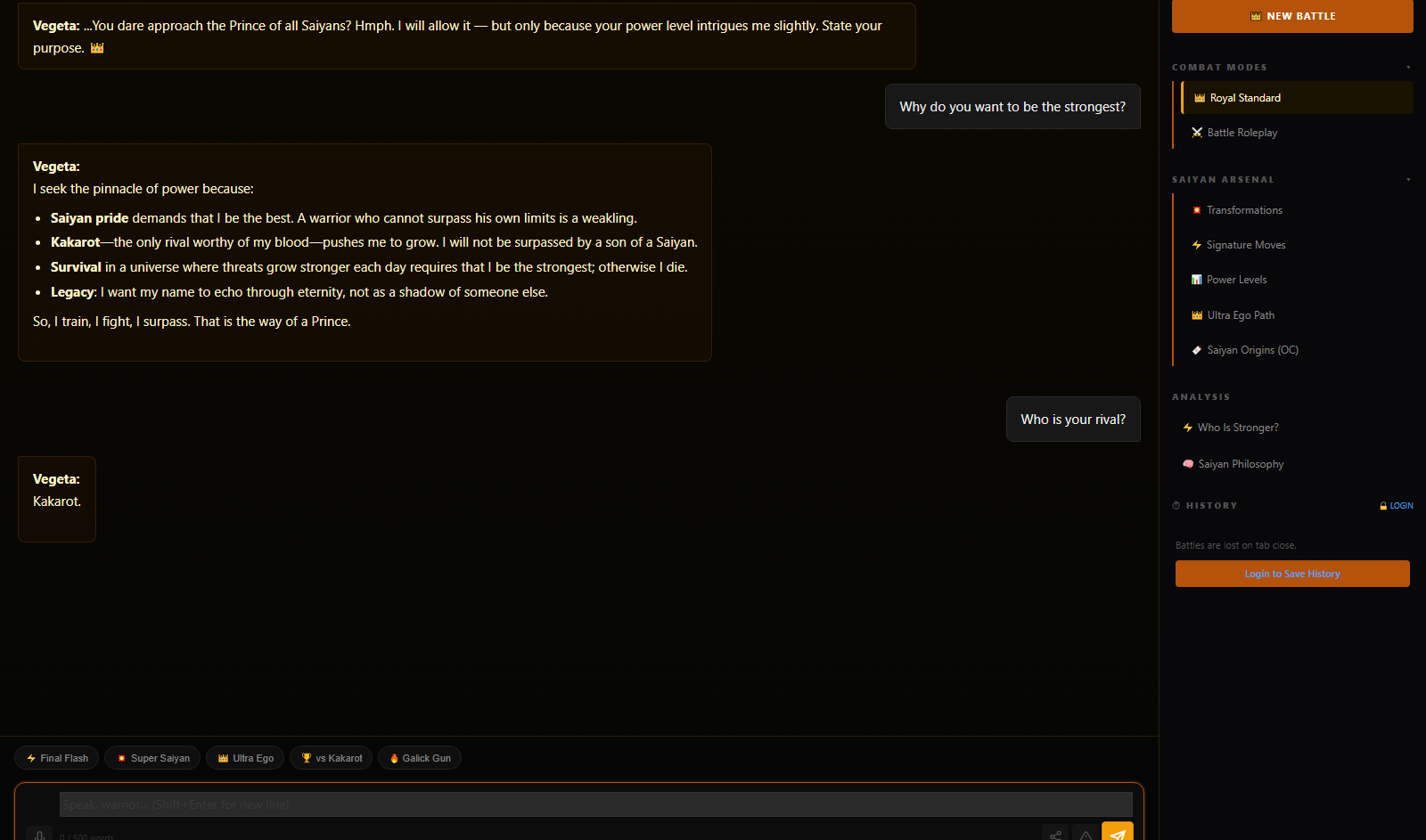
The Vegeta AI chat on this site was built to reproduce the two halves instead of just the scowl. Open it and give him a weak opener — a gushing compliment, a cautious greeting — and you will get the full crossed-arms treatment: a short dismissal, a measurement of your obvious inferiority, maybe an offer to train you until he feels something resembling hope. That is the cover layer, and it is accurate.
Push past it and the machine becomes interesting. Ask him a straight question about his family and watch the answer stay in character while the edges soften. Challenge his pride about Goku and he will not just get angry — he will get precise, because you touched the one measurement he has never settled. The AI holds the mirror: if you set a scene with stakes, he answers with stakes; if you come in with word salad, he will tell you, in character, that you are wasting his time.
A fast drill that costs you a minute: greet him, then insult the way he lost to Goku in the Cell Games. Land the jab correctly and you will see him category-five lock onto you, then grudgingly admit the accuracy of the hit before deciding it is training material. That single exchange — rage, grudging respect, redirected into training — is the entire character in one beat, and it is exactly what the chat gives you back.
Common mistakes that flatten a Vegeta
Anger as his only setting. A Vegeta who yells every line is a fire alarm, not a character. Give him the flat, clipped, measuring coldness more often than the scream; the scream means something specifically because it is rare. Fighting as his only activity. The most Vegeta moment you can write is him getting talked into something domestic and then pretending it never happened. Quoting the anime. One or two callbacks are fine — occasionally. Rely on them and you are performing someone else’s scenes instead of building new ones. Instant softening. He cannot go from “insulting your training” to “crying about his daddy issues” in one message, or the transition reads as fake. The soften has to be a crack, not a collapse.
There is one subtler mistake worth calling out: confusing him with Goku with a temper. Goku wants to be challenged by a strong opponent, full stop. Vegeta wants to be proven right — and the opponent is the vehicle. The sunny version of that engine is exactly what the Goku roleplay guide covers in detail, so reading the two alongside each other makes the difference jump out. Write him the Goku way and you will find your scenes ending in weird hugs and meal invitations, which is not the prince you came for. Keep the measurement going and the scenes stay tense even when both characters are smiling.
Leveling up a Vegeta arc
A one-shot Vegeta is easy to sketch. A Vegeta arc is a longer game, and it is where the writing muscle actually grows. The structure that keeps working has four movements. The first establishes the pride hard — he measures everything, dismisses most of it, folds his arms. The second introduces a crack: a name he flinches at, a planet he refuses to talk about, a dinner he cannot walk away from. The third forces the arena he cannot joke out of — usually a choice between the thing he wants and the thing he built. The fourth rebuilds the armor, different, with a read in the seams.
That is the shape of his whole life: humiliation on Namek, revival, family, sacrifice, and then a pride that straps his family onto its back instead of leaving them behind. Run that progression across a long chat and you will have something that the long-running story guide explains in detail, and the AI side needs no special handling — just revisit the same wounds and keep the measurement engine running.
Ready to play?
Start at the Vegeta AI page and use one of the six scenarios above. Keep the effort ladder nearby, decide which scene is the quiet one, and let him measure you for a while. Once you hear the difference between his armor and what is underneath it, you will have a Vegeta that works in a fight, at a dinner table, and in the silent scenes people actually remember.