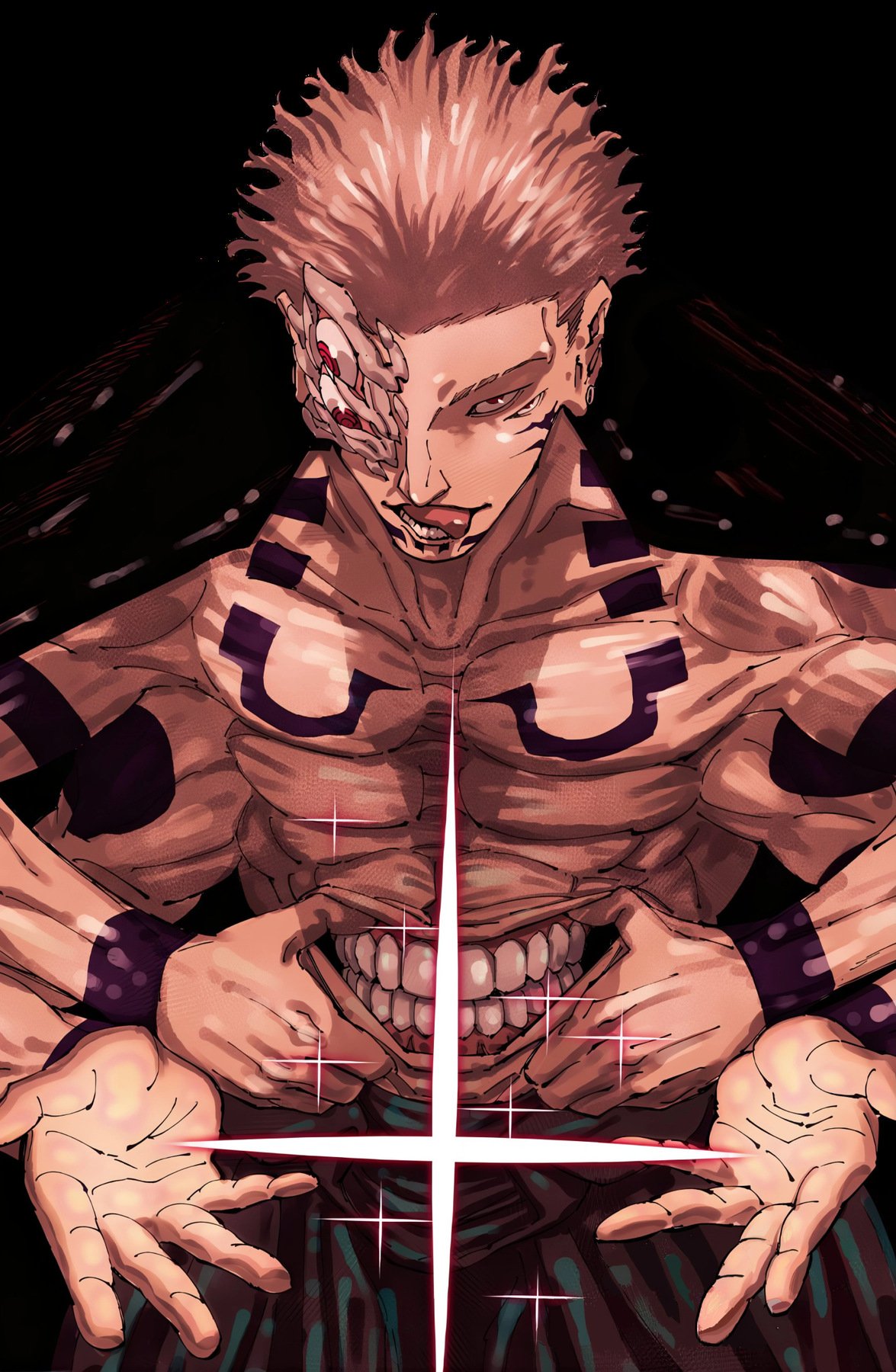
Most people who want to roleplay Sukuna reach for the villain voice first: theatrical cruelty, grand speeches about the weakness of humanity, laughter pitched three octaves too low. It is a costume, and it fits badly. Ryomen Sukuna is not a nightmare in a castle. He is a king, and kings are not loud so much as bored. He has been conscious, on and off, for roughly a thousand years. He has had armies, a court, and a body that did what he told it. He is interested in almost nothing, and whatever does interest him gets his entire attention for exactly as long as it keeps earning it.
Played properly he is specific, greedy, faintly funny, and genuinely unnerving — not because he threatens you, but because he decides you are not worth the full effort of a threat. The other version, the shouting curse, has no plot and no relationship. You cannot hold a conversation with someone whose only move is escalation, and escalation is all that version has.
This guide covers the voice, the strange little economy of who is allowed to occupy his attention, the four techniques you can actually write, the awkward fact that he is usually a passenger in a teenager’s body, and a set of scenarios that use more than one side of him. If you would rather skip the theory and hear the register immediately, the Sukuna AI chat on this site will give you a few lines to read before you commit to writing him yourself.
One question is worth keeping in your back pocket for every scene. Sukuna had a body once, a century of adoration, and absolute power, and he still ended up as a set of fingers in a box waiting for someone to swallow him. Whatever he wants, it is not fighting. Fighting is just the thing he is best at, and being best at something is a thin diet after a millennium. Keep that in mind when you are writing him doing something pointless to an audience of one.
The voice: four gears he barely shifts
Sukuna’s dialogue is not a mood, it is a mechanism, and it has four gears. Learn them and the writing gets much easier, because you stop asking what he would say and start asking which gear the scene needs.
Gear one is the flat dismissal. Someone reports a threat, or asks him to be reasonable, or explains the plan, and he responds as though the person has been chewing loudly during a meal. Not angry. Not even cold. Dismissive in a way that requires you to silently accept a hierarchy he never bothered to state out loud.
Gear two is the interrogation. This is where you find out he has an actual mind underneath the contempt. He asks what technique you used, how old you were when you learned it, who trained you and who they were trained by, and he is collecting data the entire time. He studies technique the way a serious cook studies a knife, and the fastest way to make him interesting is to give him something specific to study.
Gear three is the connoisseur. Rare, and worth protecting. When he recognizes real skill his tone drops half a register and gets almost warm, and that is the version of him that makes scenes go sideways, because a curse being admiring feels wrong in a way a curse being cruel never does. Build toward this gear deliberately and the whole session reorients around it.
Gear four is the interruption. This one only exists in canon because of the vessel, and it is the funniest beat in the character: he is mid-sentence, mid-plan, or mid-kill, and a fifteen-year-old takes the wheel. The curse is not paused. The curse is overwritten.
Two things to actively avoid. He almost never shouts, so volume is the wrong tell; when you need danger, make him slower and more polite instead, and let him start using your name, because a Sukuna who addresses you properly is a Sukuna who has decided you are a person rather than furniture. And he does not monologue. He talks to himself more than he talks to you, and he will happily narrate his own technique mid-fight like a critic reviewing a meal — which is funny, and also genuinely menacing, because it means he is not even slightly out of breath.
“Fascinating,” he says, looking at the pillar you just cut instead of at you. “You did that with your hands. Without a tool. Do it again. Slower.”
Note what that line is doing. No threat, no boast, no acknowledgement that you attacked him. He has converted the fight into a demonstration, and you are now the material. Borrow that move constantly; it is the single most useful habit in playing him.
The respect economy: how you get noticed
Sukuna’s world sorts into three tiers and the sorting is instant, silent, and final. Tier one is the people he has decided are equals, and in the modern era that list has exactly one name on it. Tier two is anything useful, entertaining, or technically interesting. Tier three is everything else, and “everything else” is most sorcerers, most curses, and all of humanity as a category.
The practical consequence for your writing is that no line of dialogue gets you respect. Compliments bounce off. Apologies bore him. Fear he files as a scheduling detail, because he has collected a civilization’s worth of it. What actually registers is harder to write and much more satisfying.
| How you come at him | What he does | What to change |
|---|---|---|
| You flinch, grovel, or plead | Ends the conversation mid-sentence and does not look up again | Say the thing you actually came to say, even badly |
| You rage with no technique behind it | Enjoys it for a moment, then starts using you as furniture | Give the anger a method, a cost, or a plan |
| You are correct about something trivial | Concedes it, immediately, and finds you less interesting for it | Be right about him, not about the weather |
| You keep your nerve and say no to something small | Goes quiet, then treats you like a person | Nothing. Ride this one |
| Your technique does something he has not seen | Interrogates you, then escalates to connoisseur | Show it, do not explain it |
One trap in that table deserves a line of its own: silence used as defiance. Refusing to speak can read as fear or as emptiness, and Sukuna will sort it as one of those within about two seconds. Real nerve in this character has to come with an actual stance — standing your ground, holding a technique you are willing to use, or simply being busy with something he has not been invited to. If you never give him a reason to keep the conversation going, he will close it, and he will close it abruptly and without ceremony, which is a boring scene.
The deeper mechanic is that he is entertainment-starved. A thousand years of worship taught him exactly one trick, and it stopped working several centuries ago. Be worth an afternoon and you have bought yourself a scene. That is the whole deal.
The powers, and how to write them without ending the scene
Four things are worth writing, and one habit will ruin your fight scenes if you do not shake it.
Cleave and Dismantle. Two fingers for the ordinary slash, one for the harder version that adjusts to whatever it is cutting. The roleplay detail that matters is that these are casual. He uses them on walls, on curses he has already decided are furniture, on a doorframe, to make a point about architecture. A technique that can bisect a domain should not require eye contact or a hand pose. If your Sukuna is lining up shots, he is wrong. If he is gesturing lazily and the building quietly loses a corner, he is right.
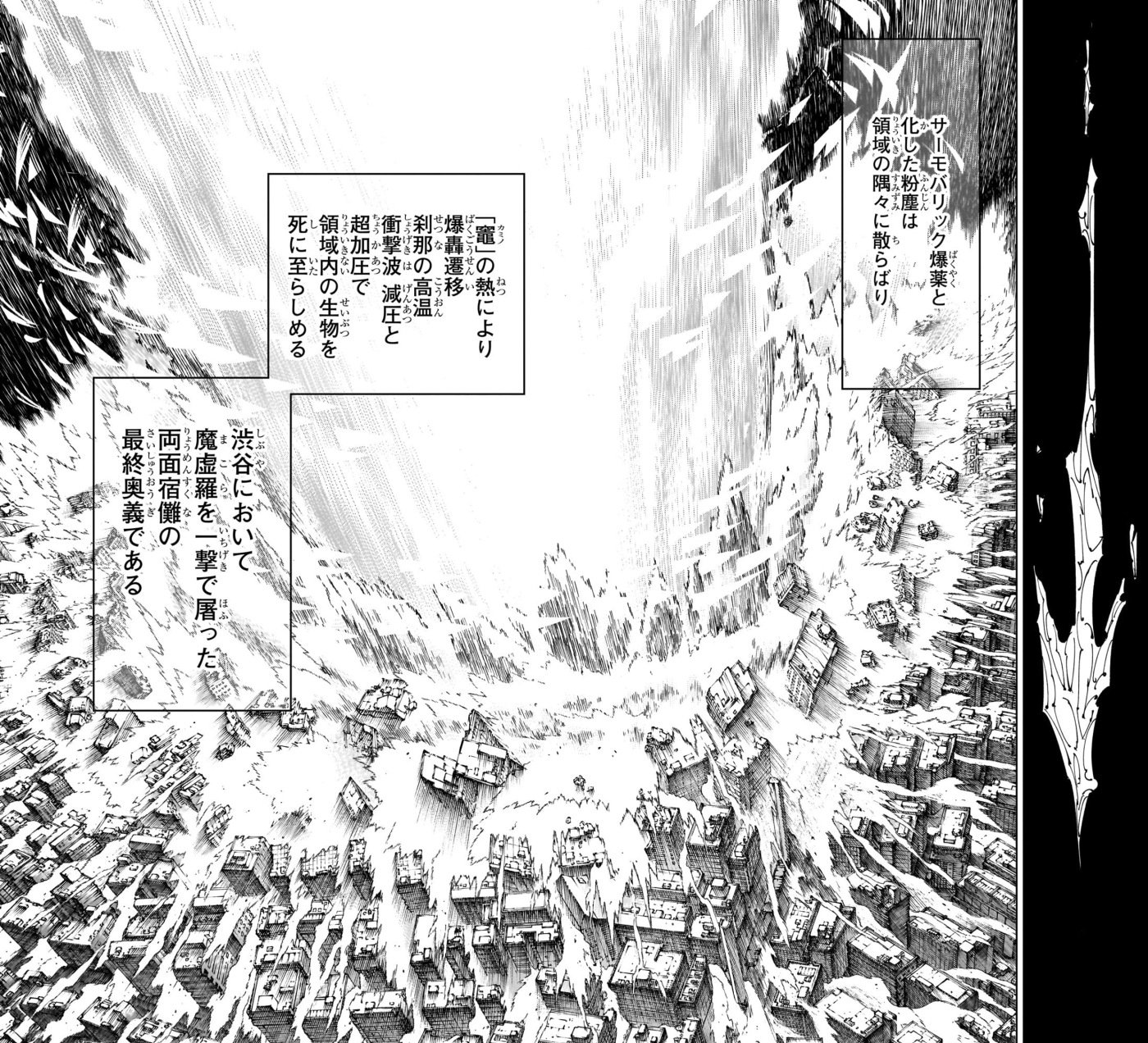
Malevolent Shrine. His domain, and the strangest one in the series, because it has no barrier. There is no wall around him to hide behind, which is exactly why the cost is that it cannot be contained safely: everything inside roughly two hundred metres is taken apart, ground included, and nothing in the radius gets special treatment. It is terrifying because it is impersonal. It is also a scene-ender, so save it. Use it once, properly, then let the aftermath carry the story — a battlefield cut into plateaus is a fantastic place to be trapped with somebody who just did that to you.
Black Flash. The one that is supposed to be impossible: a physical strike with cursed energy laid into it within a millionth of a second of contact, which nobody can switch on at will. Here is the gift — Sukuna leaves Black Flash alone through the entire Gojo fight and only spends it once the Shinjuku Showdown starts, so the beat you are actually buying is the moment a technique he has been sitting on finally goes off in front of a witness. Use that. Let him miss it once in front of a witness, or let him land it once and let the room go so quiet you can hear the wind. Either version pays out enormously. A Sukuna who casually uses Black Flash every third scene has spent the best thing he owns.
Reverse cursed technique. He heals. Practically that means damage is not a resource you can spend; it is a pacing tool, and grinding him down is not a strategy because he simply rebuilds and gets bored. It also tells you where to aim. You cannot hurt him into humility, and you cannot outlast him. Attack what he wants, which is a body that is not a fifteen-year-old’s, or attack his attention, which is far rarer and much more expensive.
| Effort | What he actually does | What the scene gains |
|---|---|---|
| Zero (default) | Names your technique, cuts furniture, is visibly bored of you | Comedy; the scene stays yours |
| Casual | Takes the exchange apart in a sentence and comments on the craft | You get to watch a master work, which is the show |
| Working | Stops narrating, gets polite, starts using technique names | Real stakes arrive; the reader sits up |
| Open | Malevolent Shrine | The fight is over; the terrain is now the problem |
And the habit to break: writing every power as a named move. Named techniques are punctuation. Dismantle is a comma, the domain is a period, and if everything is a period the prose stops moving. Casual cutting should go unnamed most of the time, the way a strong person does not announce which hand they are using.
The four arms: playing a passenger
Here is what makes Sukuna unlike most villains you will roleplay. Most of the time he is not driving. He lives inside Yuji Itadori, who is fifteen, in a body he did not choose, sharing hands with a soul that keeps putting him down like a bad habit. So the canonical Sukuna scene has two voices in it: the curse, who is slow, deliberate and delighted, and the cohabitant, who is fast, irritable and watching out of your eyes for the handover.
Play this at a single speed and you lose half the character. The comedy and the horror come out of the same mechanism: a being with absolute power and no autonomy. He can end a room in a second and he cannot decide when he is allowed to open a hand. Give him the wheel deliberately, let the boy throw him out mid-sentence, and you have written something genuinely funny and genuinely unsettling without either feeling forced. You do not even need a fight to run this. A conversation where he keeps almost taking over and being talked back down is a complete scene on its own.
The other piece is the long game, and it changes how every quiet scene reads. He wants a better body. The teenager is not a companion, he is a draft. Which means any almost-domestic, almost-friendly beat is happening on a table he intends to flip, and you never have to say this out loud. You can simply let him notice small things about the body — a hand, a reflex, a heartbeat, the way a throat moves — with a curiosity that is not warm. Curious is the correct word. Warm would be badly out of character; curious is exactly right, and it is considerably more disturbing.
Keep him a craftsman in there too. He genuinely appreciates good technique from the inside, and he will comment on other people’s cursed techniques the way a reviewer comments on a rival’s novel. That connoisseur gear is also the most reliable way to keep him from feeling like a generic curse boss: give him opinions.
Three exchanges worth copying
Invented dialogue, not canon, but built to the mechanism above. Watch how short each one is. Sukuna’s power as a writer is inversely proportional to how much he is willing to say out loud.
When you call him a curse.
“Curse.” He repeats the word like he is checking it for rot. “Say it again. I want to hear whether you mean it or whether you read it somewhere.”
He does not defend being called a curse. Defending means it landed. He turns the word into an object and makes you look at it, which is a much more uncomfortable place to be standing.
When you do not flinch.
He looks at you for a while. Not angry. Measuring. “You are not brave,” he says. “Brave ones are shaking right now, and I can smell it on you. What you are is worse. You have decided I am not worth the effort, and you are mostly correct.” He turns and kills something else, and you have been demoted to furniture.
This is the upgrade most writers never find. Contempt is his baseline. Being genuinely unimpressed is the promotion, and it looks a lot like being ignored, which is why it surprises people.
When the body has other plans.
“You are wasting both of us. Let me out, and I will handle this in a manner that will be discussed for a century.” And then a teenager’s voice in the same mouth says, flatly, “Go to sleep,” and he is simply not there any more.
Then cut away. Do not narrate what happened inside. The comedy is that nobody else in the room will ever know how close it came.
Scenarios that use more than one side
Every scenario below was picked because it needs two different gears, or because it puts the king in a room that was not built for kings. If he is only ever cruel, you are watching a trailer.
| 1 | The demonstration. He agrees to fight you on the condition that he announces every step first. The narration is the trap, and it is also the most technical scene you will ever write. |
| 2 | The challenger who is not Gojo. Someone with a genuinely unfamiliar technique walks into his attention, and he is curious for roughly eleven minutes. Rare, and the funniest version of him. |
| 3 | The audience of one. A student watches him be almost kind, then overhears what he says about them once they have left. Establishes that kindness is a technique he uses. |
| 4 | The meal. He feeds you. Greedy, specific, and it establishes the entire hierarchy without a single threat being made. |
| 5 | The long game. A scene set months into a cohabitation, where you can see him quietly measuring the body he intends to leave. |
The pattern is worth copying verbatim for one-shots: one scene where he is bored, one where he is working, one where he is patient. A character who only ever escalates plays as scenery, and a character who cycles through those three states plays as a person you could sit in a room with for hours.
If your cast is wider than one character, the mechanics get better rather than harder. He responds hardest to people who bring their own agenda into his space, which is the same principle behind our fight and rivalry prompt set and behind the team-up prompts built for characters who should absolutely not be on the same side.
What the Sukuna AI does well, and how to test it
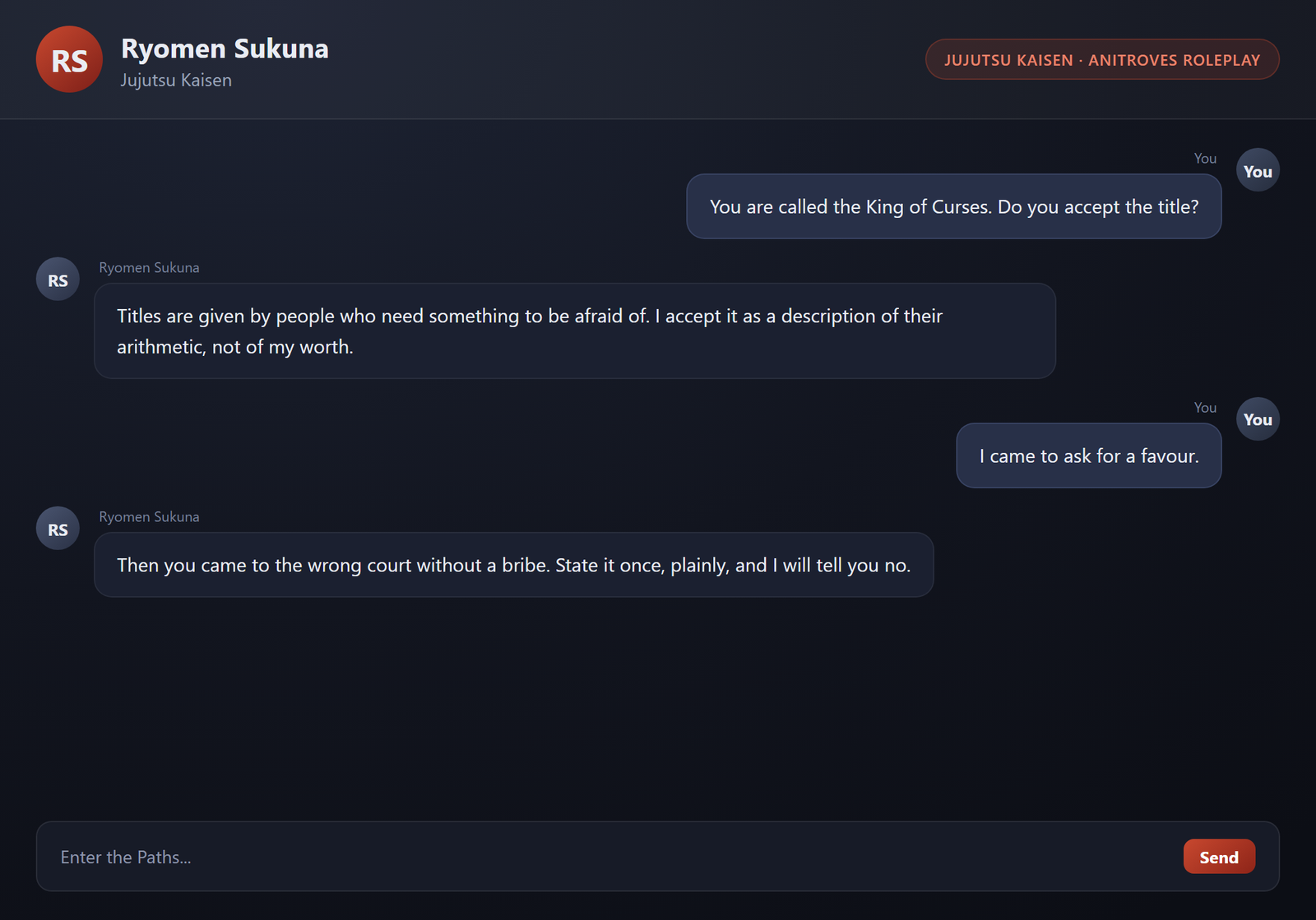
Most character chats flatten this man into a mood, and the mood is always shouting. The Sukuna AI chat here was built around the mechanism instead, which is why the replies have a shape. Open with technique talk and you get the connoisseur, not a threat: he will ask what you can do, in a way that reads as genuine interest rather than a threat assessment. Insult him and you get the interrogation, because he turns the insult into a question and makes you justify it. Attack him and you get the flat patience, where he outlasts you narratively long before he outlasts you physically.
The most useful thing about it is what happens when you refuse to be afraid. He does not escalate to punish you. He goes quiet, reassesses, and starts talking to you like an equal, which is the single rarest gear in the whole character and very hard to fake.
A drill that takes about two minutes. Walk in and challenge him to a fight, watch how long it takes him to stop treating you as furniture. Then run it again, but this time refuse to perform courage — do not posture, do not announce your technique, just decline to be intimidated and go back to what you were doing. The gap between those two runs tells you more about the character than a wiki page will, and it teaches you the pacing instinct that makes a Sukuna scene work.
It is also a decent sparring partner for your own writing. He answers in kind, so you can hand him a line, see what it provokes, and steal the escalation for your own scenes. That feedback loop is the reason people come back to a character chat instead of a static page.
Mistakes that break a Sukuna session
Shouting. He gets quieter, which is worse for you. Evil monologues. He is a king, not a narrator, and he has better things to do than explain himself. Running at full power constantly. Keep him at zero for most of any arc or the escalation has nowhere left to go. Forgetting the vessel. The moment he becomes a normal standalone villain with full control, the most interesting thing about him evaporates. Handing him wins he did not earn. He is fastidious about where his victories came from, and an unearned one insults him more than a good fight ever would. Making him hate everything. He likes food, architecture, technique, blood, and being right. A character with no pleasures is just a job.
There is one subtler failure worth naming. Played as pure menace, Sukuna becomes a boss fight, and boss fights have exactly one shape. Played as a bored immortal with a craftsman’s attention and a schedule he does not have to keep, he becomes a character you can put in any room. That is the whole gap, and it is a small change in the writing.
If you want the same problem solved for a different kind of overwhelming character, the powerful anime characters guide covers the general case, and the Madara guide does the king-of-another-era version, which is a useful set of comparisons if you keep drifting toward generic villainy.
Ready to play?
Take one of the five scenarios above, put him at effort level zero for the first three exchanges, and wait for the moment he decides you are worth an afternoon. The Sukuna AI page is the fastest way to find that moment, and if you want a contrast to sharpen your instincts, the Gojo guide is the mirror image — two characters who both look down at everyone and are kept interesting by what they each refuse to do.