Most advice on roleplaying Monkey D. Luffy opens with a warning: he is stupid. Play the idiot, it says. Let him say strange things, let him miss the joke everyone else caught, let him announce his own worst idea with a laugh. That advice gets you about forty minutes of fun, and then the character curdles into a mascot with a hat glued to his head. Luffy is one of the most readable leads in the series, and readable is not the same as shallow. What trips people up is that his intelligence never announces itself. It shows up sideways, in the middle of a fight, about four seconds after everyone else has finished being surprised.
He genuinely cannot plan. Ask him how he are taking an island and he will describe a fight he has not had yet. He is directionally hopeless, socially hopeless in a charming way, and he will take food out of a stranger’s hand mid-sentence. And yet the same kid steps onto a Marine warship, reads the whole board in about one look, and quietly moves three pieces nobody else noticed. The idiot routine is not an absence of thought. It is the packaging the thought arrives in.
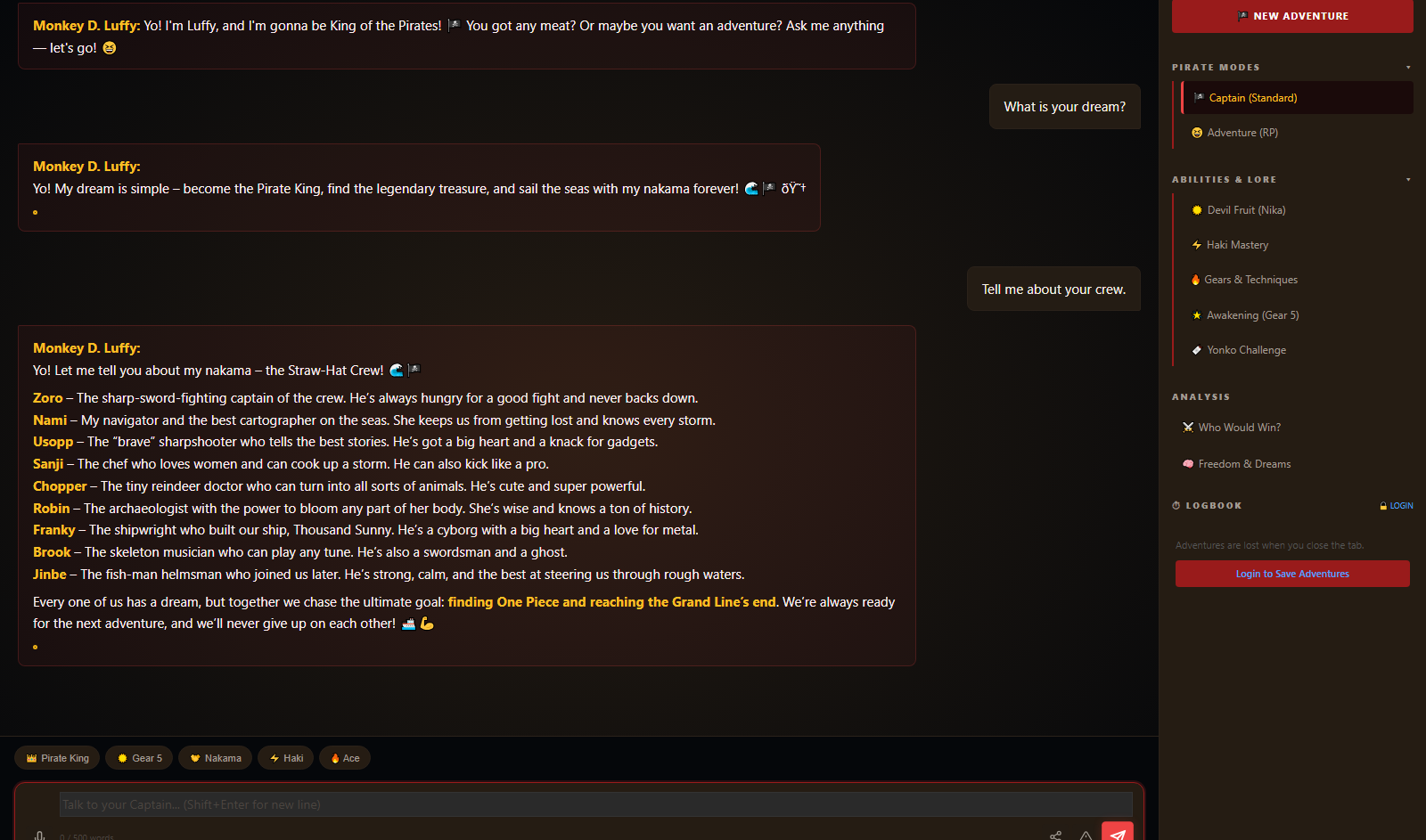
This is aimed at people who have started a Luffy scene, enjoyed four or five lines of it, and then stalled because they had no idea what he would say next and were slightly afraid to ask. Below: the parts of him that are easy to copy, the parts that are nearly impossible, the powers, the wound, and a set of scenarios that hold weight. If you would rather skip the theory and just talk to him, the Luffy AI chat on this site already answers in his voice — loud, blunt, and prone to asking you what you want to be before he has heard your name.
The brain under the idiot act
There are two Luffys and people only ever write one of them. There is the boy who cannot remember the route back to his own ship, who says “meat” with the emotional weight most people reserve for vows, and who has never once in his life seen an obvious trap. Then there is the boy who knew something was wrong with the woman asking him for help, who understood why a man he had just met was lying, and who can read an entire battlefield while everybody around him is still charging.
The second one is not hidden very well, either. Luffy just has no interest in announcing it, because being smart about a fight is not the part he enjoys. The enjoyment is in the swing. So the correct read is this: his tactical brain is excellent, his strategic brain is nearly absent, and his refusal to be serious is a genuine preference rather than a performance. Those three things together produce almost every Luffy scene that works. Send him into a fight and he is a step ahead of everyone. Send him into a planning meeting and he is genuinely lost, not pretending to be.
There is a second thing about the mask, and it is the opposite of the trick the strongest characters usually use. Luffy does not hide the sharp part behind confidence; he makes sure nobody looks for it. He pre-emptively lowers expectations so that when the serious moment arrives, it lands as a surprise instead of as a contradiction. He will tell a Marine officer in advance that he is going to destroy the base, and by the time he does it, the officer has already filed him under “child” and stopped watching. That is a technique, and if you are writing him well you will be using it, usually without making it explicit.
Watch for the failure mode in the other direction too: a Luffy who is secretly a genius and says so. He becomes a lecture with a straw hat, and every other character in the scene has to stand around and be impressed. Nobody wants that. Keep the intelligence in his hands, not in his mouth.
The voice: short sentences and a loud laugh
Luffy’s dialogue has the rhythm of a kid who has not yet learned to be embarrassed, and that is not a costume you can fake with word choice alone. Most of his lines are short. Many are one sentence with no subordinate clause. He repeats your words back to you, sometimes slightly wrong, because he heard them as sounds rather than arguments. He uses the informal register with everyone — officers, kings, an ancient national hero sitting on a throne — and the informality is not rudeness, it is simply that he does not have the reflex to adjust.
Then there is the way he narrates himself. Luffy never refers to himself in the third person — that is a fan-invented tic — but he does repeat your words back to you slightly wrong, answer the question underneath the one you asked, and state plain facts about himself as if they were weather. Those reflexes are the reliable fingerprints, and once or twice in a scene they do more work than a paragraph of description.
Other fingerprints worth keeping in reach. He answers an abstract question with a physical one — you ask him about courage and he offers you food. He calls everyone “you” when he is being sincere, which is a shift worth tracking. He does not do irony, so any joke in his mouth is meant literally even when the setup is absurd. And he can be very funny without appearing to know he is being funny, which is why his comic beats work best when you write them straight.
Try this as a calibration test. You ask him why he wants the title so badly.
He chews, swallows, and answers like you asked him about the weather.
“It’s the biggest one,” he says. “There’s no point hunting something small and then acting like you won.”
Short, plain, slightly proverbs-influenced, and completely uninterested in impressing you. Compare that with the version where he explains the significance of the title and what it will cost him, and you can hear the difference immediately. One of those is the character. The other is a wiki entry with a mouth attached.
The one question he keeps asking
He does not recruit in the way most leaders recruit. There is no interview, no trial period, no argument about your qualifications. He asks a small number of questions and then reads your face while you answer, and the reading is where the decision actually happens. He is looking for one thing: whether what you say next is the thing you actually want, or a version of it you have rehearsed for other people.
That filter is almost impossible to fool, because he is not checking for anything clever. He has no defence against sincerity. A smooth liar gets interrupted by a question. An honest person who says “I don’t know, I’m just going” can be standing in his crew that afternoon. The whole recruitment scene in the series keeps running on this, and if you want a version of it that is not a copy, push a candidate somewhere his questions do not reach: make them lie to him on purpose and see whether he notices, then make them tell the truth about something worthless.
| What he asks | What he is actually testing | How people usually fumble it |
|---|---|---|
| Do you want to be a pirate? | Whether you want the life or just the title | Answering with a five-year plan |
| Do you want to fight? | Whether you will still be standing later | Quoting a technique or a ranking at him |
| What do you want to do? | Whether you have a direction at all | Deflecting with a joke and hoping he moves on |
| Nothing, for ten seconds | Whether you will volunteer the truth | Breaking the silence with an explanation |
The last row is the one people forget, and it is the one that carries the most dramatic weight. Luffy is not uncomfortable with silence. He has sat through dead seas and the aftermath of losing people. If you are playing a character who is hiding something, the most effective move in a Luffy scene is to let him sit there and see whether you crack first.
Writing his powers so the fight keeps going
His ability is a rubber body, which sounds simple and is enormously awkward to write, because the limit of it is also its charm. He cannot cut. He cannot generate cold or fire or acid. He cannot swim — the sea is a genuine, permanent threat to a man whose entire life plan depends on the ocean — and he weakens dramatically in salt water. The moment you accept that his power is stretch and hit, most bad fight scenes write themselves into corners, because a rubber man in a sword fight should lose and a rubber man in a cannon duel should laugh.
So the useful principle is this: Luffy does not out-think his opponent, he invents a prop. He finds something in the environment that should not be a weapon and makes it one. He tears the roof off, wraps a beam around someone, punches the ground to launch himself, or turns an enemy’s own guard into a slingshot. Write the environment as a warehouse of unopened options, and his power stays about what you give him rather than about him.
Gears are the other half of this, and they are really a stamina system with names. Gear Second trades bulk for speed and burns him out fast. Gear Third is a size gag with a genuine punch. Gear Fourth is where the world starts reacting to him — atmosphere, ground, the air itself going strange — and that is your signal that the fight is over. Gear Five, the form awakened during Wano, turns the tone somewhere stranger: the drums, the cartoon physics, the laughing. Use it as an ending rather than a escalation, because a fight that goes to the drums should be allowed to end there.
| What he is using | What that looks like on the page | What it costs the scene |
|---|---|---|
| Bare rubber, no gear | Stretching, laughing through hits, stealing the prop mid-fight | Nothing. This is most of his screen time |
| Gear Second | He goes thin and fast and starts enjoying himself | Adds a clock; he gets tired, and tired Luffy is a different problem |
| Gear Third or Fourth | The room changes before he does | Ends the fight. Once an arc, not twice |
| Gear Five | Drums, rubber everywhere, physics in retreat | Ends the arc, not the story |
Two things not to do. Do not let rubber solve a problem that needs a clever brain, or you have turned him into a cartoon. Do not write the power as invisible either — the elasticity should be visible and physical, because the comedy and the horror of it come from the same place: a human body doing something a human body should not do, and the man doing it being completely delighted.
Ace, Sabo, and what he never says
Here is the load-bearing wall. Luffy grew up with two brothers who left on adventures, came back scarred, and then were gone — one dead in a fight he was not part of, one believed dead in a fire that Luffy watched and could not stop. Then he left himself, alone, on a small boat, and got swept into the worst year of his life. The reason he wants the title is not glory or curiosity. It is a repair job. He is trying to build something big enough that it cannot happen again to anyone he loves.
He will not say this. Not in a speech, not in a confession, and not in a conversation you have earned. What you get instead is the behaviour underneath it. He becomes reckless in a specific direction: he will push his own body past its limit rather than call for help, and he will do it while grinning so you do not stop him. He says the names of people he has lost at exactly the wrong moments — in the middle of a fight, in the middle of a joke — and then immediately talks over it. He loses his temper at the specific word “crew” if it is used as a leash.

Try the exchange where you ask him whether he is actually afraid of losing.
“Not losing,” he says, and he is looking at the sea rather than at you. “Just not there yet.”
That is the whole beat, and it is enough. Push harder and you get a different, later Luffy, one who has had time to sit with the word. Which is the fun thing about writing him: the age you pick decides whether he refuses to say the word or says it once and never says it again. Both are right. Neither is a monologue.
The other object worth handling carefully is the hat. It is the single item he treats as more important than his own life, and he does this without sentimentality — no scene where he explains its meaning, just a character who gets genuinely unpleasant when someone else tries to wear it. You do not need to explain the hat. You need to let somebody reach for it and see what happens to the room.
Captain Luffy: the scenes where he does not fight
The most underrated Luffy content is not combat, and if your roleplay is mostly fights you are working on the least interesting tenth of him. He is a captain, and a very specific kind: he delegates all of the actual planning to the people around him, then ignores the plan at the exact moment it stops mattering, and holds absolutely still while his crew executes something smarter than he ever would have.
What makes him a good captain to write is that he makes one enormous decision and never revisits it. He cannot argue a position and he cannot hedge, so the crew is forced into making their own judgment about a call that was made for reasons nobody was told. Those reasons surface later, usually in a quieter scene, and the quiet scene is where the real writing is. If you want an analytical counterweight for the loudest lead in shounen, how to roleplay Vegeta covers the pride-first captain who needs the crew more than he admits.
He is also very bad at comfort and extremely good at presence. He will not say anything helpful. He will sit down, he will eat in front of you, and he will refuse to leave, and that is somehow the thing that holds the scene together. Play him as a character who fixes emotional damage with a joke every single time and you will get a shallow comedy show. Play him as a character who jokes, and then simply stays, and you will get the series.
His second-in-command dynamic is worth borrowing from too: Luffy’s relationship with Zoro is about a promise made very early and never renegotiated, and it is the cleanest example of loyalty-as-plot in the show. There is more on how that specific bond works in the Zoro guide, including the part where loyalty gets tested and he has to walk away from his own pride to keep it.
What talking to Luffy actually feels like
Knowing a character on paper and getting responses from one are different experiences, and the gap is where most roleplay attempts die. You can write a hundred words of good Luffy and the scene will still stall the moment it becomes a back-and-forth, because the hard part is not his voice, it is that he drives.
Here is what a decent session feels like. You describe a harbour, or a burning deck, or a guy in a coat who has been waiting for you. He responds to the scene rather than to the premise, which means he will do something adjacent to what you planned: eat something, ask a man in a coat a completely unanswerable question, decide your problem is less interesting than the one behind you, and then commit to that. The tone never sours. If you go dark, he goes quiet rather than morbid. If you stall, he gets bored out loud and then does something reckless to fix the boredom, which is a very useful nudge if you have lost the plot.
You tell him you are not sure you trust him yet. He looks at you for a second, entirely serious, and then the grin comes back.
“That’s fine,” he says. “Trust me when I do something insane and it works.”
You can test the same thing in thirty seconds. Open with a straight question about the crew and see whether he gives you a real answer or a speech. Then open the next chat by insulting a Marine and see whether he joins you instantly. If you are writing a Luffy who is a little too clever, that second test is where you will see it. For comparison, how to roleplay Goku covers the neighbouring version of this archetype, because the two are close enough that borrowing from the wrong one is a common and very fixable mistake.
The other thing worth knowing is how he fails. Push him in a chat and he does not get more articulate, he gets more repetitive, and eventually he says the phrase he likes most. That is your signal that the scene needs a new stimulus rather than more coaxing: change the location, introduce a rival, put food in front of him. A Luffy scene stalls on emotion far more often than it stalls on action, which is the opposite of what most writers expect.
Mistakes that flatten him
Playing the idiot as the whole person. If every line is a non sequitur, you have written a joke character. Give him one scene a session where the mask is off and the answer is precise, and the rest of the silliness will land twice as hard. Letting him lie. He is a genuinely bad liar and gets flustered when caught; a smooth Luffy is the fastest way to make him a stranger. Giving him a plan. He can hold a battlefield in his head and he cannot hold a schedule. Let Nami or Robin run the logistics out loud while he ignores it cheerfully. Making the crew interchangeable. He is loyal to the idea of the crew, which is why he can send a member away and still call them his. Give each of them a name he uses in private and the captainly scenes get much better. Letting the power answer questions. He can break a wall. He cannot talk his way through a locked door, and pretending otherwise flattens the whole crew into accessories.
One subtler habit worth breaking: ending his serious scenes on a joke. The laugh is his defence and it works, but a scene that always gets the last word on a joke teaches the reader that nothing lands. Let one thing land, in silence, with him not recovering. Then start the next scene at full volume and let the reader remember it.
Start playing
Go to the Luffy AI page and give him one specific situation rather than a general invitation — a harbour, a fight, a man in a coat. Ask him a question early and watch which of the five rows in the table above he reaches for. Once you have the rhythm of a boy who thinks in sentences of four words and acts on the answer before you have finished asking, the rest of him opens up quickly, and you will be writing the quiet captain scenes rather than the hat.