Ten scenarios, and not one of them is “fight a titan with Levi.” That particular scene is fine, it is worth doing once, and then you have used up the most obvious thing about him. The problem is structural: he wins fights in seconds, so a session built on fights is over before the interesting part of the character has time to arrive. What actually holds a Levi scene open is everything around the blade work — the briefings, the corridors, the tea, the way a man behaves when forty people are watching him and he is pretending none of it registers.
So these ten are chosen for range rather than for spectacle. Two are combat. Two are quiet rooms where something difficult gets said. Two are genuinely funny, because the character is funny when he is annoyed about something trivial. Two put him in places from his childhood that he would rather you left alone. And the last two go somewhere else entirely, one into a political conversation he is uniquely bad at and one into the part of the story where the walls stop mattering.
Each one below gives you the premise and then the part that actually matters: what to bring, what to leave alone, and the specific thing about the character that the scene is built to exploit. Read them straight through if you want an idea of the range, or pick the one that matches the mood you are in. If you have never played him before, the shorter companion piece on how to roleplay Levi properly is worth ten minutes first, mostly for the section on how his silences escalate.
How to pick the one you want tonight
Match the scenario to the energy you have, not to the power level you wish you had. If you want to feel competent, take the barracks pair and let him be short with you over a broken cup. If you want to feel the floor drop out, take the last one. If you want a scene with actual blades in it, do number one and then stop — resist the urge to continue into number two in the same evening, because the tonal gearshift is what makes number two work.
Two practical notes before you start. First, decide early how much of the corps is present. A Levi scene with one other person is a two-hander and it will be quieter and more exposed; a scene with a full squad gives you witnesses, which is its own resource, because he behaves completely differently when forty people are in the room. Second, decide in advance which one moment is the honest one. Everything else in the scene can be business.
Fights and close calls
1. Two minutes of clearance
You are three weeks into the corps, sent out on a routine patrol, and you have gone slightly too far into the tree line. Somewhere behind you is something that does not move the way a person should, and you have about a hundred seconds before it works out where you went wrong.
What makes this work is that he is not rescuing you. He is arriving, and the two things happen within seconds of each other, and you get to watch him make a decision about priorities that does not include you in the way you were hoping. Play your character as competent-but-frozen, because that is a more interesting problem than being useless. The thing to bring is your gear: gas pressure, blade length, whether your straps were adjusted for you. He will look at the gear before he looks at the threat, and that detail tells your reader more about him than a speech would. Keep your own dialogue short. A recruit who monologues in the first ninety seconds of a real emergency is a recruit who dies in the first ninety seconds.
2. The blunder
You froze at the wrong moment, or you called the wrong signal, or you broke a gear you had been told twice to replace. It does not matter which. What matters is that three people who are not coming home have a cause, and you are standing in the room where that gets decided.
This one only works if you refuse the easy version. Do not have him shout. He is not a shouter, and the moment he starts yelling at you the scene turns into a cartoon of a commander doing the worst thing a commander can do in front of a grieving unit. What he does instead is worse: he asks you, quietly and precisely, to say the sequence again, and he listens to the whole thing, and then he tells you what he is going to do about it. The choice he is actually making is whether to file this as an accident or a decision, and that choice will follow you for the rest of the story. Let your character be the one who asks whether it was their fault, and let him refuse to answer that question — not to be cruel, but because in his experience, being forgiven is a heavier thing to carry than being sentenced. If you want a different kind of consequence scene, the ten-set built around Eren’s scenarios is good at the reckless-soldier end of the same problem.
Quiet rooms and hard conversations
3. Guard duty with the one nobody wants to see
He has been given a prisoner to sit on: someone from the underground trade, someone whose existence makes a particular part of his childhood legible to him. You are the second person on watch because the corps does not trust him alone with a man like that, and everyone involved knows the real reason for the order.
The scene has almost no action in it, which is the point. The prisoner is the only person in the room with nothing left to lose, and eventually says something about it. Do not make it melodramatic — one flat, factual sentence about how the work gets done, delivered without cruelty, lands harder than a speech. What makes this playable is watching him decide, in real time, whether this man is a problem or a category, and discovering that those are not the same choice. Bring your own reason for being on that watch. If your character is there because they volunteered, out of curiosity, or because nobody better volunteered, the dynamic changes completely depending on which one, and he will work out which within a few lines.
4. The question he will not take well
Somebody in your unit has worked out what happened in the forest, or heard enough of it, and asks him directly — carefully, kindly, in front of other people. It is meant well. It is the worst possible move.
This is the scenario to take if you want to play the scar without opening it. His reaction is not grief and it is not anger; it is a subject change so total and so fast that everyone else in the room has to decide whether to follow him or be left behind. Your character is the one who has to make that decision, and the interesting version is choosing to follow him and then spending the next three days noticing what it cost. Two rules. Never have him explain, and never let anyone in the scene get him to. The moment a character starts talking about the worst day of his life in front of a room full of colleagues, you have left the series and entered a melodrama. Stay with the silence and the subject change, and the scene will keep paying you back for weeks of story.
Breaking things in the barracks
5. The height problem
You are loud, you are new, and you have made the joke. Somebody in the room laughs, half the room laughs, and the most dangerous soldier in humanity turns around.
What he does is nothing, and that is what makes it funny. He does not rise to it, does not fire back, does not even really look at you. He simply makes a flat, unanswerable comment about your own performance in training and returns to what he was doing, and the room has to decide whether laughing at you was allowed. Play your character as someone who expected a fight and got something worse: total indifference. Then, twenty minutes later, when you are alone and still thinking about it, notice that he has quietly left you the better of two pieces of equipment, and that he will deny doing it if asked. That is the whole comedy engine available to him — humiliation in public, quiet logistics in private, and no admission either way.
6. He cooks, you break things
Somebody has put you on kitchen duty in a safehouse, and he is cooking, and you have managed to break a piece of kit that was not yours to break. He is standing there with a knife and no visible expression.
This is the single most reliable comedy scene available to the character, because it needs no plot and no stakes — the entire conflict is competence. He will cook better than the person who is supposed to be responsible for cooking, he will say nothing about it, and he will quietly take over the task in a way that is technically an insult. Your character should be bad at this, and should try to make up for it by talking too much, which is exactly the mistake that makes it work. Then find the turn: he is not actually angry about the kit. The kit is replaceable. What is not replaceable is the fact that you did not check it, and he is going to make you understand the difference between careless and clumsy, because in his line of work the first one kills people. Let the scene end with you understanding something. That is a better payoff than any joke in the middle of it.
Rooms he does not want to enter
7. Down into the district
The fastest route takes them through the underground city, the warren he grew up in and left as a child, and he volunteers to lead the section without being asked and without explaining. Your character notices that he knows the layout too well for someone who supposedly does not remember it.
This is the deepest well in the character and it needs restraint, which is why it is on this list rather than buried. The district is not a place that frightens him; it is a place he is extremely competent in, and being competent in a place like that is the tragedy. Keep him functional. He is better at navigating these streets than anyone on the mission, faster and more certain, and that is the detail that should unsettle your reader. Then give the scene one interruption — a doorway, an alley he turns down without thinking, a smell — and watch the only piece of information you get all evening. He will not elaborate later. He may not even acknowledge it happened. Do not ask him what the place was. Ask him something practical about the route and let the question itself do the work, because the fact that you did not ask is something he will notice and file.
8. The job he cannot refuse
Something comes in through the corps that nobody else will take: a target, a survivor, a package, a person. He says no to everyone who volunteers, which means the offer effectively falls to you, and now the two of you are running an operation neither of you chose.
The engine here is the mismatch between competence and command. He is the best person in any room he walks into, and he has spent years arranging his life so that he never has to be the one who decides. Put him in a small team with you, off the books, with nobody above him to sign off on, and you will see the whole architecture of the man strain. He will plan obsessively, control everything within reach, and refuse to explain himself. Then have him make one decision he cannot justify, and let it be a good one. The interesting aftermath is not whether he was right; it is that he will treat the fact that he was right as an additional problem, because being right on his own judgement is not what he wanted. A scenario that hands him a problem with no titan in it is a good way to see how much of the character survives without a blade in his hand, and the answer is: most of it.
When the mission stops being a mission
9. The envoy
Someone with a title and a very good coat has been sent to make him an offer: a better rank, a private unit, a war he is better suited to, protection for the people he is responsible for. They have done their research. They think they know exactly what he wants.
He is at his most lethal here and there is not a single blade involved. An offer like this is a conversation about a man’s value, and the moment the envoy starts pricing him, he stops being the soldier in the room and becomes the thing they are afraid of. Play him as almost gentle at first, which is the horrifying part — patient questions, small courtesies, and no reaction at all to the flattery. Let him let the person finish their entire pitch. The scene is at its best in the last ninety seconds, when he finally speaks and says something so short and so reasonable that the envoy realises, too late, that every question he asked was intelligence gathering and he has just reported his own position. Do not make Levi shout at a politician. Make him be right at him, quietly, once. Also worth trying the reverse — your character as the envoy, and him as the person who has to be handled — because watching him dismantle a person with manners is one of the most entertaining things the character does.
10. The last ten minutes
Late. Too late for the plan, the walls, the politics, all of it. Snow, a forest, and a very small number of people left — including your character, who is the only one still standing up. He is not in a good way, and he is not going to discuss it.
Save this one. It is the best material in the list and it collapses if you open with it. For the escalation, keep his body ahead of his mouth: he keeps working when he should be resting, he gives away the food, he sits down only when sitting down is the only option left. The scene’s whole engine is the gap between what he says and what he gives away, and your character’s job is to be the person who notices the gap without saying so out loud, because saying it out loud would cost him more than the injury does. Then let one of them be honest. Not him — at first, not him. Give your character the line that has been building all session, and let the reply be three words and a change of grip. That is the moment readers of a session like this remember months later, and it only works because you spent an hour making him refuse to be a person in public first. If you want the broader shape of the endgame handled across a longer run rather than one scene, the Levi Ackerman AI chat is unusually good at holding a bleak tone steady without tipping into melodrama.
The ten at a glance
A quick grid, so you can pick without rereading the whole thing. Tags are deliberately short, because the mood of the scene is what should decide this, not the fight level.
| # | Scenario | Tone | What it tests |
|---|---|---|---|
| 1 | Two minutes of clearance | Combat, cold | Whether you can hold your nerve while he decides you are not the priority |
| 2 | The blunder | Tense, heavy | Whether he forgives, and what that costs |
| 3 | Guard duty with the one nobody wants to see | Quiet, moral | The difference between a person and a category |
| 4 | The question he will not take well | Painful | Silence as a structure rather than a lack of writing |
| 5 | The height problem | Funny, humiliating | Public dismissal paired with private generosity |
| 6 | He cooks, you break things | Funny, warm | Careless versus clumsy, and a lesson delivered without softness |
| 7 | Down into the district | Uneasy | Competence as evidence of a childhood you cannot discuss |
| 8 | The job he cannot refuse | Plot-driven, surreal | What he does when nobody can overrule him |
| 9 | The envoy | Dry, predatory | Being valued out loud, and how he handles it |
| 10 | The last ten minutes | Bleak | The one honest line, and who has to say it first |
One last thing on choosing. Numbers three and four are the ones people underestimate, and they are the ones that make a Levi feel like a person rather than a set of moves. The comic ones are much easier to write and much easier to abandon halfway through, which is a waste of a good character. If you are new to him, take five, enjoy it, and then come back for ten when you are ready to be a little wrecked.
Running one of these in a real chat
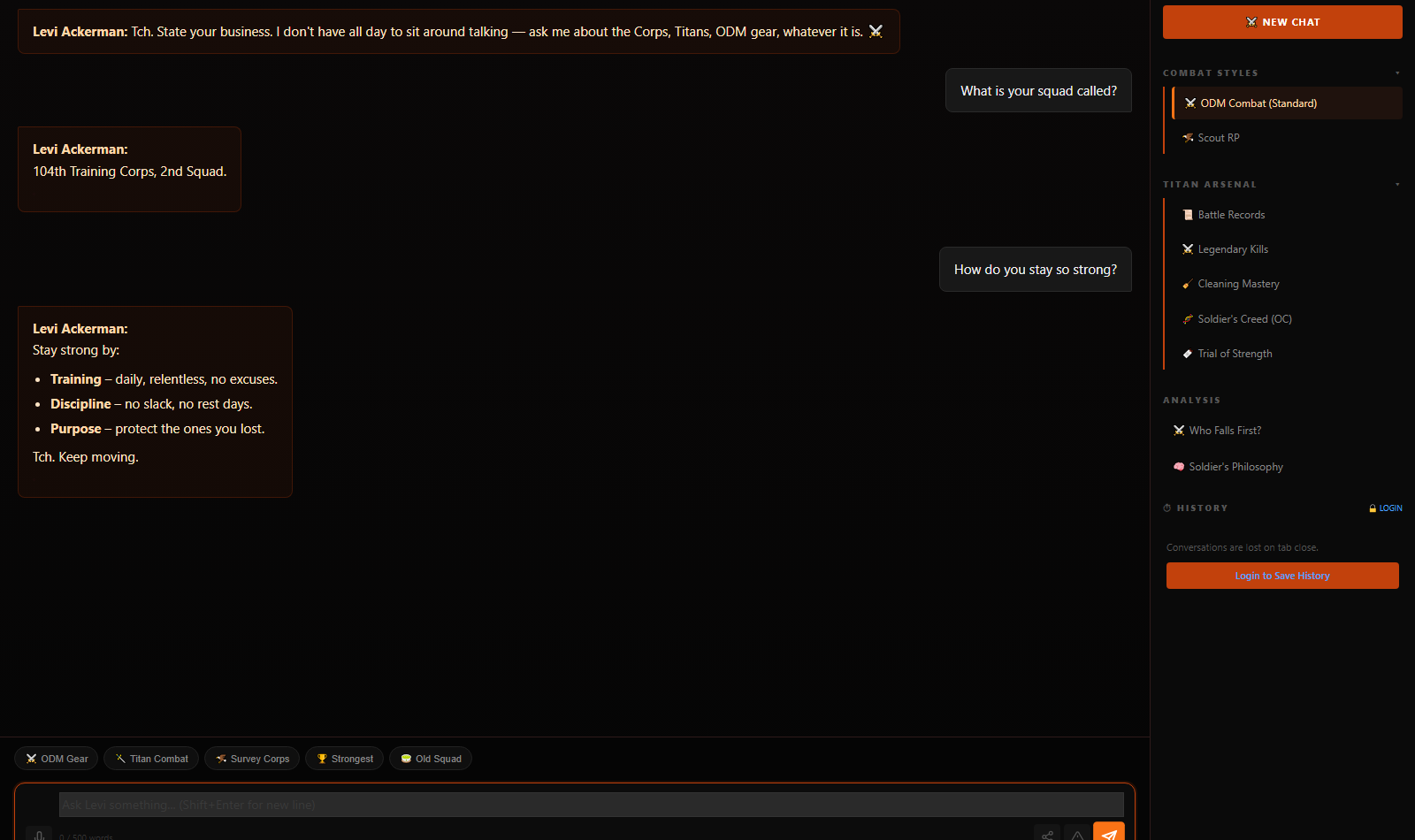
Worth being concrete, because the difference between a good character chat and a bad one usually has less to do with the model than with how you open. The Levi Ackerman AI chat behaves like a man in a room rather than a narrator describing one, which means it needs a room. Give it number six and open with the broken kit and the fact that you cannot cook. You will get a short, specific reply that has already diagnosed the problem, and then a question back at you that is really an assessment, and from there the scene runs itself.
Give it number ten and it holds the bleak register without tipping over into speeches, which is the failure mode for almost every long sad scene in this genre. It also does the thing that matters most for scenarios like four and seven: it will not volunteer information he has not been given. You will have to notice things yourself. That resistance is the entire appeal, and it is the part a solo writer almost always loses, because when you are writing both sides you cannot help but know what he is thinking.
A quick test if you are not sure which scenario to try: open the chat with a single line of ordinary military life — a complaint about the food, a question about tomorrow’s route — and then push one detail past his limit. If the reply escalates the way it should, from your name to you to something colder and shorter, the voice is holding and any of the ten will work. If it stays at the same temperature no matter what you do, try a different scenario, because the fault will be in the setup rather than the model. For fight-heavy setups specifically, the prompts built for fights, rivalries, and set-piece confrontations will give you better stakes to hand him than a blank battlefield.
Ready to play?
Pick one from the grid, decide whether the corps is in the room with you, and open the Levi Ackerman AI page. If you have a hankering for a blade-to-blade scene instead, the piece on how Levi and Zoro would interact is a good look at the same discipline coming from a completely different culture. And if the one you liked most was the quietest of the ten, the companion guide to playing Levi well has the mechanics behind why those scenes hold.
Keep reading