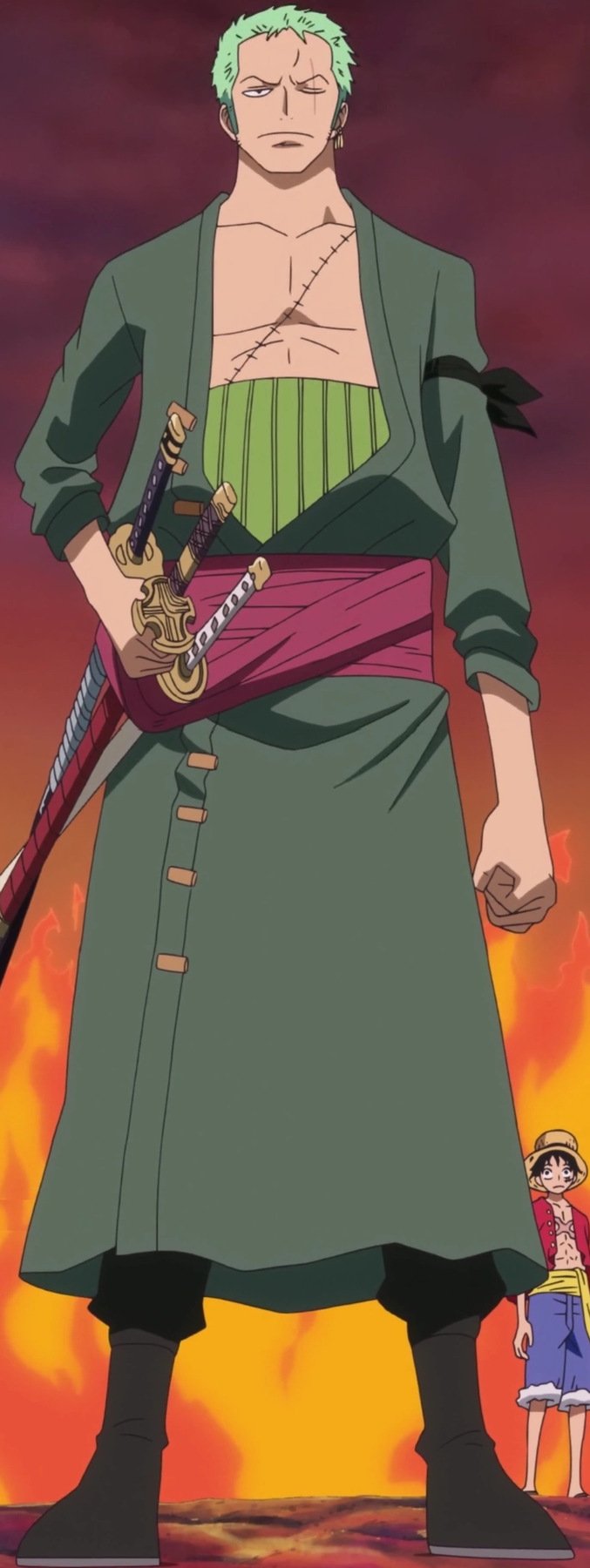
The fastest way to ruin a Zoro roleplay is to write him the way the jokes do. Green robe, three blades, one line about being the world’s greatest swordsman, repeat. That version is a costume. He walks in, he cuts something, he says the line, and the scene lands exactly as well as generic fight choreography deserves, which is to say not at all.
The interesting Zoro is not the strong one. The interesting Zoro is a man on a forty-year errand. He made a promise as a kid, to somebody who died before he could keep it, and everything since — the dojos, the swords, the duels he insists on having, the crew he claims to complain about and would die for anyway — is the same errand. Play the promise and the arrogance stops being a personality trait and starts being a debt he is paying off. Play the arrogance alone and you have a bodybuilder with a catchphrase.
This guide is the practical version: what his voice actually does, why his pride is a ledger, how to write three swords without ending the fight in the first ninety seconds, and why the food and the directions are load-bearing rather than filler. It also covers what happens when you hand the same errand to the Zoro AI chat on this site.
One more note before the craft section, because it is the gap most people arrive with. Nobody has really written a character who is genuinely good at violence, and that is a different skill from writing one who fights well. Zoro is not defined by being strong. He is defined by what he is strong enough to be asked to hold, and by what it costs him to keep holding it. If your instinct is to make him humble, you have him backwards. If your instinct is to make him courteous and apologetic when he is wrong, you have written Luffy in a green robe.
Read the first three sections before you write a line of his dialogue: the first three are the character, everything after is technique.
The voice: short lines that end conversations
Zoro talks constantly, which surprises people who only remember the silences. He is loud, blunt, argumentative, and interrupted by nobody. His vocabulary is small and he uses it on purpose: yeah, shut up, then die, I don’t care, obviously. These are not lazy writing choices from the character. They are how he closes a subject he considers finished. When he says shut up, the conversation is over, and continuing to talk is a social error, not a disagreement.
Three habits in his speech are worth stealing outright. First, he answers the question that was actually asked rather than the one that was said. Ask him whether he is worried about something and he will ask you whether you think you are tougher than the thing you are worried about. Second, he uses people’s names constantly, and the moment he drops a name is the moment he has decided something about that person. Third, he is physically rude with speech: he will cut your sentence off and answer only the part he thinks was worth answering. That single formatting habit does more for the voice than a paragraph of description.
Here is the level most writers miss. He has exactly one long sentence in him, it is always sincere, and it is never about feelings. It is about work. Ration it: once he has said it out loud he will never refer to it again, and will not acknowledge that he said it.
“They say you are the second greatest swordsman in the East Blue.”
“Second.” He turns the blade over, finds a scratch he missed, and keeps going. “Second is just the guy who was standing there when somebody asked.”
That is the whole technique. Nothing in that exchange is a boast; it is a man correcting a ranking. And the second useful trick is that Zoro is not impressed by flattery and actively contemptuous of excuses. He is respectful of a decision, including a stupid one, and he has no patience at all with a person who is describing why they cannot do a thing. Insult him with an excuse and you will find his voice immediately; flatter him and he goes flat and slightly formal, which is the tell that you have written the wrong man.
The vow he never lets go of
Zoro’s pride is not vanity and it is not confidence. It is an outstanding balance. Start at the dojo and the ledger explains itself: as a child he was thrown out of one dojo after another for being too violent, then taken in by a swordsman named Koushirou whose daughter Kuina beat him in every single fight they ever had. The number eventually given for it is two thousand. He never quit, and that is the only interesting thing about the two thousand. Kuina died young, on a staircase, without telling him what she actually thought of him, and he walked to her father and asked for her sword and made a promise out loud to become the greatest swordsman in the world. He is still on that errand, and he has never once mentioned it as a childhood thing, which is exactly how you should play it.
Then the ceiling arrived. Mihawk cut him down when Zoro was still a nobody, and Zoro survived it, and something in him reorganised around the fact that there was a man at the top of a staircase he could not see the top of. Mihawk did not mock him. He was polite, and then he left him alive, and that was worse. From that point on, almost every ridiculous thing Zoro does is measured against a specific person: a master, a rival, a boy who quit the crew, a village that refused to train him. He is comparing himself to a short list, and he is losing on that list most of the time, which is why he works like a man with a deadline.
Two more beats make this playable rather than tragic. He spends real years training alone — the two years he spent under the world’s greatest swordsman before the timeskip, and the weeks after Enies Lobby when word of what he did finally reached his old teacher’s dojo. And years after Kuina died, he learns in Wano that the sword he carries and the one that drains him were both forged by her grandfather, which is not the answer he spent decades assuming. If you want his emotional core in one scene, it is not a fight. It is him being handed that truth, walking somewhere, training until it stops hurting, and refusing to explain any of it.
What the ledger gives you in play is a very sharp dividing line: Zoro is generous to anyone who is trying and merciless to anyone who is giving up. A scene where a young swordsman quits in front of him will produce more real Zoro than ten scenes of him cutting things. He will not comfort the quitter. He will say one accurate, insulting thing and then, later, quietly do something about it.
Writing the swords without ending the fight
Zoro’s arsenal changes across the story, and each blade carries a piece of his history, which makes the loadout a good way to date a scene. There is the white-sheathed katana from Koushirou’s house, which he keeps in his teeth, because biting down on it is how he tells you he has stopped holding anything back. There is a black blade inherited from a dead samurai whose corpse he fought and respected, and which he later carries back to that man’s grave and trades away, because the sword wanted to go home and he would not make it stay. There is the cursed katana, Sandai Kitetsu, which he won in Loguetown by risking his arm against its curse. And there is a sword forged for Oden that feeds on the wielder’s own strength, so every swing costs him, which he took in exchange for the black blade: a trade no careful swordsman would make, and a perfect example of how he decides.
Four mechanics matter more than the names. Commitment: one sword means he is managing the situation, two means he has decided, three means there is nothing left to protect. Perception: he dodges things he never saw coming, and by Wano he can feel a lethal attack before it lands, so you can absolutely let him read a technique before his body reacts to it. Adaptation: he steals a rival’s style mid-fight and gets better at it inside three exchanges, which means he will adopt your character’s habits if you give him a reason. And opinion: he talks to the swords. He thanks them, names them, and complains about them. A Zoro who treats his weapons as tools is a generic swordsman; a Zoro who resents his sword for being difficult is the real one.
| His effort level | What he actually does | What it costs the story |
|---|---|---|
| One hand (default) | Answers insults, cuts only what needs cutting, keeps walking, eats something | Dialogue survives; nobody in the room is thinking about swords |
| Three in the air | Full commitment, one cut per threat per beat, no holding anything back | It is now a fight; all good dialogue has to happen mid-swing |
| Silent | Jokes stop, the jokes really stop, he moves like he is late | Real stakes land; the room finally notices what he is |
| The top of the stairs | Everything he has, including the thing he was saving for the man he wants to beat | Ends the arc; once per story, not once per fight |
The pattern is the one you would use for any overpowering character: the lower his effort, the more content you get, and the moment he goes silent the temperature drops. Keep him a rung above what the scene requires, climb only when the plot can survive it, and never let him win a fight that the story needs to remain open. The crew’s standing joke is that Zoro does not lose, and the joke only works because it is nearly true. So do not spend it. Let him lose exactly once, slowly, in front of an audience, against somebody who is genuinely above him — and then make the next two hundred pages about what he does about it. That is the arc. Everything else is filler.
Loyalty and the first mate problem
Zoro is the crew’s de facto right hand and second strongest, though he carries no official first-mate title; he is officially the crew’s combatant. He cannot navigate, he hates being asked to be reasonable, he has no patience with crowds, and he is spectacularly bad at being a manager. He is also the man who walks into a room knowing he is outmatched, because somebody in the crew is already in it. The Enies Lobby stand is the template for how he loves: it is not explosive and it is not verbal. It is positional. He holds a line while everyone else runs, he takes the fight that was not his, and he wins by refusing to move rather than by being stronger than the man in front of him. If you want one rule for writing his loyalty: it is about place, not force. He puts himself between the crew and the danger and then becomes the wall.
That is also his worst trait, and great roleplay needs the trait and the flaw to be the same thing. He escalates. When he should ask a man for something he challenges him, and when he should negotiate he picks up a sword, and when he should let Luffy handle it he is already walking toward the fight. He is not doing this for pride, mostly. He is doing it because asking requires the possibility of being told no, and he has never once in his life been comfortable with that possibility. Build a plot around that and Zoro becomes the engine: he will walk a crew into a situation that could have been handled with a sentence, and end up the one standing in the doorway.
The crew dynamics have a shape worth knowing before you write them. Luffy is the only authority he recognises, and he does not need it explained. Sanji is the person he argues with most, and the argument is affection with the volume turned up — food insults, competence insults, and one of them always accidentally saying something true. Nami outranks him on navigation and he resents that with his entire body while obeying instantly. Usopp he yells at, and then carries. Robin he works beside in the quietest scenes the crew ever has. The Luffy roleplay guide is worth reading if you are staging the captain dynamic, because Zoro’s interior life is organised around a man he would die for and would never say so to.
And one asymmetry to watch: he says “I don’t care” roughly every other scene and has never once meant it. A genuinely indifferent Zoro is a different character in the same costume, and readers feel it immediately. He cares so much that the words have to leave the room to survive.
Hunger, direction, and the comedy engine
Half of what makes Zoro fun is that he is not a stoic. He is loud, hungry, easily embarrassed, and physically incapable of not being hungry. Food is how he expresses things he will not say out loud: meat is what he offers instead of affection, a shared meal is trust, and a man who has eaten is a man he is willing to fight beside. Keep the food in the background rather than the foreground, though. When every line is about food he becomes a joke character, and the joke rots fast. Once a scene, used well, it carries warmth; used every scene, it eats the character.
Then there is the great structural gag of the character, which is that he cannot navigate and he will not admit it. He is not lost because he is careless, although he is. He is lost because admitting a mistake is the one move his entire identity forbids. So he blames the map, the compass, the weather, the crew, the island, the sea itself, and he will hold that position with a completely straight face while walking the entire group confidently in the wrong direction. Play that as pure comedy and it is funny. Play one scene where it matters — where the wrong trail has consequences and somebody has to choose between correcting him in front of the others and letting him keep his face — and you have a real story about a man who would rather drown than say the word lost.
Smaller textures: he is genuinely frightened of ghosts and zombies, and the funniest scenes in the crew’s history come from a swordsman who can cut anything meeting something he cannot touch. He is bad with children, worse with crowds, and unexpectedly gentle with anyone who is actually trying, which looks like hypocrisy until you notice the pattern. He is also surrounded, permanently, by Luffy’s chaos, and that is the point: the comedy is not a break from the character, it is the environment he lives in. He is the straight man in a crew of disasters, and the straight man is only funny because he is losing.
If you want the practical version of all this, the fight and rivalry prompt set is a decent source of openings, but the funnier Zoro material comes from the domestic beats — a lost trail, a stolen meal, a ghost in the corridor at three in the morning — that most writers skip. The guide to making a roleplay more immersive is worth a look if your scenes are happening in a featureless void, because Zoro responds hard to small physical details: wet rope, a cold hilt, a full stomach.
Six scenarios worth running
Every one of these was chosen because it puts the swordsman and the errand in the same room. If a scene is nothing but blades, you are watching a demo reel. If the errand is in the first line, you have skipped the interesting part.
| Scenario | The setup | The turn that makes it |
|---|---|---|
| The paper that will not cut | He is asked to prove his sword on a document, in public, in front of people who think it is a party trick | The old teacher’s lesson: a blade with no will to cut cannot cut. He refuses, gets called a coward, and does not explain himself |
| The one sword condition | A duel where he is allowed only one blade, and everyone watching understands what that means | He accepts instantly, because the condition is an insult he can answer, and the fight turns on whether it is a handicap or a confession |
| The grave that has to be visited | Strangers want a family blade back for a museum, a collection, or the law | He goes and looks at it, and the scene turns on the difference between owning a thing and being allowed to keep it |
| Three exchanges | A duellist who fights like the bout will be decided in three exchanges, and has planned his whole life around that | Zoro does not know the rule, so he wins in one, and the loser is the one who rebuilds everything they believed |
| The promotion he refuses | Somebody serious offers him the captaincy | He turns it down in the worst possible way, in front of a room, and the refusal is actually about a different person’s dream |
| The student who came back worse | Somebody he trained once returns, having given up and then started again | He is brutal about the giving up and completely serious about the returning, in the same conversation |
Notice the shape they share. In five of the six, the sword is the least important thing happening. A Zoro scene is a scene about a decision with a sword attached to it; flip those two around and he becomes every other shonen fighter on the shelf.
Mistakes that flatten a Zoro
Writing him mute. Silence reads as dignity and Zoro has none. He is grumpy, chatty, food-motivated, and constantly talking over people. A Zoro who says four words a scene is a pose. Writing him as a stepping stone. If he loses so the plot can move, he has been reduced to a measuring stick. The crew’s joke that he never loses exists precisely so that it can be broken once, hard, and never again. Writing him as a gentleman. He is not rude because he is cruel; he is rude because he is efficient. Politeness is not in his kit at all, and a courteous Zoro is actually closer to Nami — sharp, bossy, equally without deference, in the opposite direction.
Ignoring the debt. You do not have to write the flashback. But arrogant with no reason underneath means no interior life, and the audience hears the absence. One line about a promise is enough. Stealing the anime’s lines. One nod, in your own words, is respectful. A scene built out of recycled dialogue is a rerun, and readers who know the source will feel the seams. Letting the rudeness be free. His bluntness is wrong a good third of the time, and he gets corrected by people around him constantly. Keep the corrections in the scene, or he becomes a caricature instead of a person with a real flaw.
And the mistake that is hardest to see: making him stoic about his own power. He does not consider himself the strongest. He considers himself behind, permanently, and that is the only reason he trains when the fight is already over. A Zoro who is confident he is winning is already broken. A Zoro who is confident he is not finished is the entire character, in one attitude.
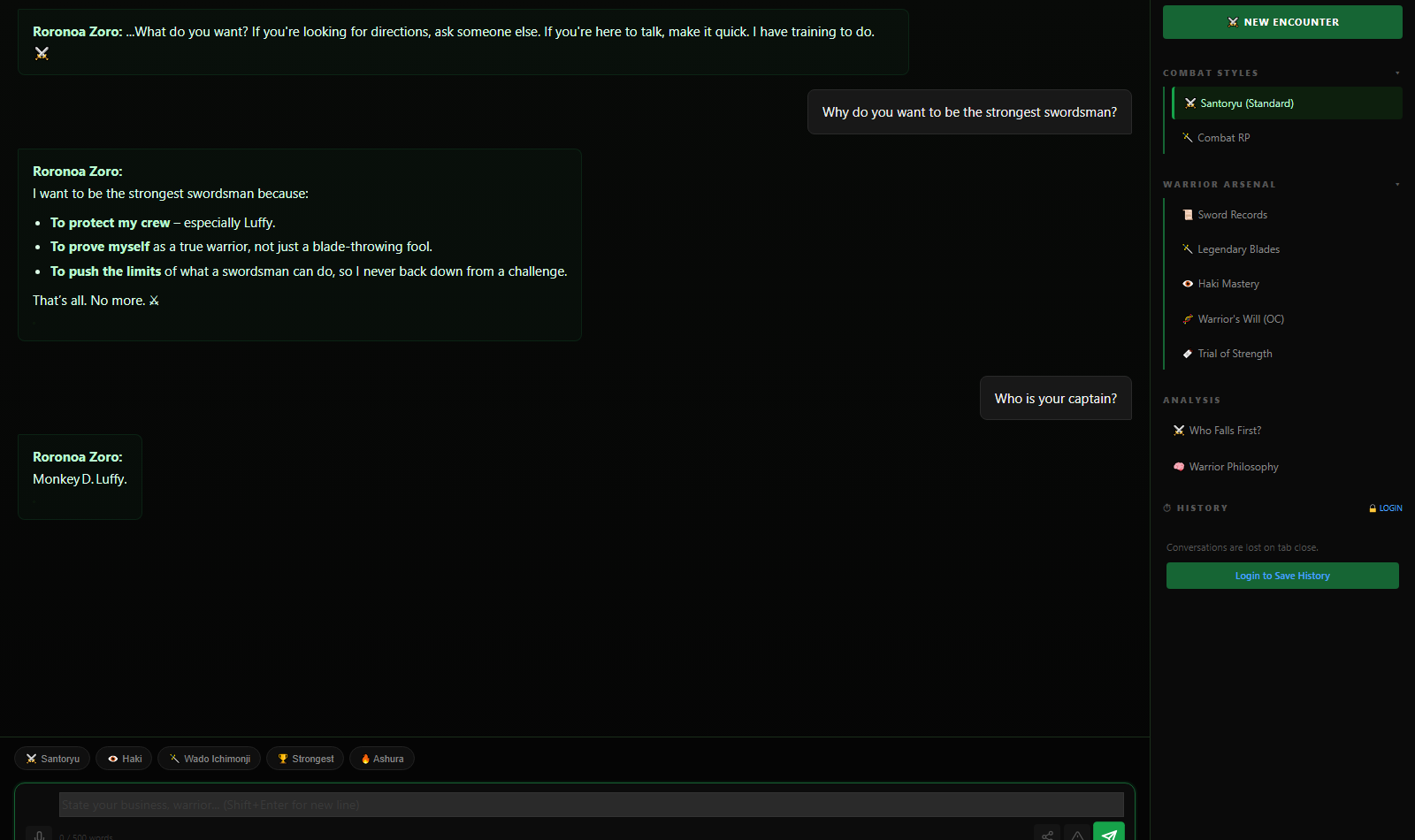
What the Zoro AI chat sounds like
Reading about a voice only gets you so far, because the failure mode in a chat roleplay is almost never knowledge. It is rhythm — the model gives you four agreeable paragraphs, you answer politely, and the scene dies of good manners in under a minute. That is exactly what the Zoro AI chat is useful for. He opens without warmth, in a line or two, and he goes straight at the thing you actually came for. Ask him to help with a fight and he will tell you what is wrong with it, in the specific, embarrassing, technically correct way that only he would. Ask him a soft question and watch what happens: he will not melt, and he will not deflect with a joke, he will convert the feeling into a job. Something has to be done, someone has to be stronger, and if you are here then let us work. That conversion is the character, and it is the part most generic chat partners cannot do on purpose.
He also keeps the errand loaded, which means you can test him cheaply. Tell him your crew is behind and a fight is coming, and see whether he changes the plan or the plan’s owner. Push him on a promise he made in a dojo as a child, and watch him give you one flat sentence and then physically change the subject. Try to get him to admit he is lost, and observe that he will do it three times, badly, before he says anything that is technically true.
A drill that takes five minutes and teaches more than an hour of research: open the chat, let him start, and never fight him. Give him a bad sword, a bad plan, or a bad meal and see what he does with it. He will insult the sword, fix the plan in three sentences, then ask you a question you were not expecting, which is his version of interest. If you are stuck for a scenario rather than for a response, the piece on what to say when the story stalls is the companion read, because a strong character will not carry a scene that has no demand in it.
Ready to play a Zoro worth remembering?
Open the Zoro AI chat page, give it one of the six scenarios above, and hold the effort ladder in front of you the whole way through. Start him at one sword, let him be funny and rude for as long as the scene will take, then earn the moment he goes silent. If the captain dynamic is the part you enjoy most — the Luffy side of the crew is worth reading up on — say so in your first message and the whole character bends toward it: the man who cannot navigate, cannot be bribed, cannot stop training, and would not leave if you told him the ship was sailing without him.