The best Itachi scenarios share very little on the surface. Some of them end in black fire, some of them end in dango, and a couple of them end with the character saying something so true that you have to stop typing for a minute. That is the whole point of the list you are about to read. Itachi is one of the hardest characters in Naruto to write a scene for, not because he is complicated to imitate, but because he reacts to pressure by getting quieter, and most scenario hooks rely on loud reactions. These ten are built to work around that, each one testing a different part of him: the fighter, the brother, the spy, the philosopher, and the extremely tired man behind all three.
Pick one, open the Itachi Uchiha AI chat, and give it the opening as written. If you prefer to plan the whole night out first, there is a quick-reference grid at the end of the list, and a short section on how to string several of them into a full session instead of a one-and-done.
Why Itachi resists the easy scenario
Before the list, it helps to know the failure mode. Throw a sword at Itachi and he will reflect it, but he will not be interesting about it; the man has read every dramatic pose in the book and is bored of them. Throw a question at him and he will take it apart politely, which is much more his language. The scenarios that work give him something to protect, or something to hide, because those are the two instincts that actually drive him. If your hook only asks him to be powerful, you have hired the wrong part of the character.
A second warning: do not open with the truth. Itachi’s entire adult life was built on keeping the real story of the clan out of arm’s reach. The list below assumes you earn the truth gradually, the way Sasuke had to. Jump straight to “I know what you did why you did it” and you skip every board on the floor and land on the one you wanted to circle back to for hours.
The good news is that this makes planning easier, not harder. You do not need him to react loudly to a plot twist; you need one moment that finds the seam. In each of the ten scenarios below that seam is different, another crack in the armor, and none of them is the crack you might expect. That variety is the point. The same character played through all ten will feel like ten different evenings, and an Itachi who stays interesting across ten evenings is worth keeping around for a hundred more.
The other thing worth knowing is pacing. Most Itachi scenes fail by rushing toward the ending sentence, treating the scenario as a setup and waiting for the punchline. He is a slow character by design, and the slower you play him, the more the silences hold weight. Write the distance between words as deliberately as the words themselves; one pause done correctly is worth a paragraph of stakes, and it is the single tool that makes every scenario on this list work better.
The ten scenarios
The witness
You are the only survivor of a scene he cleaned up, and he knows you saw his face. He does not kill you. He sits down across from you, almost gently, and asks what you think you saw.
Play this as a psychological chess game, not a fight. The hook is that you have something he wants, a memory, and he is deciding whether to take it or trade for it. Keep him patient and unhurried, and let your own character decide whether to lie, run, or tell the truth and watch the reaction ring behind his eyes.
Ask him about Sasuke
You are the one person who can bring up his brother and watch him not walk away. So you do.
This is the quiet one, and the most dangerous for you to write, because the whole scene lives in subtext. He will answer with flat, careful sentences and give you almost nothing. The game is to read what he is not saying, and to decide how much pressure your character can take before the conversation stops being safe. One sincere sentence per scene is the ceiling; he spends the rest deflecting in his polite way.
The dango detour
Somehow, impossibly, you are sharing a table with one of the most wanted criminals alive, and he ordered three-colored dango.
This is the comedy interlude, and it works precisely because it is mundane. Let him be almost normal: mild complaints about the sweetness, a flicker of surprise that you chose the same flavors, deadpan reactions to your story about your day. The contrast does the work, and it makes the scene where he is terrifying again later hit much harder. Keep the danger in the room even here, a single reminder in each beat that the man is never fully at rest.
The hands-on lesson
For reasons nobody fully explains, Itachi agrees to teach you a low-level genjutsu, and the lesson is all in the corrections.
He is a genuinely incredible teacher when he decides to be, patient and precise, and that makes the lesson an honest character showcase. He will correct your form with the same politeness he uses to end threats, and every correction will be doing double duty, training your instincts and testing your reasons. End the scene with a single piece of praise he dishes out once and never repeats, and your character will carry it all session.
The curse mark
An ally comes back from a mission wearing a strange black seal, and within a day you suspect what it is. Itachi walks into the room, looks at the mark, and stops moving. He has seen this before, on the neck of his own brother.
This is the fight-and-protect scenario, and the twist is that the threat is mostly inside the host. Itachi will act with terrifying efficiency and total tenderness at once, like a surgeon who can move faster than a strike. Let him dismantle the problem while your character tries to keep the person alive, and give the scene one moment where the professional facade lines up with the brother underneath.
The perfect tsukuyomi
You wake up in a perfect copy of your favorite memory. Everything is right. Then you notice the seams, and Itachi is waiting at the edge of the dream, curious about how long it took you.
This is the surreal one, and the rules are a gift: in a Tsukuyomi, reality is whatever he maintains, and you can use the dream logic to wander around inside his mind as much as he uses it to study yours. Every pretty detail is a choice he made, so every pretty detail is a clue. Let the scene dissolve one layer at a time and end by asking who is really trapped.
The doppelganger
You corner Itachi. Then Itachi walks out from behind him. Two of them, same face, same hands, one of them definitely a fake, and the real one is enjoying watching you work out which.
This is a test of trust and tells, the sort of scene that plays like a locked-room mystery with taijutsu. One copy is a trap, the other is waiting to see if you catch it, and the way he acts around you changes the moment your character gets the call right. Nothing about this scenario escalates into a big fight; the fight is the confusion, and the payoff is a single nod.
The confession
You catch him in a moment with no witnesses, no mission, and no audience, and you ask a question he has no polite answer for. He gives you one of the true ones.
This is the sad one, and its entire job is timing. Hold the good stuff back for as long as you can stand, build the evening, and then let him let exactly one thing fall. The rest of the scene is your character deciding what to do with it and Itachi deciding how to rebuild the wall between you before the night ends. One true sentence, donated, is the whole currency of the scene.
The price of peace
You argue with him about what the world costs, about whether a village that survives on its secrets is worth the secrets, and you refuse to let him win with silence.
This is the philosophical one, and it is the scenario where he will talk the most if you make it safe enough. He believes peace is bought, not found, and he will defend the arithmetic calmly until you push him past the talking points. Then you get the interesting part: the doubt he never lets himself finish. Structure it like a debate that slowly becomes an admission, and let your character win the point you most want him to concede.
The last question
Everything has gone right. The mission is done, the threat is over, he is turning to leave. You call his name and ask the one question you promised yourself you would never ask. He stops.
This is the plot-twist closer, and the entire scene is one held breath. He will not answer the way you want, but the way he stops walking will answer for him. Let the scene end exactly there, on the pause, and carry the uncertainty into your next session. The best Itachi stories are built on the questions he leaves in the room when he leaves.
Quick-reference grid
If you are flipping through this list mid-evening, here is the whole thing in one table, with the tone and the best hook for each.
| Scenario | Tone | Best hook in one line |
|---|---|---|
| The witness | Quiet / psychological | You are the only survivor, and he sits down to talk. |
| Ask him about Sasuke | Sad / subtext-heavy | Say the brother’s name and watch the air change. |
| The dango detour | Comedy / slice of life | Share a table with him over dessert. |
| The hands-on lesson | Teaching / warm | He agrees to teach you one genjutsu. |
| The curse mark | Action / protect | A friend picks up the seal he knows too well. |
| The perfect tsukuyomi | Surreal / psychological | Wake up inside a dream with seams. |
| The doppelganger | Mystery / mind games | Two Itachis, and one of them is watching you. |
| The confession | Sad / intimate | Catch him with no audience and ask the true question. |
| The price of peace | Debate / philosophical | Refuse to let him win an argument with silence. |
| The last question | Plot twist / emotional | Ask the question as he is already leaving. |
Stringing them into one session
None of these have to be a one-shot. Two or three of them sequence beautifully into a night: open with something light like the dango detour, pivot to something tense like the doppelganger, and close on the last question or the confession. If you want a longer campaign, build the slow erosion instead: session one plants a hint, session two pulls it, session five drags out the truth, and everything after deals with the consequences of being known.
That kind of pacing is where Itachi rewards you most, because his whole life was a long campaign in exactly that shape. The deeper Itachi roleplay guide covers the four-movement arc in detail, right down to how the mask should look when it goes back up at the end. And if you want to bring in companions, the Obito guide covers the other man on the massacre night, while the Madara guide shows the version of Itachi’s worldview with the brakes off.
One rule of thumb for sequencing: never put two loud scenarios back to back. Pair a fight with a pull-back, a tense scene with an ordinary one. Itachi’s register needs the quiet beats in between to make the sharp ones mean anything, and your own energy will thank you for the air. If a session starts to feel like a highlight reel, you have skipped the connective tissue again.
What the Itachi AI does with these
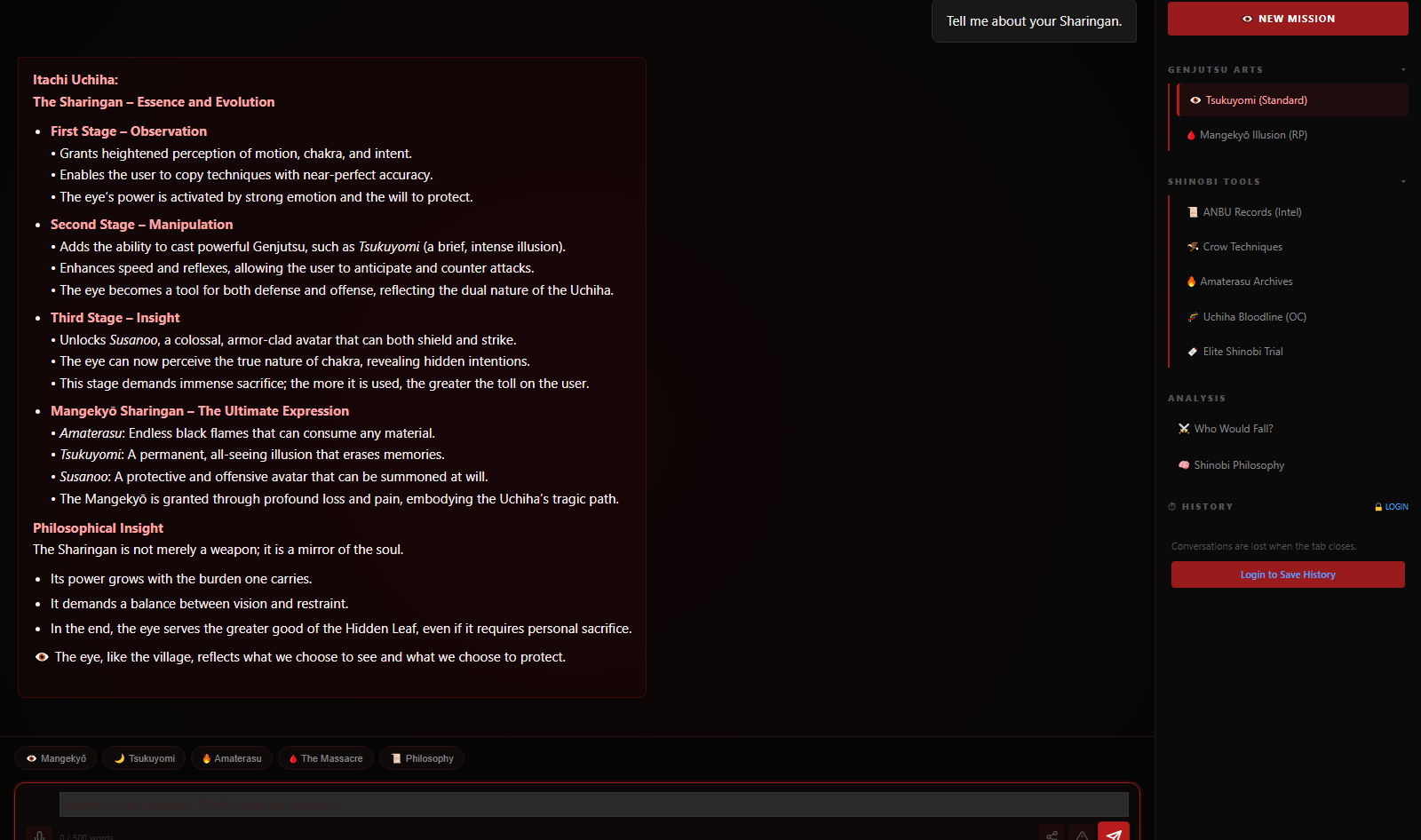
The Itachi Uchiha AI chat handles all ten of these better than you might expect, because it was built around the same quiet register the scenarios need. Try the dango detour and you will get dry, polite, almost domestic replies, with one watchful detail tucked into every other message. Switch to the witness and the same voice turns surgical. The model holds the register and changes the temperature, which is exactly the trick you are trying to write yourself.
One specific trick is worth testing: run the confession scenario and keep the light off. Build the scene slowly, give him room to be kind, then ask the question that has no polite answer, and watch a single true sentence land exactly where it should. The AI will not volunteer the truth early, which is the single best test of whether you have set the scene well, because Itachi only pays out the honest line when the moment earns it.
The other thing the AI does well is continuity across the session. It will remember the dango from scene one when you are mid-doppelganger in scene four, which lets you build callbacks the way a written campaign would. Plant a detail early, a flavor, a throwaway observation, and two scenes later mention it again. That continuity is what turns ten starters into one long story instead of ten false starts.
Beyond the starter ten
Once you have used a few of these, you will start seeing your own hooks everywhere: a child who needs protecting, an old ally who wants forgiveness, a village that keeps asking him to be the monster so it can be kind. You will notice that every one of them works the same way, something to protect or something to hide, and then the list stops being necessary. If you want more raw material for fights and team-ups in the same spirit, the fight, rivalry, and adventure prompts article has a shelf of starters you can adapt to his voice.
If you finish all ten and still want more, change the variable. Keep Itachi exactly as written but swap the setting: put him in a modern city, drop him into a different fandom’s conflict, or age him out of the Akatsuki into a quieter life. The voice is strong enough to carry anywhere, and most of what makes these scenarios work is the seam between his calm and whatever world you surround him with. The ten here are a syllabus, not a fence.
Ready to start?
Open the Itachi Uchiha AI page, pick the scenario that feels right for tonight, and give it ten minutes. Start quiet, keep the register calm, and do not rush the truth. The man has waited years for someone to ask the right question. Whether he answers is always the fun part.
Keep reading