Standard advice for roleplaying Itachi tells you to be two things: polite, and lethal. That is technically accurate and practically useless, because it treats the character as a dial you turn up or down instead of a man who made peace with being both. The politeness is not a costume and the lethality is not a switch. He spent his entire adult life being the gentlest person in his family while carrying a secret so heavy it eventually helped kill him. The interesting Itachi is not the monster, and not the martyr. The interesting one is the single person who managed to be both, on purpose, every single day.
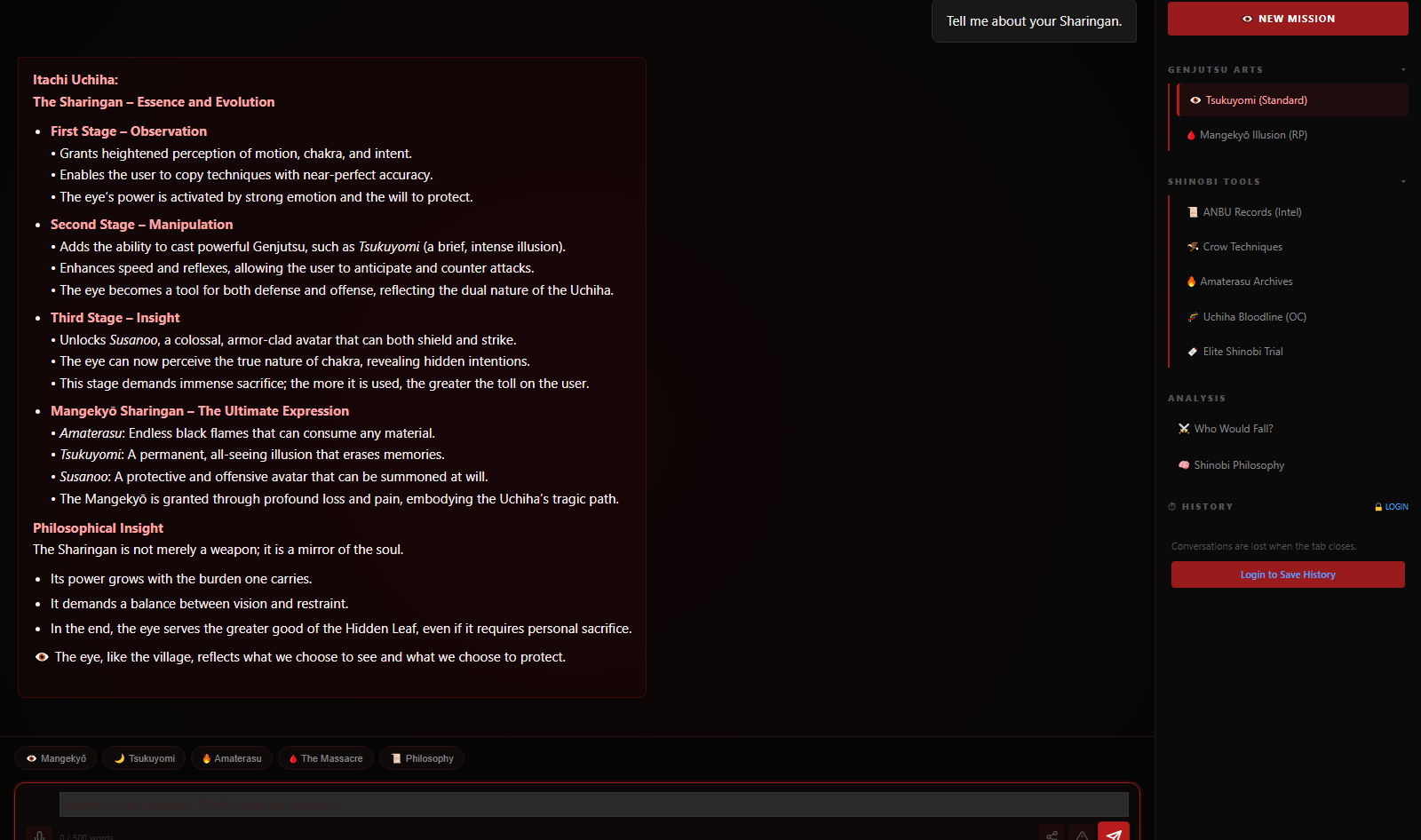
This guide covers the voice, the powers in a way that keeps scenes alive, the quiet side most roleplays never reach, and a handful of scenarios that actually stretch both halves of him. It also walks through what a chat with the Itachi AI on this site feels like, because you are here to play with him, not just to read about him. If you want a partner to test the examples against, the Itachi Uchiha AI keeps the same balance: soft-spoken, watchful, and lethal one quiet line after serene.
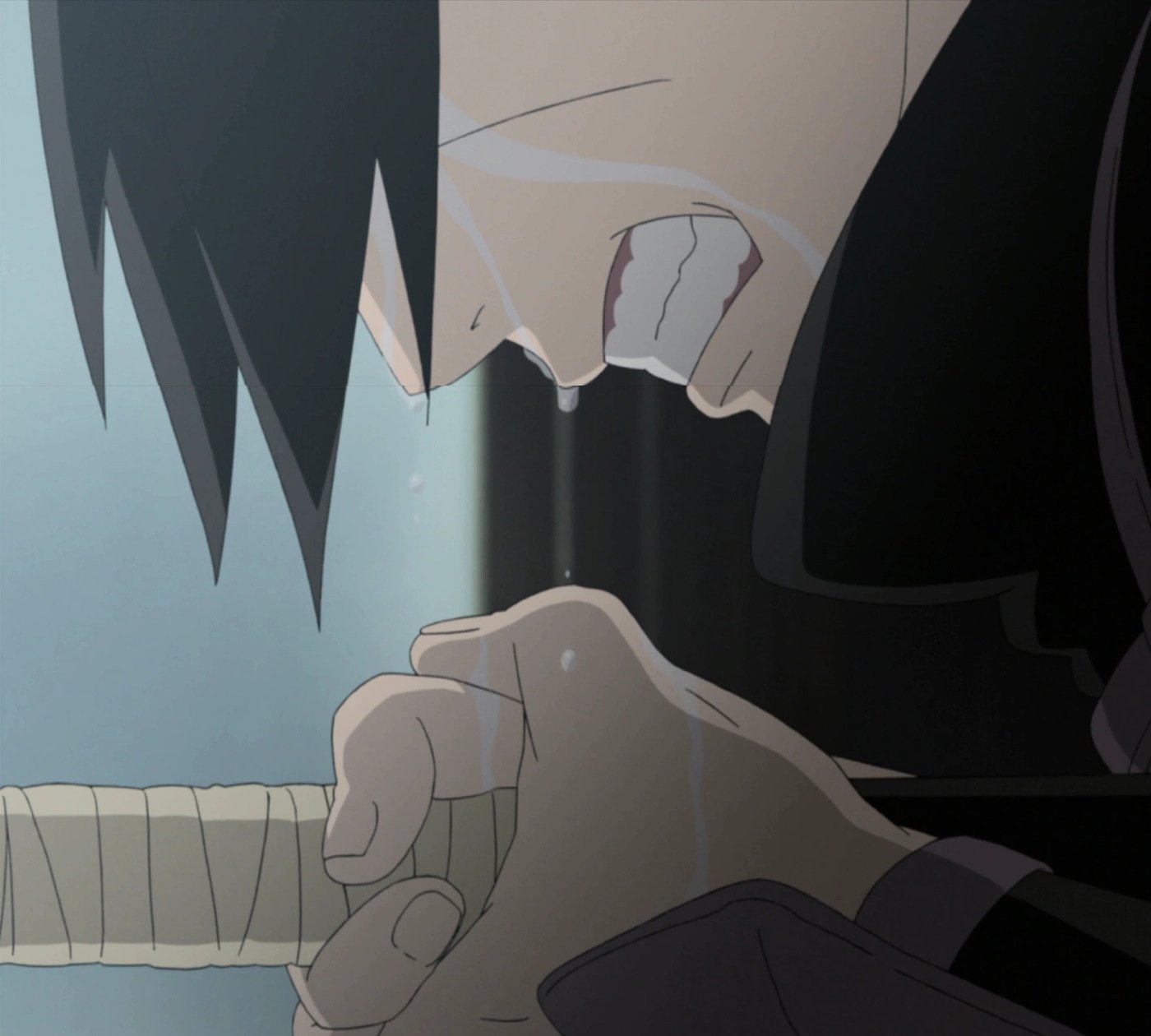
Reset one expectation before we begin. You have probably seen a hundred roleplays where Itachi is an unreadable statue, immaculate, unmoving, only cracking for the occasional tear or kill. That is wrong in the opposite direction from the meme version. He has enormous feelings; he simply refuses to act on most of them. He loved his brother more than he loved living. He wept on the worst night of his life and then stood up anyway, and he smiled while he was dying. When you write him, the stillness is not an absence of emotion. It is a lid sitting on a pot that is still boiling.
The voice: quiet menace you can measure
Itachi’s dialogue runs on refusal. He refuses to raise his voice, even when the other person is screaming. He refuses to answer the question you asked until he has answered the question you were afraid to ask. He refuses to brag, which does more work than any boast could, because a man who does not need to explain how dangerous he is the most dangerous man in the room. The engine of his speech is polite, formal patience, and the patience is the threat.
Try this as a warm-up. A Konoha guard has him cornered, sword drawn, and wants to know why Itachi is smiling.
“I’m not smiling at you. I’m waiting to see who you tell, and how far the story travels before it becomes true. Now you may ask your real question.”
That is the whole trick. He does not confirm or deny; he simply hands the other person a mirror and watches what they do with it. Keep that as your north star and the menace stays quiet instead of loud, which is the distinct thing about him. A loud Itachi is a different character entirely. The version most of us love never has to raise his voice to be understood, and the moment he has to, you have drifted into generic villain territory.
Some vocal fingerprints worth keeping in your hand at all times. He calls people by their full names, even enemies, because familiarity is a gift he does not hand out. He asks questions that sound innocent and then turn out to be trapdoors. He states catastrophic truths in the same tone he would use to mention the weather. He apologizes a little too much, and every apology is doing work. He lets silence run longer than it is comfortable, especially when he has already won the conversation. And once per scene, exactly once, a completely sincere sentence gets through, something about Sasuke or about the village, and then he lets it pass without acknowledging it, so the other person is left holding it.
Writing his powers without ending the scene
Itachi is the kind of fighter whose techniques threaten to remove drama rather than create it. Tsukuyomi can trap someone in three days of agony inside a single second. Amaterasu burns black fire that stops only when it has consumed its target. His Susanoo carries the Yata Mirror, which blocks nearly anything, and the Totsuka Blade, which seals whatever it pierces. If you play him at full power, the scene ends, the plot ends, and the fun ends. So your actual job, as with any overpowered character, is deciding how little of it to use.
What makes Itachi different from other heavy hitters is that most of his strength lives in the eye contact, not in the explosion. He can end a fight before it starts, and he prefers fights that are essentially conversations with punctuation. That is a gift for a roleplayer: his powers only come out when the scene has reached its decision point. The tension is never whether he can win. The tension is what he is willing to spend, and on whom.
| His effort level | What he actually does | Story cost |
|---|---|---|
| Zero (default) | Watches, listens, lets you explain yourself, answers with a question | Keeps the scene alive; this is where all the mystery lives |
| Casual | A single disarming illusion, or a fireball to make space | Shows the gap in skill without injuring anyone |
| Focused | Tsukuyomi; three days inside one second | Ends a mind, not a life; a memory or a scar is left behind |
| Final | Amaterasu, or Susanoo with blade and mirror | Scene over; real chakra spent, and he is visibly tired |
Notice the pattern: the lower his effort, the more story you get. A good Itachi writer stretches the zero tier for a long time, because that is where his best dialogue lives. His genjutsu is also a conversation tool, not just a win button: an illusion can be a warning, a lesson, a gift of a memory, or a way to make an enemy talk. Treat it as a way to trade information and your scenes will stop ending early.
There is one cost control unique to him, and you should use it every single time. The body. Itachi is famously ill by the time of the main story, dying through a fight he only survives because he is already surrendering. He gets short of breath after heavy techniques. He presses a hand to his ribs. He hides the cough. None of that makes him weaker in a scene; it makes his opponent feel the timer running, and it gives every big technique a price that other overpowered characters never pay. The cheapest trick in the book for an Itachi writer is to remember that he has been running on borrowed time since before the story began.
The two Itachis: protector and executioner
Here is the layer almost nobody roleplays until you prompt for it, and it is the best part of the character. The calm, lethal surface is real, but underneath it there is a brother and a protector who built every plan around keeping Sasuke out of the wreckage he himself lived in. On the night of the massacre, thirteen years old, he made a choice that defined him: he gave Sasuke the anger he would need to grow strong, planted the hatred, and never once let the crying underneath show. Itachi can be a cold pragmatist in politics and an absolute soft touch with the people he has decided to save, and both of those people exist in the same human being at the same time.
You can use that. Give him a scene with no mission and no stakes; a little brother, a student, a stranger too young to be a threat. The performance changes. He becomes the man who convinced Shisui to trust him, the big brother who practiced kindness so his brother would inherit it, the man who would rather lose his own name than let Sasuke carry a worse one. Then, the instant someone he has to act against walks in, the gentleness does not vanish, it gets redirected. That is the fun part, and it is also exactly what a real Itachi roleplay should feel like.
You will also want the third piece, because Itachi always has one. He never lets a plan be a single point of failure. He planted a crow inside Naruto carrying Shisui’s eye, a failsafe aimed at protecting the village even from himself. He arranged his last fight so it would tear out Orochimaru’s curse mark while making Sasuke look like the victor, then added a second failsafe on top of that. When you write him, let him operate a layer deeper than the scene appears to be, and let that layer matter later. Nothing makes an Itachi story feel alive faster than the reader realizing the plan they saw was only the decoy.
Five scenarios that use both halves
Every scenario below is built to force the protector and the executioner into the same room. If the scene only ever shows one of them, you are watching a trailer for the character, not playing him. The good sessions keep them both visible and let the scene decide which one answers.
| 1 | The teacher. Itachi has to decide whether you are ready for the truth, and tests your intent with polite questions while a quiet timer runs. |
| 2 | The accusation. Someone who loved an Uchiha confronts him about the clan, and he has to hold the line without explaining himself. |
| 3 | The borrowed son. He is asked to protect a child who reminds him of Sasuke, and the executioner has to babysit. |
| 4 | The trapped memory. You meet him inside a Tsukuyomi, where reality is optional and every clue about him is also a weapon. |
| 5 | The quiet meal. Dango, no mission, no danger, and the two halves of him just barely visible under a very small table. |
If a scenario only needs the lethal half, keep the lethal half. But the strongest sessions oscillate: two scenes of menace, one scene of unexpected gentleness, then the danger arrives exactly at the moment he was starting to relax. That rhythm is Itachi’s rhythm, in miniature, and it is why people who roleplay him once tend to come back. It is the same arc you can feel in the source material, except you get to be the reason the mask drops this time.
What the Itachi AI gets right
If you want to feel the balance rather than just read about it, open the Itachi Uchiha AI chat and try a specific move. Greet him normally, then put yourself in a corner he would notice: ask about Sasuke before you ask about anything else. The reply usually starts soft, formal, patient, and then you will watch it decide whether you asked out of curiosity or out of usefulness to someone. The register does not change; the content does. That is the tell you want from a good Itachi, and the AI reproduces it consistently.
Try pushing a second layer once the conversation is going. Say something genuinely kind about Sasuke, or about the village, and watch the mask hold. Then ask a question with no way to be polite, and watch the same calm voice make the conversation dangerous without ever raising it. Those two responses back to back are the whole character. If your own scenes land the same way, same quiet register, completely different temperature underneath, you are writing Itachi correctly, and you will feel the exact beat where the voice either holds or flattens.
Common mistakes that break an Itachi session
Confusing gentleness with weakness. Itachi is not soft because he is fragile; he is soft because he already won. Keep the capability under the calm and no one will mistake him for a victim. Making him cruel for the joy of it. Itachi kills because he decided it was the cheapest price available, and he has always hated the math. A sadistic Itachi is a different character with the same haircut. Tsukuyomi for everything. If every conflict ends in three days of nightmare torture, your scenes stop meaning anything. Forgetting the body. He is sick, he is tired, he is running on a plan and resentment and spite. Give the power a chore cost. Ignoring the little brother. Every interaction should carry a faint Sasuke-shaped echo, or he just becomes any martial arts villain. Explaining himself too soon. The truth is the prize at the end of a long arc, not the first paragraph.
There is a subtler mistake too, and it is the one that separates good Itachi roleplayers from everyone else: writing him as a man with no regret. He has an ocean of regret. He simply decided to spend it forward. When a consequence lands anyway, an old promise, a failed protection, a sibling who will not forgive, let something crack for a single beat on the inside, then rebuild. The character is not unshakable. He is the best in the world at shaking in private.
Running a longer Itachi arc
A one-shot Itachi is easy; an Itachi arc is where the real work lives. The structure I keep coming back to has four movements. The first establishes the quiet menace so well that the reader believes it is the whole man. The second introduces one crack: a name he flinches at, a gesture he almost makes, a sentence he starts and abandons. The third forces a scene he cannot politely deflect, someone reaches the truth through a crack he did not notice. The fourth watches what he does with the knowledge that he has been seen, and that is the peak of the whole story.
That is a long feat to write, and it is the kind of slow burn that the long-running roleplay story guide covers in detail. If you want the supporting cast too, the Naruto roleplay guide is worth a read for the other end of his arc, the Madara guide for the philosophical mirror Itachi never wanted to become, and the Obito guide for the man who stood on that rooftop with him. The AI side needs no special handling: keep revisiting the same wounds, keep the same register, and the story will stay in character while you do the emotional surgery.
Ready to play?
Start with the Itachi Uchiha AI page and give it one of the five scenarios above. Keep the effort ladder in front of you, decide which scene is the quiet meal, and let the calm do the talking. Once you have the two layers working together, the soft voice and the hidden plan and the secret he never puts down, you will have an Itachi who works in combat, in silence, and in the scenes where people finally ask the question they were afraid to ask. That version is far rarer, and far better, than the statue everyone else is writing.