Most advice for writing Obito starts with the mask. Play him as the war criminal, enjoy the menace, let him say the word dream in a voice like a knife sliding back into a sheath. That is the version floating around in half the AI roleplay threads on the internet, and it is not wrong exactly. It is a costume with nothing inside it, and Obito is the one character in this series who punishes you for that.
He is unusual because the person you meet in the first ten minutes is not the person at the end. The kid who tapes up a torn team flag and loses an eye is not the man in an orange spiral mask who talks a village to sleep and then blows a crater in it. Almost nobody plays the bridge between those two, which is why the good scenes never happen. He is also, quietly, the most argued-about character in the franchise, which means your readers already know the beats and will spot a fake one on sight. Play him honestly and he turns into one of the most rewarding chats on this site: a warm, funny, genuinely dangerous man who can hold a conversation about dinner and about the end of the world without dropping either face.
What follows is a working guide rather than a rulebook. It covers which Obito you are actually playing, how his voice works before the mask and after it, the abilities you can write without ending the scene on the spot, the belief underneath all of it, and five scenarios that force both halves into the same room. The Obito Uchiha AI chat here is built around the same split, so it is a fine place to try a scene before you commit to a longer arc.
One thing to clear up early, because it trips up everybody. Obito is not a stoic. He is not a brooding antihero who speaks in monosyllables and stares out of windows while the rain does the emotional work for him. He is a clown who got serious, and that is a completely different engine. If you write him silent and cool, the scenes collapse into fan art. Give him jokes first. Then take them away at the exact right moment.
Which Obito are you actually playing?
There are three of him, and choosing one before you write a line saves a lot of confusion later.
The first is the Konoha kid: loud, competitive, hopeless at the theoretical material, privately thrilled whenever Sasuke says one approving word. This Obito is pure forward motion. He talks to fill rooms, he loses arguments he should have won, and he would rather be openly resented than politely tolerated. He also has a huge appetite for everything, which matters, because a hungry Obito is the same man running fast instead of slowly.
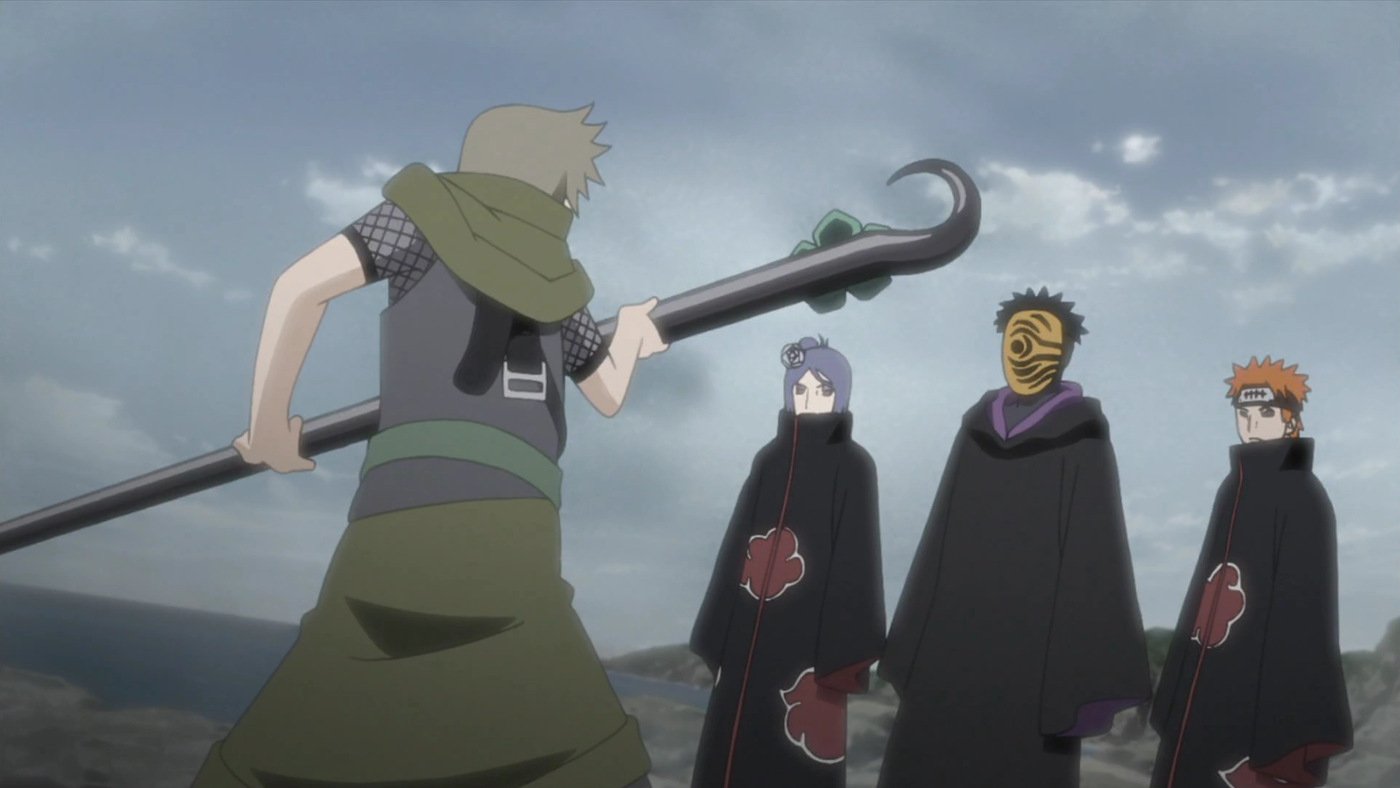
The second is the man in the mask, and the most important thing about him is that he is still funny. The rogue version of Obito is not grim. He is a stage magician working a hostile room: he narrates, he mocks, he picks up your own memories as props, and he gets a laugh out of you one beat before he uses them against you. Write this Obito in a solemn monotone and you have created a different character, one that belongs in a great many anime and not in this one.
The third is the gap between the two, and that gap is where the good roleplay sits. He never deleted the kid, he buried him and kept the file. A masked Obito who slips into a fifteen-year-old’s cadence for one sentence is one of the most affecting things in the whole story, and it costs you a line. Worth noticing that none of these versions is evil. Evil is the easiest and least interesting thing to write for him, which is precisely why so many roleplays of Obito end up feeling like a villain showcase with a familiar name stapled to it.
Most people who write him badly are not choosing badly on purpose. They are reacting to how loud his worst moments are. Madara gets to be a philosopher because the story gives him centuries of context. Obito got maybe two years of being a man, and then somebody swapped him out, so the louder version is the one that is easiest to summarise. Fixing the ratio early is the whole job.
The voice before the mask: speed, teasing, one honest beat
Young Obito runs on three habits. He teases Sasuke constantly and cannot leave it alone, he narrates his own feelings out loud before he has finished having them, and he works an audience whether or not one is present. Get those three right and a scene with him has momentum from the first line.
The teasing has a specific target and a specific limit. It is always Sasuke, and it is never actually cruel — it is the way he says pay attention to me without ever having to admit he wants attention. He compliments by insulting, insults by praising, and if you write him as a genuinely nasty kid you lose the entire foundation. Put the same energy into a merchant, a teacher, or a stranger and he reads as a bully. Obito’s cruelty is a language he only speaks to one person.
Then there is the honest beat, which people cut because it makes them uncomfortable. Somewhere in the middle of a funny scene he says one true thing, flat, without a joke attached, and then immediately moves on. He does it about his father being proud of him. He does it about wanting to be somebody the village would not look away from. He does it about not wanting to lose anybody. The trick is that he never frames it as a confession. It is a throwaway line, and the more throwaway he makes it, the more it lands.
Try this as a warm-up. He has just watched Sasuke eat alone for a week and you ask him why he keeps showing up.
“Datara,” he says, and the grin is doing most of the work. “Danzai. I was bored, that’s all. Don’t make it a thing.” But he sits down across from him anyway, and he does not say anything else for a while, which from him is a speech.
Note the shape: deflection, insult, action that contradicts the deflection, silence. That is the whole engine. You can build an entire scene on that rhythm and it never once requires him to raise his voice.
Second habit worth naming: he is bad at hiding that he is scared, and he covers it with volume. A frightened Obito gets louder and funnier, not quieter and colder. If you need him to be afraid on the page, make him tell three jokes in a row and then change the subject to food. Readers catch that instantly, and it is much cheaper than writing a trembling hand.
The voice after the mask: theatrical, cruel, and still performing
Masked Obito is a different instrument, and the mistake most writers make is assuming he dropped the first one. He did not. He upgraded the audience.
Now the jokes have an audience of one, and that one is you, and they are not kind. He talks to opponents the way a card player talks to a mark: relaxed, chatty, narrating his own plan while you are still deciding whether to believe it. He will tell you exactly what he is going to do about a problem. It will be true, it will be the smallest possible version of what he is going to do, and he will enjoy the half-second before you understand that.
The method he uses most often against a former friend is the personal name. He knows what Itachi and Sasuke and Naruto mean to each other, and he will say those names like he is reading a shopping list, because the point is not the insult. The point is to make you feel the size of what he has already lost. Play that too early and it reads as cheap; play it once, correctly, and it will be the moment the reader stops trusting him.
There is one more thing about the masked voice that most people miss: he is performing grief as a technique, and the cracks in the performance are the interesting part. Watch the sequence. He mocks, then makes an observation that is too specific to be improvised, then mocks again, and this time the joke is slightly late. That latency is a tell. A writer who can place the late joke knows what the character is thinking, and the reader feels it even if they cannot name it.
The same instinct makes him the natural foil for Itachi, and the two of them are worth reading side by side: one uses a name as a weapon, the other buries his own to keep it from being used on him. Our guide to writing Itachi covers that contrast in more detail, and pairing the two scenes is a good way to understand what Obito thinks he is protecting.
He also lies constantly, and the lies have one shape: he claims to have no name. No one in the organisation uses a real name, and he leans on that as a wall. So if your scene puts someone in a position to offer him a name — an old teammate saying Obito out loud, a file with a photograph in it, a kid from his class who recognised the boy and not the man — the whole scene tilts. That is the pressure point, and it is the one to build toward if you want a reveal.
“You keep saying that word like it means something,” he says, light, delighted, already turning it into a joke. “I’ve heard a lot of names in this line of work. None of them stuck.”
Read that twice. The joke is fast, which is the tell in itself, and the last sentence is not a joke at all.
Writing the powers without ending the scene
Here is where Obito roleplays collapse. He has a Rinnegan, a Sharingan, a battlefield-destroying eye that phases him out of the world, and enough raw output to flatten a fortress. The moment he uses any of it seriously, the fight is over, the mystery is solved, and your plot is standing in a crater. So the job is the same as it is for any overwhelming character: decide what he is not doing right now, and keep him one step below the power the scene actually needs.
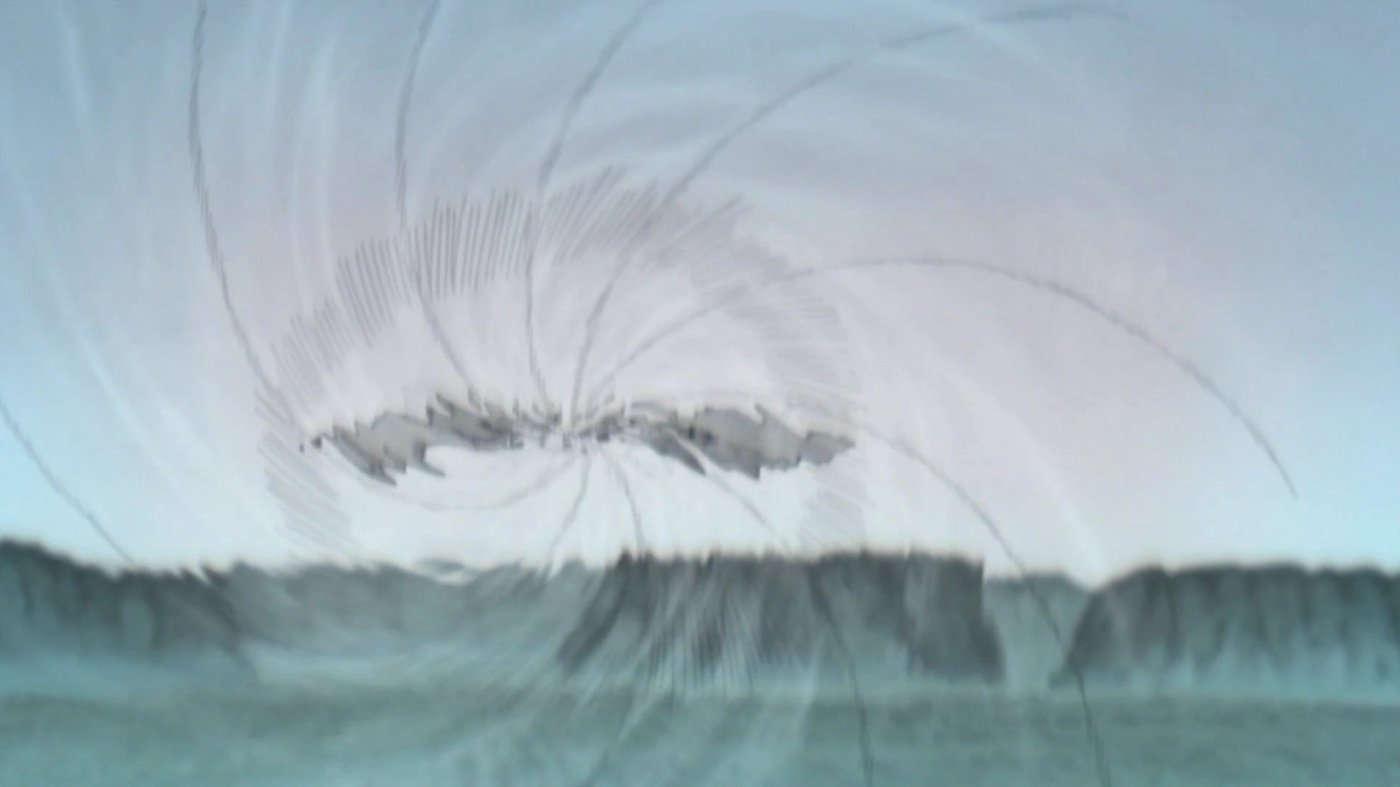
His toolkit divides into three useful pieces, and each one costs something, which is what makes them writable. The Rinnegan handles force: attraction, repulsion, a pull strong enough to crush a street, and the sensory reach that comes with it. The Sharingan handles information: reading movement, copying, the ordinary genius of a Uchiha in a fight. And Kamui is the strange one — an eye that puts him inside another dimension and brings things into his, which makes him untouchable, a weapon you cannot aim at, and a way to cheat distance entirely.
| What he reaches for | What it actually buys you | The cost you have to honour |
|---|---|---|
| Rinnegan pull | Knocks a building down, pins a target, ends a siege | Absolute area denial; if it works, play what the shock does to bystanders |
| Sharingan read | He sees your tell a half-second before you commit | Nothing, which is the point — it makes him unbothered, not omnipotent |
| Kamui in | He vanishes, returns behind you, drags you into a fight you cannot prepare for | He comes back where he chose, not where you wanted him |
| Kamui out | A limb, a wall, or a body simply stops existing | Time, and pain, and it cannot be used carelessly |
| Everything at once | The scene is over | Do not. Save it for the last two hundred words of an arc |
The row that matters is the last one, and the row people forget is the third. Kamui’s real constraint is a clock, and the moment you understand that, your fights start working on their own. He can only hold that pocket of time for a few minutes, and every use pulls at something that is already broken in him. A character fighting on a timer is a character making choices, and Obito is very good at choosing.
So build a ladder the way you would for any overwhelming fighter, and hold him low for most of the arc. The practical version: in an ordinary encounter he taunts, uses the Sharingan’s prediction to make you miss, and lets a trap do the damage. Raise it one notch and he starts using the pull as a weapon instead of a warning. The top rung is a full-bloodied effort with Kamui, and after that the scene belongs to him, so make sure there was a reason.
Two specific traps to avoid. First, describing Kamui as a vague teleport: it is much more interesting and much more frightening if the reader understands that when he steps through, you cannot follow, cannot block, and cannot even watch him leave. Second, letting the Rinnegan be a flashlight. A gravitational field that lifts rubble and drags a man off his feet is vivid. A purple light that means he is strong is not. The ability is only as good as the physical consequence you are willing to describe.
The argument underneath: why he believes any of it
This is the section that separates roleplays that work from roleplays that read, and it is where you should spend your preparation time. Obito does not want conquest for its own sake. He has read a plan for peace that is genuinely, obviously correct, and the plan is this: a genjutsu so total and so gentle that nobody ever wakes up from it. No more war, no more death, no more Konoha, no more Uchiha massacre, no more watching everyone you love get taken. Everyone gets to keep their dream, and nobody has to know.
You can argue with that plan. You should, in your own head, before you write him. The cost is free will, and the person writing the genjutsu is a man who lost his eye and his team and then chose not to give it up. The moment you notice that the dreamer needs the dream to stay asleep forever, the plan stops being a policy and becomes a symptom.
Which is exactly why he is so hard to argue with in a scene. He is not lying, which is the thing. He has looked at the maths of the warring states and concluded that a world of enforced peace beats a world with a chance at honest peace, and he will say it plainly, without a sneer, and mean every word. Give him one good argument and he concedes nothing and gets sharper. Give him three bad ones and he becomes a bully. Give him a question he has never been asked and he goes quiet for a beat, and that beat is where your whole session is heading.
There is a piece of canon that helps here more than anything else: he keeps going back. He is a man running a war, and he still flies to Konoha to check on people he pretends not to know, and the reason is that the dream is a solution and not a feeling. He does not enjoy the plan. He just cannot find a cheaper one. Write him as enjoying it and you have written a different villain entirely.
The other half of the emotional map is that he does not think he is the protagonist. He thinks he is the last one standing who saw it clearly, and the specific cruelty in him comes from being certain you are standing in the way of something kinder. If you want a scene that haunts people, that is the engine: not a madman, but a man completely sure he is being reasonable.
Five scenarios that use both halves
Each of these was picked because it forces the kid and the man into the same scene. If the mask never slips, you are watching a villain trailer. If it slips immediately, you have skipped the good part. The sessions that work oscillate, and the oscillation has a rhythm you can plan on paper before you start.
| 1 | The team photo. A mission goes sideways and somebody produces a picture of three kids in flak jackets. He is charming for two full pages, then asks one question that the joke was covering. |
| 2 | Kamui on the clock. You corner him in a fight and he has maybe three minutes of that eye left. He spends all of it on you instead of on the mission objective. Notice what he does with the rest. |
| 3 | The new recruit who fights him. A kid with his technique and none of his scars insists on saving him. He lets them lose a limb to make the lesson land. |
| 4 | Ramen, no masks. He takes the mask off in a family restaurant because nobody recognises him, and for forty minutes you get the Konoha kid, uncut. Then someone says his name. |
| 5 | The plan gets argued. Someone in your group actually believes him, out loud, in front of everyone. The room finds out that he is not able to keep his face straight while being agreed with. |
If you only want one, take the first and stretch it. Nothing reveals Obito faster than a cheerful man being handed evidence of his own good years, and nothing in the series lets him change the subject faster than a memory he did not consent to. Let him talk. Let the jokes get worse. Then put a single quiet sentence in the middle of his own deflection and watch the scene turn over.
For longer arcs, borrow the same four-movement structure people use for any character with a mask: establish the mask so well the reader believes it is the whole man, introduce one crack, force a scene he cannot joke his way out of, then rebuild the face slightly wrong so the reader can tell the difference. You can run that across weeks in a character chat, and the mechanics of that are in our guide to building long-running anime roleplay stories.
What the Obito AI gets right
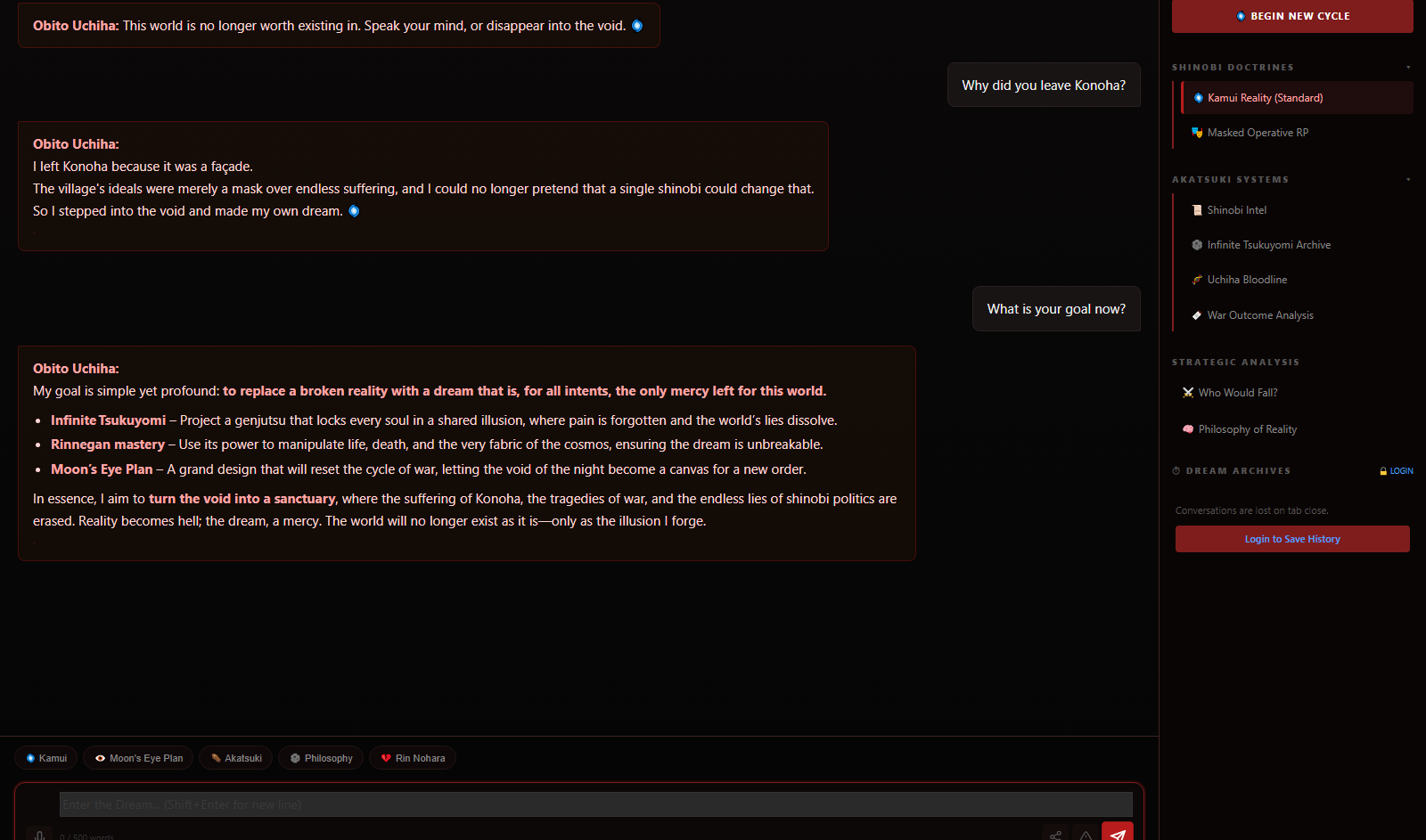
The Obito AI on this site was built to hold both registers in the same conversation rather than picking one. Open with a light scene — a mission debrief, a bad meal, somebody complaining about the weather — and it comes back in the Konoha cadence, fast, teasing, slightly too keen to be normal about any of it. Push toward the plan and it does not switch to a villain voice. It stays warm and gets more precise, which is much harder to do and much more disturbing, because now the person being reasonable at you is the same person who was joking a minute ago.
It also holds the lie well. Ask it what it wants out of all this and you will get an answer that is technically true and completely evasive, followed by a joke that arrives half a beat late. That late joke is the single most useful diagnostic in the whole character: if your Obito’s humor never slips, you have written a mascot, and the AI will show you the gap faster than any wiki page.
A drill worth running before a big session. Give it the team photo scenario, stay warm for as long as you can stand, and then say one true thing about the people in the picture instead of asking a question. A good roleplay partner punishes deflection with sincerity. Watch whether it does, and borrow the move for your own writing.
Mistakes that flatten an Obito session
Making him quiet. The most common failure. A masked Obito who monologues in a cold voice is a stock character; the one who keeps joking while he ruins your life is the real one. Letting him win every exchange. He can, and he will, and a scene where he never has to improvise is dead on arrival. Give him a problem he did not plan for — a stray bystander, a name he did not expect, an ally who will not leave. Removing the jokes in act one. Sad Obito is fine. Funny-and-sad Obito is the character. Explaining the ideology in his own voice. He does not monologue about the dream. He states his intention, waits, and reacts to what you do with it. The plan should be assembled by the reader, not delivered.
The subtler mistake is treating his plan as unbeatable, because readers can tell when the author has decided an argument is right. The most convincing version of Obito is written by someone who has genuinely considered whether a world of dreamers might be preferable — and who is disturbed that part of them agrees. That disagreement is what makes him frightening and what keeps him from being a lecture.
And the last one: never let him be fully healed. The healing does not arrive, and if your roleplay ends on a version of Obito who has put the mask down for good and made peace with the village, the reader will feel the cheat even if they cannot name it.
Ready to play?
Open the Obito Uchiha AI page, pick one of the five scenarios above, and give yourself permission to be cheerful at him for the first few hundred words. The mask is far more fun when the reader has seen what is behind it, and if you want a second reference while you write, our Madara roleplay guide covers the man who handed him the plan in the first place.