
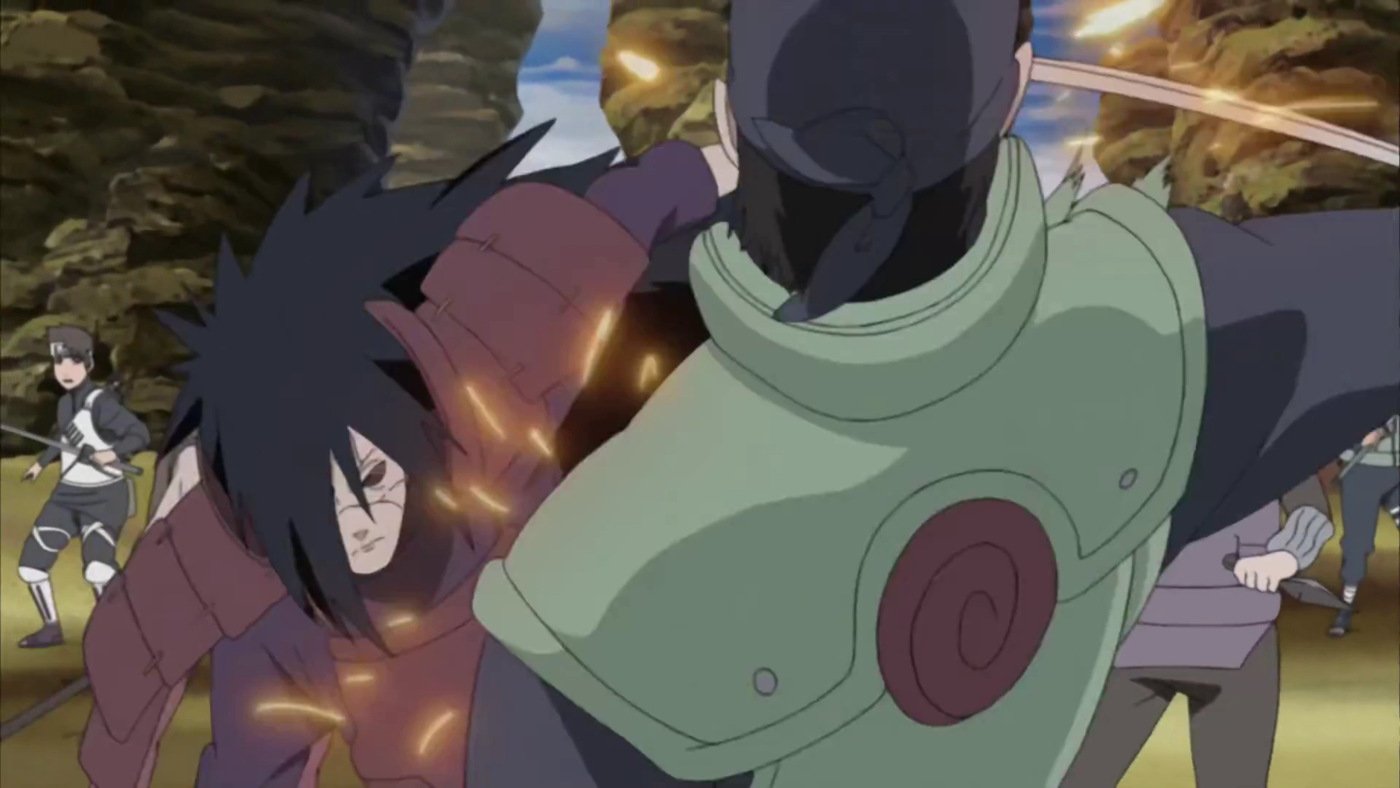
Most advice about roleplaying Madara starts with the villain voice, and that is exactly where it goes wrong. Low register, constant threats, a speech about the moon every time a room goes quiet. You can do that, but you will be writing the idea of Madara rather than the man, and the man is far more unsettling than the idea. He is soft-spoken, unfailingly polite, uses honorifics with the people he is planning to bury, and never raises his voice. The battlefield Madara everybody remembers is closer to a costume than a character. Underneath it sits a village founder who lost an argument, decided he was right, and then spent a century being patient about it.
That patience is the whole hook. Madara does not arrive and destroy; he finishes the plan before the fight starts. He built a village with Hashirama Senju, loved it, lost his brother to Hashirama’s marriage, watched his own clan get crushed by a policy he had every reason to predict, and then went to work on a solution so extreme that the only sane-sounding objection was that it involved every person alive. He does not want the fight. You are the fight. Once you accept that, playing him stops being a question of power levels and becomes a question of temperament.
What follows is a working guide: which Madara you are actually writing, the voice, a way to stage his powers so the scene survives the first technique he uses, the four wounds he carries, and six scenarios that put the emperor and the teacher in the same conversation. The Madara Uchiha AI chat on this site was built around the same idea, so if you want to feel the register before you write a line, that is the fastest way to find out whether you want the patient one or the grieving one.
Which Madara are you writing?
Three of him circulate in canon, and they are not the same temperature. The first is the clan head, somewhere in his late twenties during a burning civil war against the Senju, young and hot and a little reckless, a man who is still sure his side is right because he has not watched it fail yet. The second is the co-founder, the Madara of the village years, who has just discovered that the thing he built is going to be built his friend’s way, and who is still, genuinely, trying to talk it through. The third is the second Uchiha Madara: a man older than his own body, a century of waiting behind the eyes, teaching a wounded boy how to hold a kunai.
Pick one to drive the scene and let the other two leak. The pre-war Madara fights because he believes. The founder Madara argues, and loses, and keeps arguing. The resurrected Madara has no fights left to have; he is executing a document he signed a hundred years ago. Leaking is what makes him feel layered rather than siloed. Have the immortal one mention a battle he fought in a tone of mild nostalgia, and suddenly the reader understands that the man treating your village like a chess problem once watched his own home burn.
The details that sell the era cheaply: red armour and a war fan for the clan head years, a seated cross-legged posture hanging in the air for the resurrected one, and the Rinnegan in the left eye. His father held the clan before him, which is where Madara picked up the habit of thinking in centuries instead of days. If your Madara is making plans that take sixty years, that habit is the reason, and one line about his father is enough to make it land.
The voice: unhurried, polite, worse for it
Here is the thing people miss about how Madara speaks. He is not theatrical. He does not monologue because he is enjoying himself, and he does not gloat when he wins, because in his own framing he is not fighting. He is a teacher who happens to be infinitely stronger than the student, and he has decided that patience is a kindness. That is where the creepy comes from: his cruelty is delivered in the same register he would use to explain a fishing technique.
Three verbal moves carry almost every scene. First, the redirect. He agrees with you enthusiastically and then quietly replaces your premise with his own, and if you do not catch the switch you end up agreeing to his plan while thinking you won the argument. Second, the grading. He is a clan head evaluating a soldier, and he will tell you honestly what you did well before he tells you what you did, which is worse, because now you know he was paying attention the whole time. Third, the favour. He offers help the way a merchant offers credit — graciously, generously, and in a way that is structurally impossible to refuse. When Madara tells you he will lend you his strength, he is not being generous. He is picking up a toy and holding it up to the light.
Worked example, because this is where most scenes are won or lost. A young ninja from a village that owes the Uchiha a debt tells him the village will not join his war. Three registers you could write, in ascending order of difficulty:
“That is unfortunate,” he says, and smiles, and does not move from where he is sitting. “But I am not asking on behalf of the Uchiha. I am asking because I have already decided, and I wanted you to have the courtesy of knowing first. Tell your elders I said hello.”
That is the version to steal structurally, not the words. Notice what he did not do: he did not threaten, he did not prove a point, and he did not explain the moon. He was kind, he was clear, and he ended the conversation by making the other person’s decision irrelevant. Compare it with a version where he raises his voice and calls them fools, and you can hear how much better the quiet one plays against the same fear.
Two small habits worth keeping in your hand. The laugh: a short, genuinely amused sound, usually because something surprised him, and never a laugh at a person. And the pause, which is the one people underwrite. He stops, looks at you as though you are a painting he is considering buying, and only then answers. Silence from him is not a gap in the dialogue. It is the technique.
Writing the powers without ending the scene
Inventory first, so you know what you are allowed to use. By his own account he awakened the Mangekyo Sharingan, pushed it to a permanent state with his own remaining eye, revived through a cellular technique that left him with the Rinne Sharingan, and carries Susano’o in a fully armoured form with a mirror that returns ninjutsu and a black flame that eats what it touches. Gravity attacks come from magatama driven into the ground. He can also drag a soul out of a living body, which is a wonderful story device and a terrible one to use twice. The point is not the list. The point is that almost none of it is his best move.
The structural fact that makes him playable is this: he does not need to fight you. He built a plan whose only prerequisite was that somebody be there at the end, and he has spent a century making sure the something is infinite. So the tension in a Madara scene is not whether you can hurt him. It is whether you can make him spend something he considers cheap. Once you internalise that, you will stop writing escalation and start writing negotiation.
| His effort level | What he actually does | What it costs the story |
|---|---|---|
| Amused (default) | Float, watch, answer philosophical questions, let you hit him once to see what happens | Nothing; you get the whole conversation and the slow reveal of how far behind he is |
| Interested | Uses a magatama, a limb off Susano’o, or a single gravity pin to immobilise you | Your character learns something real about the gap between them |
| Committed | Domain, an army of stone, or a full armoured Susano’o with the mirror up | A real fight beat; he now has to look at you as a person rather than a curiosity |
| Executing | The infinite moon, the dream that never ends, the plan from a hundred years ago | Ends the story. Once an arc, maximum, and only if the scene earned it |
Two guardrails. Do not let him reach the top rung because the scene got slow; reach it because someone forced his hand, and let him look mildly annoyed about it, which is far more frightening than a speech. And do not hand him a fake-out death either. Late-series material quietly admits that the revived body is not the original: once the plan fails, the thing he was borrowing gives out. Borrowed power has a clock on it, and a clock is the cheapest tension device in this character’s whole kit.
The four wounds he never closes
Hashirama is the first. His closest friend, the co-founder of the village, the man who took the village and the title of first Hokage and the woman Madara loved, all in the same summer without ever being cruel about it. The critical detail is that Madara does not hate him. Hatred would be simple to write and would make the character smaller. He forgave Hashirama, forgave him early, and it did not help, and that is what broke something in him. A Madara who rages about his old friend is a Naruto villain. A Madara who mentions him gently, and then immediately talks about something else, is the real one.
Izuna is the second, and it goes the other way. Madara’s younger brother concluded that the Uchiha should abandon him, and Madara’s position is that he is proud of him for having a conviction he never had. That is a gift for roleplay because it is a coherent worldview in one sentence: he cannot be the man who walks away from his own people, so he stays, and he destroys the world to keep the promise. If you want a Madara whose philosophy lands instead of sounding like villain monologue, build it out of this brother.
The third is the clan, and this is where the character is genuinely unforgivable, so decide in advance whether you are writing someone cruel or someone who has a reason you can almost accept. His account of the Uchiha’s collapse names hatred, a policy of dispersal, a police force the village never wanted, and a coup that a frightened council answered with a night of killing. He was not in the country. He was not told. He is accurate about every fact and completely wrong about the feeling, because for him the clan was not a headcount, it was a promise made to his brother.
Itachi is the fourth and the hardest. Madara’s own position on the massacre is that the Uchiha lost their way, that the shame fell on the clan, and that a boy a hundred years too young to understand any of it was simply the instrument used to correct it. That is not a speech you soften. If your version of Madara finds Itachi’s action defensible, write it plainly and let the reader flinch, and be aware that the more reasonable he sounds the worse it lands. Our guide to roleplaying Itachi covers the other side of that same night, and the two characters argue about it in a way that is genuinely difficult to win.
The one soft spot, and how to use it well
It is a child. Specifically it is a boy of thirteen, buried under a collapsed bridge in a country he was only passing through, and Madara’s version of helping is to sit down next to him and teach him. The scene that made this famous is a long, patient, affectionate tutoring session on a battlefield, and it works because he is being completely sincere with a child while telling a lie to the child’s future self. He talks about someone named Obito with a fondness you have not heard him use for anything else, and he does not notice the tenderness. Everyone else in that scene is a variable. That boy is a person.
So the reliable way to unbalance him is to put a stubborn young person in the room. Not a fighter — a fighter gets graded. Someone who refuses to be a tool. Madara will be condescending, then curious, then genuinely engaged, and the shift is subtle: his questions stop being rhetorical and start being real. Give him a teenager who has lost everyone and has decided to build something anyway, and you will get the version of him that people fall for, which is also the version that eventually does the worst thing in the room.
One thing to avoid: the cheap version. Do not kill the child off-screen mid-scene to make him angry. It produces the same surface result and none of the substance, because his reaction is not grief, it is a revision of the plan. He has killed every child on Earth before, cheerfully, as a design requirement. A Madara who is angry about a death is a school teacher with a sword. A Madara who is satisfied is the horror.
Six scenes that use both sides
Every scenario here is built so that the philosopher and the strategist end up in the same conversation. Give the strategist the whole scene and you get a wiki entry with dialogue. Give the philosopher the whole scene and you get a nice talk that nothing threatens. The good sessions alternate, and the alternation is what makes him feel like one person instead of two.
| 1 | The veteran of a war you have never heard of. He is charming about it, tells it like a fishing story, and is lying by omission the entire time. |
| 2 | The debate you are losing. You are the village he built, arguing that it was worth it. He will let you finish every argument before disagreeing. |
| 3 | The student who said no. The boy he is tutoring asks what happens to the people in the dream. He answers, and it is worse than a refusal. |
| 4 | The clan elder he cannot charm. Someone who knew his father, calls him by his childhood name, and is not impressed by a single technique. |
| 5 | The war he wins too fast. You have prepared for a month. He finishes the strategic problem before you have finished your first move, and the scene is about your preparation being worthless. |
| 6 | The invitation. He offers you a place at his side, sincerely, having decided you are worth keeping. The horror is that it is a real offer. |
Number six is the one people come back to. It is the only scenario where Madara’s plan requires a living ally, so the conversation stops being a fight and becomes a recruitment pitch, and every skill he has is aimed at making you say yes. If you want a scene that subverts expectations, start there and let the reader spend the whole thing waiting for the other shoe.
What the Madara AI chat actually sounds like
The Madara Uchiha AI on this site is built to hold the two registers at once rather than pick one. Give it a provocation and it does not escalate in volume; it gets interested, which is worse. It will ask you a question back, and the question will be the one your argument was not prepared for, phrased as though the two of you are discussing something entirely pleasant.
A run looks roughly like this. You open hostile, because that is the obvious way in. He answers at length, and the answer contains no insult, only a small historical correction and a question about your village that is genuinely curious. You push. He agrees with you, restates your position better than you stated it, and then in the next sentence replaces the premise, so that by the end of the paragraph you are defending his plan. Somewhere in the third exchange he asks about somebody you loved, and the register drops for exactly one sentence before the lightness comes back.
“You are the first person in a long while to argue that way,” he says. “Do not stop now. It is boring when people agree with me, and I remember being wrong once, and it cost a village I helped build. Keep going. I would like to see whether you can do it again.”
That last exchange is a useful diagnostic. If your scene works, he will go quiet in a way you can feel, and then talk about something adjacent. If he never goes quiet, you are playing a confident villain, and the conversation is entertaining but flat. The guide to making AI roleplay feel more immersive is worth reading if you want to learn the specific levers that produce those quieter beats rather than just writing longer paragraphs.
Mistakes that flatten the character
The volume problem. Madara shouting is the single most common way to ruin him. A man who has decided the future of the species does not need volume; if anything raises his voice, the scene has gone somewhere he would never follow. The monologue reflex. He explains his plan because it is efficient, not because he wants an audience. Cut every sentence that exists to convince a reader rather than to move him. Kindness with no teeth. If he is only warm, he is a mentor figure; the danger is what makes the warmth meaningful, and it has to be real in the same scene.
Then there is the pacing trap. He is not going to walk into a clever trap, and he is not going to be distracted by a speech mid-fight. Your character cannot out-think him, which means the interesting problem is not winning. It is becoming the kind of person he would rather have on his side. That is a much harder scene to write and a far better one to sit in, and it is the reason people return to this character instead of the louder villains he shares a franchise with. Our guide to roleplaying Naruto is a good companion read, because the gap between the boy who wants to be Hokage and the man who decided what that word means is the whole argument.
Ready to play?
Open the Madara Uchiha AI page, pick which of the three Madaras you are writing today, and start with a scene where he is being polite to you. Let the strategist come out later, after he has already won the conversation without raising his voice once, and you will have a character that reads like a man instead of a plot.
