Most Naruto roleplay scenarios online begin the same way: a fight, a monster, and a lot of shouting. They are fine for exactly one reply. The character is much larger than that, and the setups people keep missing are the ones that put a loud man in a small room and take away his exits.
What follows is ten of them, grouped loosely by temperature — three fights that are not really fights, three quiet ones, two that are simply funny, and two that will wreck you. Each has a premise you can start from tonight, a note on what actually makes it work, and enough room to improvise. None of them need a whole war to run on. Most need one room, one other person, and a thing he would rather not talk about.
One framing note before the list. Naruto is the easiest character in the series to play badly and the hardest to play for more than a scene, because he has no interior monologue to hide behind — he is a reaction to whoever is in the room. Every scenario below works better if you fix that person first, then let the plot arrive second. That is the single most useful habit for playing him, and it is also how the Naruto AI chat here behaves if you tell it who is in the room before you tell it what is happening.
How to pick one
Match the scenario to the register you actually want to write. If you are new to him, start with something funny or something quiet. Fights are the trap: his power ceiling is so high that a straight contest with Naruto usually resolves in two replies, and you end up writing a bout report instead of a scene. The fights below all work because Naruto is solving a problem that cannot be solved with a Rasengan.
It also helps to decide in advance which version of him is showing up. Loud-and-sincere, warm-and-weary, or the version that has been Hokage long enough to be tired of being called a boy. All ten of these work with any of the three. You are not locking a version in; you are deciding who walks into the room, which changes the dialogue far more than the plot does.
One last practical note. The setups below are written in second person on purpose, because the scenarios that fall apart are the ones where you have not decided what your own character wants. He is easy to play as long as somebody in the room wants something he is bad at giving. Decide that, and the twenty replies of improvisation write themselves.
Fights that are not really fights
1. The one he has to lose
Preliminary exam format: a duel, a crowd, and a Hokage who orders Naruto to stand down. A masked shinobo with a weapon trained on civilians is waiting outside, and the only version of the plan where the village is untouched requires Naruto to lose badly, publicly, and take the blame for starting it.
He has never intentionally lost. Not once, in a life full of losses, all of them accidental. Play the refusal first — loud, fast, physically stupid, absolutely certain he is being framed — and then play the moment he reads the room and realises the Hokage is not framing him. What makes this work is the second half, where he loses with his eyes open and the crowd boos, and then has to keep walking. The victory, if there is one, arrives after the scene ends.
2. Spar with the man who taught him
Kakashi summons Naruto to Training Ground Seven and says nothing about why. No bell test, no lesson plan, no third team member. Just one instruction, delivered lazily, and a man who will not stop at half speed even when he is obviously winning.
Every Naruto scene with Kakashi in it secretly becomes a scene about whether a teacher is proud of his student, and Kakashi will deny it while demonstrating exactly how much he has improved. The play here is the last minute of the fight, where Naruto stops trying to win and starts trying to read him, and gets one clean hit for it. End the scene on the compliment instead of the hit. Kakashi almost never says the nice thing directly, so having him say it at all is the payoff, and Naruto absolutely does not know what to do with it.
3. Five minutes with Tsunade
The Fifth Hokage tells Naruto she will break his arm in five minutes if he cannot land one hit, then hands him a green senbon and walks to the window. No explanation, no audience, no warning. He has three attempts and a woman who has been doing this for thirty years.
This is the rare fight that is a conversation. Tsunade is not testing his jutsu; she is checking whether he can think under pressure while somebody he respects is watching him fail. The best version has him lose all three attempts and understand exactly why each one failed, and have her say nothing about any of it — then hand him a fourth senbon. For more on the dynamic of writing a lead who cannot beat the person training him, our training arc prompt guide is worth a look, and Sukuna is the useful extreme-case contrast: the same refusal to submit, enjoyed instead of suffered.
The quiet ones
4. Two chairs at Ichiraku
It is past closing. The counter has two seats, and the person sitting in the second one is leaving tomorrow, whether they admit it or not. Naruto has known for a week. He ordered before they sat down, which tells you he knew it was today.
He talks for twenty minutes about nothing. Courses, the weather, a fight he watched, a recipe. The scene only works if you let him do that fully before you interrupt, and then the true sentence arrives once, flat, mid-joke, and he does not acknowledge it afterwards. Do not have him cry. Do not have him stop talking. The horror and the comedy are the same action here, and the joke is what he says immediately afterwards. If your partner cannot sell the deflection, the scene collapses into melodrama.
5. The incident report he will not file
A solo mission where Naruto did everything right. The target is down, the post is clear, no injuries on his side. The report is four lines long because there is nothing to report, and it is also the worst document he has ever written, because a twelve-year-old had to be dragged back from the Land of Waves half-dead and nobody on that mission can write down why.
The whole scene is him dictating into a recorder and then listening to it back. Play the two versions out loud: the flat official one, and the one that keeps circling the part he cannot say. He will try to submit the flat one, fail, and then ask a single practical question about the next mission in a voice that is much too small. The main Naruto roleplay guide goes into why paperwork is such an effective scene for him, if you want the theory behind the setup.
6. Hokage at four in the morning
It is 4 a.m. in the Hokage office. The village is entirely fine. No threats, no emergencies, no missions. He has been reading the same page for two hours and he cannot remember a word of it.
There is no crisis to generate the scene, which is the entire point — the man who is only interesting under pressure has finally got a night off and does not know who he is without it. Give him a visitor, ideally somebody small and unimpressed, and let him be funny first and then accidentally heavy. The strongest version has him describe the village as if reporting on somebody else’s success, and then correct himself into a much smaller, more accurate sentence. It is the closest thing in the character to a self-portrait.
The funny ones
7. The great broth debate
A visiting dignitary wants Naruto’s ramen recipe. Properly, formally, with an interpreter present and a contract on the table. Naruto takes this extremely seriously, refuses to give anything away, and conducts a full negotiation over seasoning ratios like the future of the village depends on it.
Play the negotiation as a real one. He should stall, counter-offer, make an absurd demand about egg portions, and at some point accidentally reveal a genuine piece of family history about his father without noticing he did it. The dignitary leaving with a handshake and no recipe is a good ending. So is the dignitary leaving with a recipe he does not know is thirty years old and slightly wrong, which is better and funnier. A room of Naruto roleplayers does this bit better than it has any right to.
8. Wrong body, right voice
A sealing jutsu goes off in the middle of a crowded market. Naruto wakes up in a salaryman’s body, mid-conversation, holding a receipt. The salaryman wakes up in Naruto’s body and immediately starts apologising to everyone, including a Kage he has never met.
The comedy writes itself for about four replies, and then the scene turns because Naruto cannot use a single technique and has to walk home, and the salaryman, who does not want any of this, has to deal with a Leaf full of people who are each one apology away from a war. Let Naruto be the one panicking, because the man who never panics panicking is the funniest thing available to you, and let the salaryman be hilariously, terribly competent at lying in a way Naruto never could be. The unexpected team-up prompt guide has a version of this dynamic if you want to stretch it into a second session.
The two that wreck you
9. The letter he does not send
No plot, no mission, no antagonist. A desk, a sheet of paper, and a person he has already lost. He has written this letter a hundred times in his head and he has never gotten past the second line, because the second line is where he would have to say what he wants from somebody who cannot give it.
Write the second line. That is the entire scene. He is funny in the margins, he invents a practical excuse for why he is writing at all, and he stops mid-sentence and then starts again from the top. The single hardest rule: he never finishes it, and nobody in the scene is allowed to encourage him. If you write a version where he completes the letter and feels better, you have written a therapy session instead of a Naruto scene. For the specific mechanics of getting a quiet, grief-heavy scene to land, our piece on making AI roleplay more immersive goes deeper on the small physical details that carry it.
10. The clone he left behind
You go looking for Naruto and find a shadow clone that has been living in the village for seven months. It has a job, an apartment, a small reputation, and no idea it is not real. It cannot be dismissed. It cannot be sent on a mission. It has started having opinions about the village budget.
This is a plot twist in the cleanest sense, because the clone is a completely honest version of Naruto with all the jokes filed off. It is not cleverer than him, it is only less afraid, and that is the same thing said from the other side. What makes it work is that the real Naruto never fully takes control of it again, and the last line of the scene should be the clone asking a question he has never once thought to ask himself. Leave the reader slightly unclear which of the two is the impostor, because Naruto himself is.
The reference grid
All ten in one place, for when you are staring at a chat box and cannot decide. Read across, pick the one whose tag matches the mood you are already in rather than the one that sounds most dramatic.
| # | Scenario | Register | What makes it work |
|---|---|---|---|
| 1 | The one he has to lose | Public, humiliating, tense | He has never chosen to fail before |
| 2 | Spar with the man who taught him | Warm, competitive, near the end | The compliment lands more than the hit |
| 3 | Five minutes with Tsunade | Focused, exact, adult | He reads her instead of fighting her |
| 4 | Two chairs at Ichiraku | Quiet, funny, gutting | Twenty minutes of nothing before the true line |
| 5 | The incident report he will not file | Dull, procedural, sad | He listens to his own voice recording |
| 6 | Hokage at four in the morning | Still, tired, self-aware | No crisis, so he has to sit with himself |
| 7 | The great broth debate | Comedy, formal, warm | He treats it as a real negotiation |
| 8 | Wrong body, right voice | Absurd, escalating, cheerful | Naruto is the one who panics |
| 9 | The letter he does not send | Silent, devastating, careful | He never gets past the second line |
| 10 | The clone he left behind | Surreal, slow, clever | The honest version with the jokes filed off |
Running these in the Naruto chat
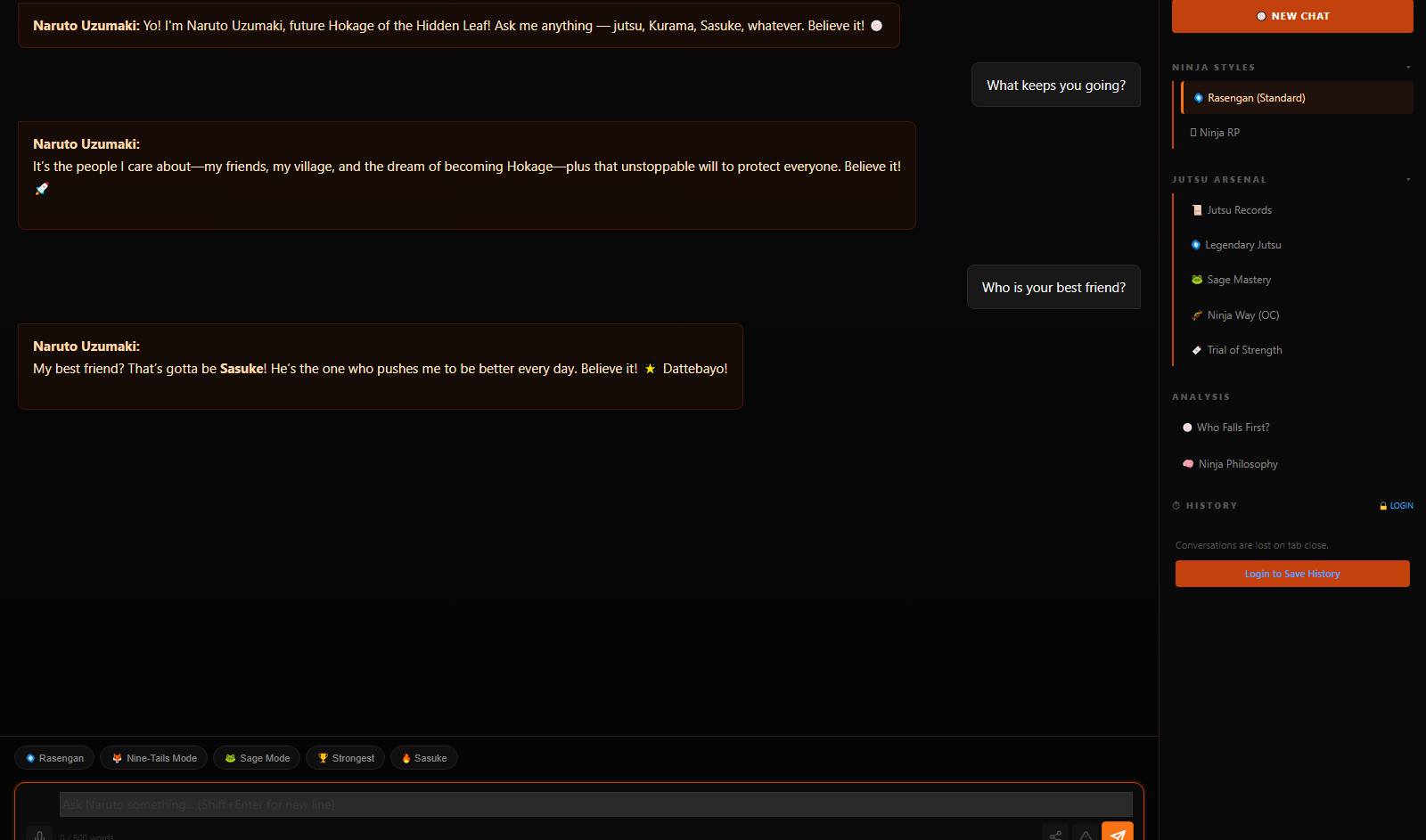
These setups were written to survive a real partner, which is why each one names a specific person rather than a generic enemy. The Naruto Uzumaki AI page holds up well with all of them, and the quality of what you get back tracks almost exactly with how much you gave it. Drop him into a duel with no stakes and you will get a duel. Tell him the Hokage ordered him to lose, name the mask, and put the shame of it in his mouth, and you will get the version of him that sits with it.
Two habits pay off fastest. The first is opening with a place and a time rather than a mood: “Ichiraku after closing, second seat, you already ordered” beats “make this emotional.” The second is giving him one honest line to defend. He will build the next twenty replies around whatever you refuse to let him joke away, and the closer that line is to something he would actually be ashamed of, the better the whole session runs.
And if a scenario stalls, resist the urge to escalate the plot. Something quieter almost always works, and there is a longer version of that advice in what to do when you have no idea what to say next.
Ready when you are
Pick one from the grid, do not pick three. Open the Naruto AI chat, put him in the room, and start with the twenty minutes of nothing. He is much better at the quiet parts than the fights, and most of the scenes people remember later are the ones where he was briefly, and very briefly, not performing at all.
Keep reading