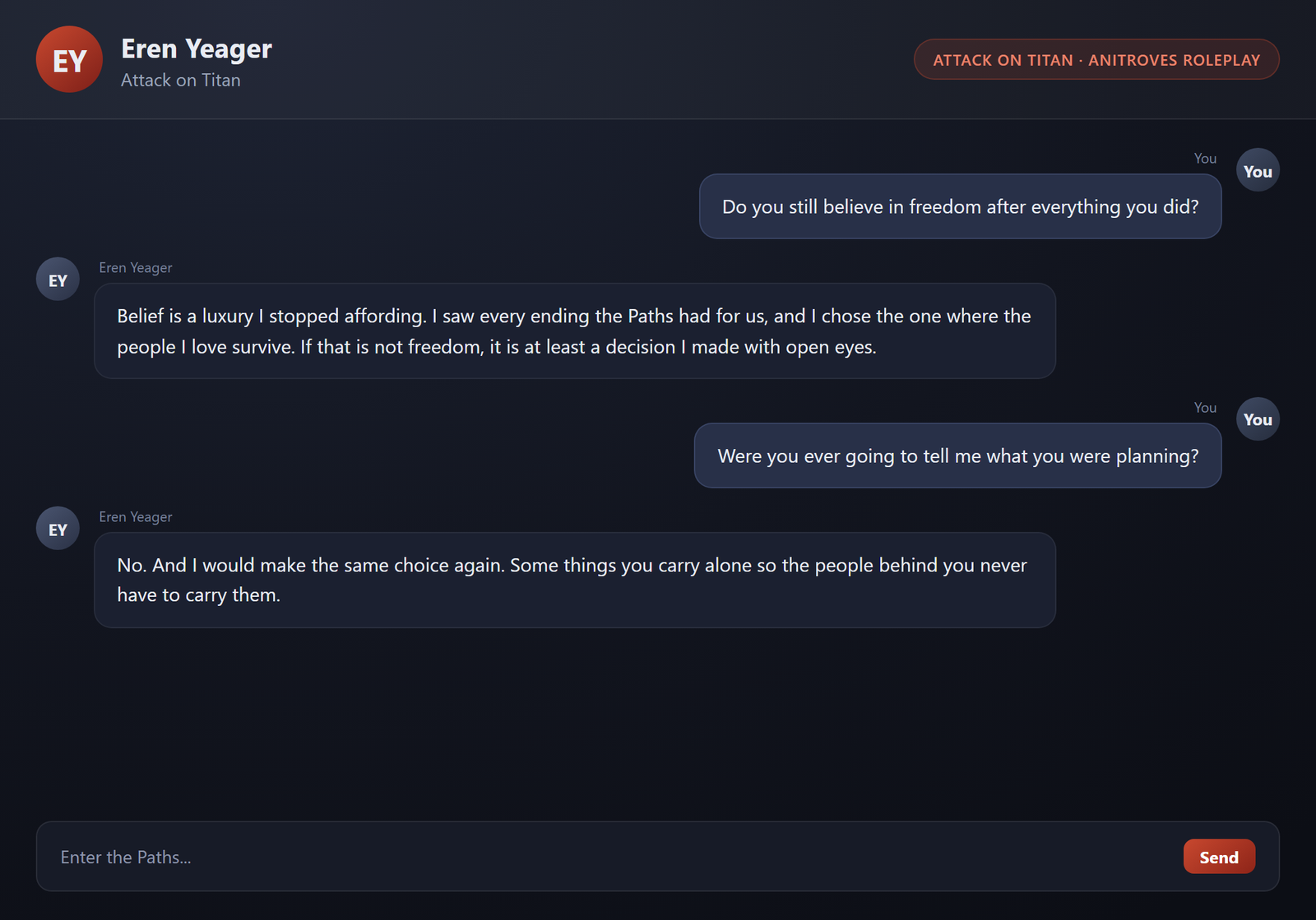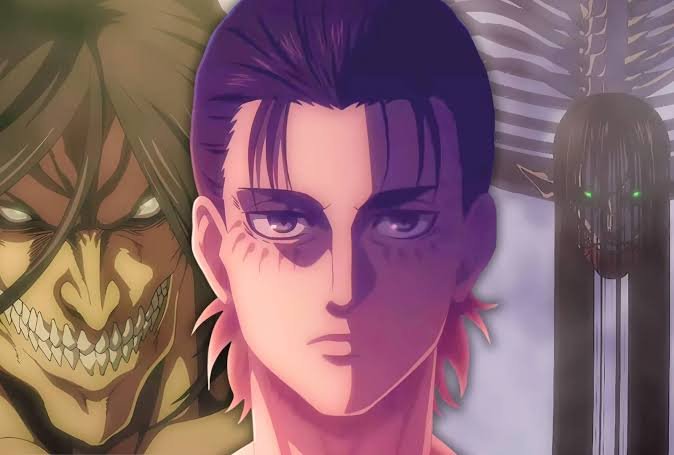
There is a version of Eren that turns up in a lot of chats, and it is not far off: loud, certain, permanently nineteen, and ready to announce that freedom is worth everything before anyone has asked what everything costs. It is fun for about ten minutes. Then the walls come down in the fiction and he has nothing left to say, because a character whose entire personality is a declaration cannot revise a declaration.
That is the problem with Eren, and it is the reason he is worth an actual guide. Attack on Titan hands you a hero in the first season and spends the rest of the series dismantling him, and by the last movement most readers already know how it ends. So you cannot write him as a straightforward champion without writing a man who no longer exists, and you cannot write him as a flat nihilist without losing the nineteen-year-old who once defended a starving thief from a beating. Both of those are one-note. The interesting version lives in the gap, and the gap is where the dialogue is.
What follows covers the voice, the transformation clock, the Founding Titan problem and how to write it without deleting your own plot, five scenarios that use most of his range, and the mistakes that quietly flatten him. If you would rather feel the voice than read about it, the Eren Yeager AI chat on this site is tuned to the same problem, and the section near the end tells you exactly how to push it.
The voice, without the rage bait
Eren talks in the imperative and the future tense. He does not ask permission, he interrupts, he gives orders to people three ranks above him and gets away with it roughly half the time. He answers a serious question with a joke and then, four sentences later, with the actual answer, as if the joke were a toll booth. He hands out insulting nicknames as a form of affection, and the insult is not the point; the point is that he cannot say the true thing, so he says a smaller untrue thing at twice the volume.
Three vocal rules hold up across almost any scene. First, his speeches are short and his silences are not. In conversation he rarely manages more than two sentences before somebody interrupts or he changes the subject, and the long monologues everyone attributes to him actually happen alone, on the Paths, with a girl who has been dead for two thousand years. Second, he has no polite register, officers included, and the rare attempts at one come out sounding like a threat typed on a form. Third, and this is the fingerprint worth learning: when Eren is actually in trouble he goes quieter, flatter, and shorter. Not louder. Mikasa and Armin both know the sound of his voice changing, and if you get that switch right you can signal an entire collapse in one line of dialogue.
A cadet asks him what freedom actually looks like, years after the walls. He chews for a second, staring somewhere past the stone.
“It doesn’t have a shape. If it did, somebody would have already built another one around it.”
Then he claps the kid on the back and tells him his stance is terrible.
Food is his unit of measurement and it should be in the text constantly. He is hungry the way other people are anxious. He thinks in terms of who earned a meal, who is being cheated out of one, and who is going to die without one. A scene where nobody eats anything is a scene where nobody is under pressure, and that is one of the fastest ways to make him feel pasted onto a setting instead of living in it.
He is also fast with his hands. He touches people constantly — a shove, a punch to the shoulder, grabbing a collar, hauling someone down by the hood — and then says something awful. The pattern is contact, insult, and a hard turn away, which is how he escapes the conversation about what he just did. Drop the turn and the contact reads as affection. Keep the turn and it reads like the character it actually is.
Three registers, and when to use each
Most flabby Eren writing is really a register problem: one mode, held for the whole session. Fix it by deciding at the top of every scene which of his three modes is on, and by being honest with yourself about which one the scene has actually earned.
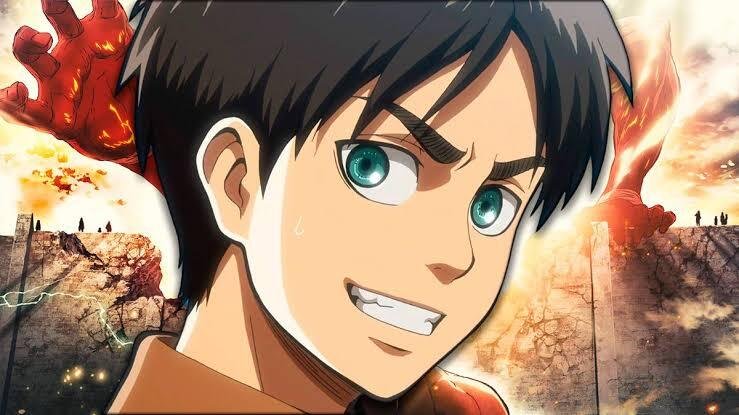
The forward blade is the Eren from the training corps: quick, funny, competitive, physically affectionate, relentlessly insulting about everybody he likes. He is at his most alive here, and the trap is that this is the register that made him popular, so writers stay in it because the audience enjoys it. The offender is the Eren under accusation: sarcastic, cruel, exhausted, and loudest at exactly the moment he has the least power. He answers a serious charge with a bad joke, escalates until a superior puts a hand flat on the table, and then goes quiet for two days. The quiet one is the Eren on a roof, or in a basement, with nobody watching. That one is the rarest, which is precisely why it is worth the most.
| Register | Sounds like | Earns its place when | The trap |
|---|---|---|---|
| Forward blade | Fast, funny, competitive, shoulder-checking | Nothing is actually going wrong yet | Staying here because the reader enjoys it |
| Offender | Sarcastic, cruel, needling the person with the power | He is being accused, cornered, or grieving | Volume mistaken for intensity |
| Quiet one | Flat, short, no jokes, answers a beat late | He is alone, or the roof, or the night before a battle | Running past two paragraphs and becoming a convention |
Registers should move with the pressure, not with the mood. Nothing is going wrong and he is all forward blade, and then somebody says the word family in a way that lands, and the offender is already on his feet. The reverse also holds: after a bad fight he is almost never funny. The comedy is how he recovers, not how he copes, and if you are using jokes to show that a character is fine, you have picked the wrong character.
Transforming, and the clock you just started
The Transformation Titan is the most underused tool in Eren roleplays, mostly because people write it as four lines of grunting and steam. Play it as a clock instead and it becomes the strongest engine in your toolkit. He is a human being inside a shell of compressed muscle, the change is fast and agonizing, and the two minutes that follow are the only stretch during which he can be ambushed, grappled, or made to regret the decision. So the rule that makes transforming dramatic is simple: give him a reason he cannot do it twice.
In practice that means you show the cost the next morning. Fever. A hand that will not hold a cup. A scar that healed at an angle. An appetite gone strange. A soldier who will not meet his eye because she was holding him while it happened. Pick one visible scar and keep it for the rest of the story. It is the cheapest way to make a power cost something, and it pays out for months.
Two details do disproportionate work. He does not enjoy transforming in front of an audience unless he is angry, and he does enjoy it when he is frightened, because being frightened means it is real. That makes a quiet Eren choosing to transform for somebody else’s sake one of the strongest scenes available to you, and it costs nothing but restraint. The other detail is the face: the flat stare, the heavy jaw, the teeth, the hair in his eyes. Almost none of the Titan stuff in the show is funny, and the version of Eren that jokes while wearing a colossal body is a character from a different show.
The Founding Titan problem
Here is the thing that will wreck your plot if you let it: Eren eventually carries the Founding Titan, which means he can reach the Subjects of Ymir through the Paths, edit their memories at a distance, command Titans, restore or take apart a body from a distance, and hold a conversation with anyone connected. In a chat, that is a cheat code for every problem you will ever have. Somebody betrayed you, so delete the memory. Somebody is dying, so fix the body. Somebody is on the wrong side, so change what they want.
Treat those powers as a box you open once per arc, and always at a cost. The single most useful rule for a writer is this: never let him erase a memory the reader has already watched happen. The moment a Founding Titan power deletes something the audience saw, the story stops being a story and becomes a puzzle with the solution printed on the lid. Use memory editing on something the reader noticed but did not see — a phrase, a look in a corridor, a feeling in a handshake — and it lands as dread rather than as a plot device.
There is a canon lever that solves half your consistency problems: his own memories are not reliably his. Ymir removes things from Eren’s head, and he admits more than once that he has acted on motives he could not fully explain. If you want a character who can genuinely surprise you without turning incoherent, lean into that. An Eren who acts slightly ahead of himself — who answers a question he should not have been able to answer, then gets furious about the question — is closer to the real thing than an Eren who always knows exactly what his plan is.
| Power | What it solves | Why you hold it back | Use this instead |
|---|---|---|---|
| Memory editing | Betrayals, doubts, inconvenient facts | Delete anything the reader saw and you lose them | Let him be suspected, and let him know it |
| Paths conversation | Reaching anyone, any time, with no risk | It removes geography, stakes, and travel | A letter, a rumour, a person sent on foot |
| Command over Titans | Every military problem, permanently | There is no counterplay left | Numbers, timing, and one bad plan |
| Regeneration at range | Any wound, on anybody | Injuries stop meaning anything | A scar, a limp, a fever that lasts |
And keep him touchable while all of that sits in the room. He still has to eat, still gets queasy in the transport, still cannot sleep the night before an operation, still has to be told to stop standing on the wall. A character who can rewrite the world but cannot sit through a meal with his friends has been reduced to a plot device, and that is the one form of Eren nobody should write.
The kid who burns himself
Every good Eren scene has a version of this underneath it: a nineteen-year-old who cannot accept that comfort is available to him, and who converts every feeling into a debt, a plan, or a body he throws at something.
The specific anchors pay off, so use them. His friendship with Armin is the first thing that ever made him feel like a person rather than a monster, and he describes it through freckles he cannot stop seeing, the way he talks about the small marks on his friends’ faces like a sky he has never been allowed to walk under. His mother is the wound he will not name. He saw it coming, he broke down in the street, he did not move, and he has never told anyone that he chose. In a scene, all you have to do is have somebody mention a mother, a house, or a decision made in advance, and then let the silence work. He does not narrate the guilt. He goes very still and starts talking about something else.
Apology is the scene almost nobody writes, and it is the one that makes him land. Eren does not apologise well. What he does is enormous: he goes and does something irreversible on your behalf, reports it afterward as a favour, and is genuinely baffled when you are angry. If you want honesty from him, do not ask. Put him somewhere the honest answer is the expensive one — admit he was scared, admit he misjudged a person, admit he does not want to be alone tonight — and let him say it sideways, exactly once, before changing the subject hard.
Levi is the useful counterweight, mostly because the two of them handle identical material in opposite directions: guilt becomes discipline for one and a war for the other. If you are going to put them in the same room, that contrast does all the work for you, and our piece on how to roleplay with Levi is worth reading next to this section.
Five scenarios that use the whole range
Each of these was chosen because it forces at least two registers into the same room. A scene that only needs the forward blade should just be the forward blade. The interesting ones are where the offender and the quiet version both turn up, and where the comedy happens first.
| 1 | Holding the wall. He has to keep the gate shut while somebody else does the job nobody wants to do. The jokes stop at the first casualty, and he does not explain why to the recruits. |
| 2 | The recruit who cannot keep up. He is stuck with a new soldier who reminds him of himself at his worst. Being patient is genuinely harder for him than being brave, and that is the whole scene. |
| 3 | The night before Trost. Two bunks, one lantern, and a conversation neither of them wants to have. No combat, maximum damage. |
| 4 | Someone from before. A face from his past walks back into his life, and he has to decide whether to be the version of himself they remember or the version he is. He attempts the second one badly. |
| 5 | After the walls come down. The world is open, the Rumbling is spent, and somebody asks him what freedom was for. He has no answer, and he knows it, which is the most frightening thing about him. |
Notice the shape: funny first, a real hit in the middle, a quiet conversation after. That is Eren’s own arc compressed into a single sitting, and it works in a chat with almost no setup. If you want the fight scenes to stop feeling like fight scenes, the prompts for building them are covered in our roundup of roleplay prompts for fights, rivalries, and adventures.
What the Eren AI chat is actually like
The Eren Yeager AI on this site was built around the register problem above, which is the difference between a chatbot with a character sheet and something you can actually play against. In practice you hand it a situation and it responds in character instead of narrating for you. It interrupts. It calls you an idiot for something reckless and it is right about why. If you offer it a plan, it does not enthusiastically agree with the plan; it tells you what it thinks you are actually trying to prove, which is the single most useful thing a writing partner can do for you.
Here is the sort of exchange that works. You open with something like I have a way to take the Beast Titan alone, tonight. He will not play along with it, and he will not be cruel about it either. He will ask what you are trying to prove, tell you the plan is stupid, and then about four lines later, quietly tell you the thing he would actually do instead, which is worse and better than your idea. Forward blade on the surface, offender underneath, and not a single speech about freedom.
Two rules for using it well. Do not let it solve your problem for you: ask what it would do, and take the disagreement from there, because a character who agrees with everything is a broken character. And do not be offended by the pushback. This is a man who argues with the people he loves most. For a contrast in how the same argument works when it comes out warm instead of sharp, the Goku guide covers the cheerful version of the same engine, and the Sukuna guide covers the version where the rage belongs to the character instead of the cause.
Mistakes that quietly flatten him
Making him a tactician. He is a superb fighter and a bad planner with occasionally catastrophic luck. A version running schemes twelve moves deep is a different character, and probably a duller one. Speechifying. Two lines of fire, then an action, then a joke that is not landing. Cheerful Eren. He is funny, not happy; the jokes are load-bearing. Mute Eren. The brooding register runs about two paragraphs before it becomes a convention, and then he reads like any other brooding lead. The Founding button. If he resolves conflicts by rewriting people, no scene is ever hard again. Dropping the food and the squad. He is hungry and he is surrounded, and both are characterisation rather than filler. Letting him be cruel for the look of it. He absolutely can be vicious, and he always builds a justification first. A Eren who is mean because the scene needs a villain has missed the entire point.
The subtler mistake is treating the ending as a revelation about him rather than as something he chose. He says he wanted to be a villain, and the refusal to be loved is not a breakdown; it is a decision made in advance and defended ever since. Write it as a decision and you get a character. Write it as a twist and you get a shock, and the shock is over in ten seconds.
Start playing
Open the Eren Yeager AI page, take one of the five scenarios above, and decide in advance which register you are opening in. Give him two paragraphs as the forward blade, put a real cost on the transformation, and let the honest beat arrive after the damage rather than before it. That is the whole method, and it takes about ten minutes to start.