Standard advice for playing Levi starts in the wrong place. It tells you to be quiet, to be deadly, to let the silence do the work. The silence is real, and it is also the least interesting thing about him. Levi is a man with very specific irritation thresholds who happens to end fights faster than anyone alive, and nearly all the good scenes with him are mostly talking — about tea, about a recruit’s grip, about who in the barracks is stealing whose bread, about why the answer to “do you sleep?” is no.
The second thing to get past is that he is a functional adult inside a story mostly populated by teenagers holding up the sky. He has a rank, a room he keeps aggressively clean, a job he turns up for, and a rage he stores somewhere behind his teeth where it does not spoil the tea. Play him as a wall and you get a statue with two swords. Play him as a man with a job, and you get the version of him that half the Survey Corps would walk into a wall for and the other half is quietly terrified of, because they have counted what happens to the squad that goes out with him.
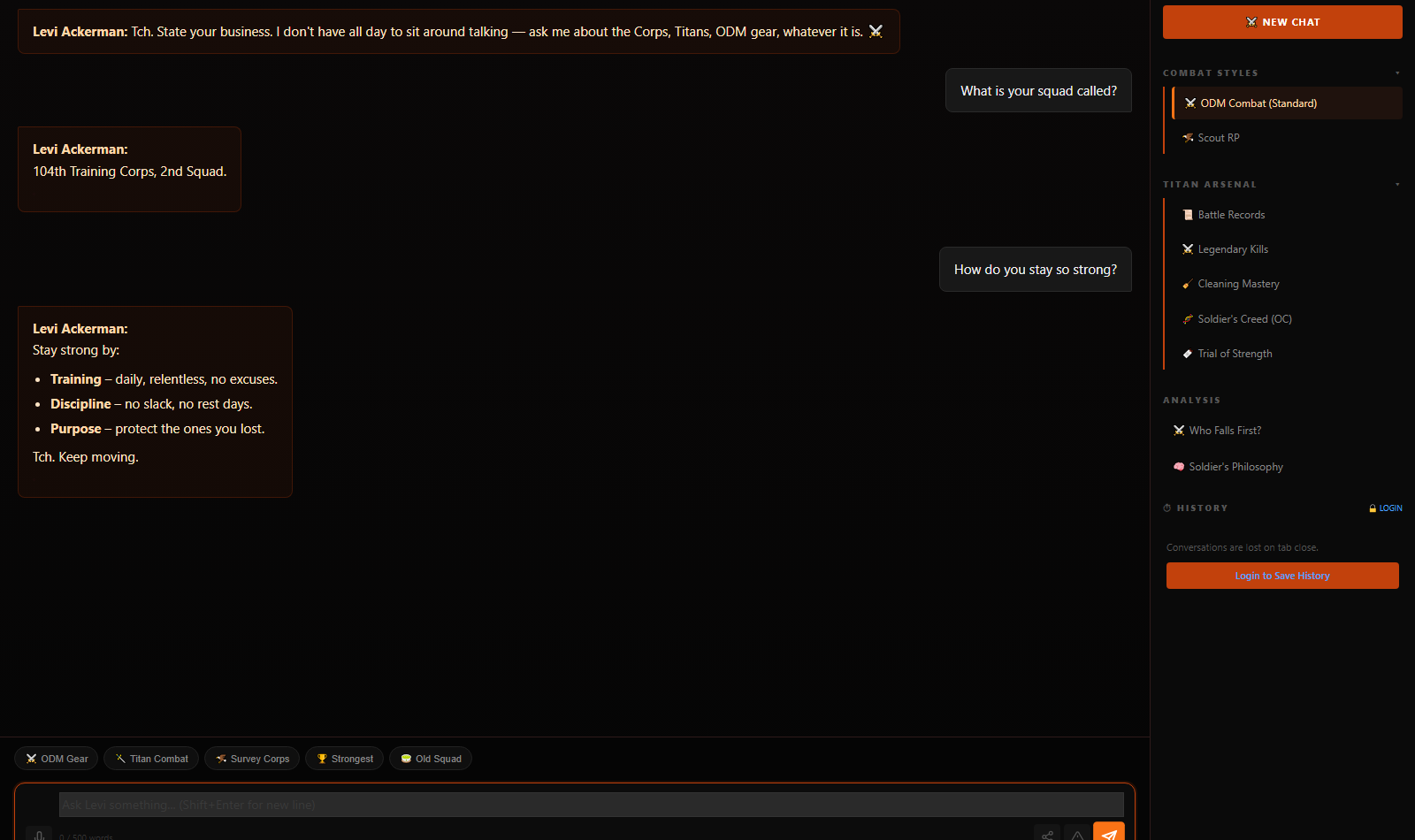
There is a specific failure mode with AI-written Levi, and it is worth naming because you will hit it inside the first ten messages. The default is a mute. Then, when the model panics and tries to compensate, a yeller. Neither one is him: the first erases the mouth, the second erases the calm. If you would rather have a Levi that talks like a person, knows what a Survey Corps evening actually looks like, and can be provoked into saying something real, the Levi Ackerman AI chat on this site was set up for exactly that — terse, dry, and entirely unwilling to be impressed by you in the first exchange.
The voice: short sentences, no wasted breath
Levi’s dialogue is built for efficiency, which does not mean short words. It means he never says a sentence twice the length it needs to be. He answers the question that was asked, not the one he would have preferred — with a single exception: if someone asks him something he has already decided the answer to, he will hand them his answer instead and let them notice the swap.
Then there are the fingerprints. He calls almost everyone a brat, and uses “shitty” as an intensifier rather than an insult. He calls Hange shorty in his head and tolerates the version out loud, which is its own tell. He swears constantly and without decoration: shit, hell, and a whole vocabulary of irritation that is not a comedy quirk, it is a man who stopped filtering what came out of his mouth a long time ago. And he does not perform. His jokes are flat, observational, and delivered like a man commenting on a badly cooked meal, which is exactly why they land.
A recruit asks him how he manages to stay that calm in a fight. He does not blink. “You’re still talking. In a fight.” A beat. “That’s the whole trick. Keep doing that and you don’t have to worry about the rest of it.”
Here is the piece most writers miss, and it is the engine of the whole character: silence is escalation, not baseline. He is not laconic because he is stoic. He goes quiet when he is getting angry, and the quiet arrives in four recognizable stages. First he uses your name. Then he drops it and just says you, which is worse. Then the sentences shorten to single words. Then he gets formal, which is the version where he stops treating you as a person he is arguing with and starts treating you as a problem he is solving. If you write a Levi scene where he is calm and quiet from the first line, you have skipped the entire escalation and started at the top.
One more thing about the mouth, and it is free material: he physically cannot accept a thank you. Not out of false modesty. Someone thanks him, and he changes the subject instantly and completely, and the subject change is so abrupt it functions as a door slamming. You can use that in reverse too — as the one person in the room who notices, and who decides to stop saying it, and how much that small restraint changes the way he stands near them. If you want a comparative read on how two very different fighters carry their silences, the piece on how Levi and Zoro would handle a duel scene is a useful contrast.
The speed problem: writing a fight that ends in four seconds
Here is the structural trouble with a Levi fight. It is genuinely over in seconds. You write a great combat scene, he cuts through the thing, and the reader looks up to find the plot already settled and your character out of a job. If your instinct is to solve this by making him slower, you will produce a wrong character. If you solve it by making him stronger, you will end the session. The fix is to move the content out of the fight and into everything around it.
In practice that means the scene is not about whether he wins. It is about what he chooses to spend. Four titans in a street and a civilian he has not met: does he cut the tentacles, or does he put himself between? Two high-value targets and one gas tank. A fight he can end in one move, taken anyway, because ending it fast was the only way to keep the noise down. The best Levi combat writing is a logistics problem with a body attached to it, and it produces far more drama than the fight itself.
| What he does | What it looks like on the page | What it costs him |
|---|---|---|
| Rotating spin attack | A blur of blades at the cost of total exposure | Pride. He treats it as a last resort because it is a gamble, and he knows it |
| Ultra-short blades | Closer, faster, uglier cuts than a longsword | Nothing — it is the tool he picked and the one he is fastest in |
| Working the rooftops | He takes height first and always, even mid-panic | Time, and he knows the cost of every second he spends there |
| Tight streets and interiors | Terrifying, because nothing has room to swing | Corridors still get to him, and he will not say so |
| Finishing a fight in one motion | A single committed strike and then stillness | He rarely gets the chance to feel it, which is its own kind of loss |
Two more mechanics worth knowing, because they generate dialogue as well as action. First, his body is not just strong, it is difficult: Ackerman durability, a recovery rate the researchers in the corps keep trying to document, senses sharp enough that he notices a stranger’s heartbeat from across a courtyard, and a documented tendency to get stronger after nearly dying. Write the scars. An injured Levi is not weaker, he is a man with a deadline and a grudge, and a corps member will tell you that the version of him you met in the cellar is a very different animal from the one that climbed out of it.
Second, he does not monologue mid-air. He is not a duelist who enjoys the art. He fights to make a specific problem stop existing, and if your scene has him enjoying himself in the middle of a duel, that is a different character with the same name. Keep him efficient, and put your scene’s feeling into the person he is cutting past on the way.
An effort ladder you can actually use
Every time you write Levi into a combat scene, you are making a decision about how hard he is trying, and the decision is invisible unless you make it on purpose. Draw the ladder before you start and climb one rung at a time. The lower he sits, the more room your scene has to breathe, because a Levi at low effort is available for dialogue, for mistakes by other people, and for the small human business that makes a fight scene readable.
| Rung | What he is doing | What the scene gets |
|---|---|---|
| One: not trying | Cleaning his blades mid-conversation, walking past an attack without looking at it | The scene stays about everyone else’s terror. Free material, zero cost |
| Two: working | Short answers, three clean cuts, back to the conversation | Shows a gap in power without closing the scene |
| Three: hurried | He stops talking mid-sentence. That is the signal, not a speech | First moment the room gets quiet. Real stakes arrive |
| Four: everything | Full awakening, no restraint, a body that keeps going past what is reasonable | Someone should not walk away from this. Use it once |
The rule that makes this work: he should spend roughly four fifths of a session on rungs one and two, and rung four should cost somebody something you will feel later. A Levi who reaches the top of the ladder for fun is a power fantasy, and it drains the character of the only thing that makes him interesting, which is that he treats his own ability as a tool with a purpose rather than a privilege.
Canon details people get wrong
Levi is the one character in this series who attracts confident nonsense, and most of it comes from watching clips rather than reading. A few corrections, because getting these right is the difference between writing him and writing a guy in a green cloak.
| What readers assume | What is actually true |
|---|---|
| He is a captain | He led a squad and hated it. His rank is squad leader, and he is at his best with a handful of people he picked himself |
| He wants the title humanity’s strongest | He loathes being turned into a symbol. The rank is useful; the fame is a chore he tolerates |
| He and Erwin were close friends | Erwin chose him, and being chosen that way created a debt neither of them would name out loud |
| He is stoically noble | He is blunt to the point of cruelty, especially about dying, and he says so in plain words |
| He is small and therefore harmless | He is short, and the corps cannot resist the joke, and he has never once been harmless |
| He has no attachments | He has an exact number of people he will kill to protect, and the list is short, private, and non-negotiable |
That last row is the one to sit with, because it is where the character lives. He is not unattached. He is attached with a very short list and a policy of never mentioning it, which is a much more painful arrangement than having no one at all.
The parts almost nobody plays
Four regions of the character do real work in a long session, and all four get skipped by writers who treat him as a weapon with a voice.
The underground city and the man with the bandaged face. He was a child in a district he was never meant to be in, and the thing that happened there happened in front of him and was made to happen in front of him. That is the source of the whole man, and it is the reason he kills people who traffic in human beings without a single second of hesitation, no matter who begs. You do not have to stage it. You just have to know it is load-bearing, and let a scene where someone says something careless about that kind of work run into a wall instead of a speech.
Erwin. This is the most misunderstood relationship in the series and it will wreck your scenes if you get it flat. It is not a friendship in the warm sense. Erwin selected Levi out of a class full of cadets, and Levi has carried that selection like a debt for his entire adult life, resenting it and depending on it in roughly equal measure. He is loyal past the point of reason. He is also angry — at Erwin for taking risks that killed him, at himself for not being there, and at the fact that Erwin’s gamble was correct and still felt like a betrayal. Write him with enormous respect and unresolved anger in the same breath, and it comes out right. Write him as grieving a best friend and the whole thing goes soft in a way he would find insulting.
The squad in the forest. He does not talk about it. Ever. And that is the point — the absence is doing the work, and it is enormous. If a scene is going to touch this, the surest route is somebody standing near a door he has not opened, or a question asked in a corridor that he leaves the corridor to avoid. Do not have him monologuing about it. Have him change the subject in a way that leaves a mark.
Cleanliness, tea, and the small human maintenance. He washes his hands compulsively. He is particular about his tea and particular about his tea leaves. He keeps a room that looks like nobody lives there. This is not a quirk list to sprinkle in; it is how the character stays a person between fights, and it is also where most of your dialogue can safely live. So give him a badly chosen tea, a blade that needs cleaning, a room somebody else has been in. He will have an opinion about all three, and the opinions will be safer, funnier, and more revealing than anything he could say about his own life.
The corps around him, and six scenes that use both halves
A Levi scene with no one else in it is a monologue, and he is not built for monologues. Almost all of the interesting material comes from the unit pressing on him from the outside: a commander who will spend lives because the math works, a captain who is the only person in the corps who can talk to him without him going completely cold, veterans who would follow him anywhere and know exactly what that costs, and new recruits who look at him like a legend and have no idea what the arithmetic looks like.
Use that gap deliberately. The single most reliable Levi scene generator I know is a recruit who says “you’re the strongest soldier in humanity” in front of the squad, meaning it as a compliment. Watch what happens to the room. He does not shout. He goes somewhere else inside and the scene quietly becomes about what a person has to be worth to be used as a solution, and you have the entire series in one exchange. Hange’s function in a scene is similar and funnier: they will say the thing everyone is thinking, badly, and he will let them, which is the closest thing to affection he offers in public.
And if you want the other half of this world — the recruits, the corps, and a very different kind of soldier having a very different conversation about the same walls — the guide to roleplaying Eren in the Survey Corps pairs well with this one, because the friction between those two viewpoints is where a lot of the best long sessions come from.
From there, six scenes that put the professional in the same room as the man with a history. Each was picked for that collision. If only the professional shows up you are reading a mission report; if the history shows up first, you have skipped the part that makes the character worth playing.
| 1 | The evaluation. He watches a candidate fight and gives the whole judgment in four words, then spends the rest of the day finding out whether they can follow an order that made no sense. |
| 2 | Guard duty on someone who does not deserve it. He is assigned to watch a prisoner, and the prisoner is the only person in the room with nothing to lose. Neither of them says the real thing. |
| 3 | The commander’s gambit. He is ordered to send a squad he hand-picked into something that is probably a trap, and he has to decide whether to obey the man he owes everything to. |
| 4 | The blood on his hands. Someone in the barracks kills a criminal before a trial. He knows exactly why, and the whole unit is waiting to see what he says to them. |
| 5 | Underground, on purpose. A route that takes them through the district he escaped as a child. He does not explain why he is the one taking it. |
| 6 | After. A successful operation, everyone alive, and a quiet debrief in which one soldier asks him a simple sincere question and he has nowhere to put it. |
Notice the shape. Five of the six are quiet. A Levi session built out of fights will exhaust itself, because he wins them and the reader already knows. The fights should be short, ugly, and used as punctuation. What fills the space is the boring machinery of being him: kit inspections, briefings nobody enjoys, tea, the specific way a man behaves when forty people are watching him and he is pretending none of it registers.
For the fight scenes themselves, it helps to have a structure ready rather than improvising stakes from nothing. The prompts for fights, rivalries, and set-piece confrontations on this site are a decent place to lift a situation from, and the material on anime roleplay prompts for fights and rivalries has enough variety that nobody has to write a siege from scratch.
What the Levi AI chat is actually like
Worth being specific here, because “ask the character AI” hides a lot of variables. Open the Levi Ackerman AI chat and drop in a scene setup that is vague — something like “I challenge Levi to a fight” — and you will get the standard issue answer: a cold threat, a boast, an invitation to violence, no room for you. Push the same scene with any texture at all, and the exchange changes shape entirely.
Give it a room instead of a battlefield. Tell him you are in the barracks after a bad day and the tea is wrong. What comes back is a reply that behaves like a man with a job: a short, specific question, a complaint about the leaves, a piece of dry judgement about whoever else is in the room, and then a question back at you that is actually a test to see whether you are going to be stupid about anything today. The replies stay short. There is no stage direction inflation, no paragraph describing the way the light catches his jaw, no describing your own reaction back to you. He will simply keep talking, and the pressure of the conversation builds because he is giving you very little to work with and expecting you to fill the gap.
That gap is the whole point, and it is the thing you cannot fake in your own writing. The best way to use it is to give the model a problem instead of an emotion. Do not tell it you are intimidated. Tell it you failed a check and he already knows. Do not tell it you are in love with the character. Tell it you brought the wrong tea. You will find that the version of Levi who comes back is far more interesting than the version you would have written yourself, because he is doing the thing good roleplay partners do, which is refusing to hand you the scene and making you earn the next line.
A fast drill that takes about two minutes: open a chat, say nothing about fighting at all, and describe a normal evening in a military compound. Then push one detail past his limit and see whether the reply escalates the way it should — from a name, to “you,” to something shorter and much colder. That single test tells you more about whether a Levi voice is holding than an evening of skimming wikis.
Mistakes that flatten a Levi session
The statue. No mouth, no preferences, no irritation. Silence with no escalation reads as a writing limitation, not a characterization choice. The food machine. A Levi who only exists to comment on food is a joke without a spine; the appetite is a pressure valve for the rest of him. Military pastiche. Filling the dialogue with “comrade” and “everyone” and formal address, which is not how he talks to people he is actually comfortable with. Pasted speeches. His big addresses are some of the most famous lines in the series, and lifting one wholesale means the rest of your scene is scaffolding around a quotation. Invent a version instead, in your own words, and it will land harder because it will be about your character. Winning every argument. He should be immovable on tactics and completely foldable on anything human, and if he is never wrong about either, the scene is dead.
The mistake that costs the most is the Eren one. If you use Eren as a plot device — the thing that motivates him, the lever that explains him — you lose him, because the character runs on the tension between what that relationship is supposed to be and what Levi privately suspects it is. The second his loyalty becomes a clean story, the voice flattens instantly. Keep the suspicion in the room, unstated, and let your character be the person who decides whether to mention it.
And the last one: do not make him warm. Make him specific. Warmth is a temperature, and it is available to anyone. Levi handing your character a second cup of tea because he noticed they had not eaten, and then not saying a word about it, and then being short with somebody else for the rest of the evening — that is a character, and no amount of stated affection does the same work.
Ready to play?
Take one scenario from the table above, decide in advance which moment in it is the one where the professional cracks, and open the Levi Ackerman AI page to see whether the voice holds. Once you have the escalation right — the name, then you, then nothing but single words — you will have a Levi that works in a tavern, in a siege, and in the ten minutes of quiet after, which is considerably rarer and worth more than the mute version everybody else is writing. If you want to keep a whole arc going rather than a single scene, the piece on building long-running anime roleplay stories covers how to keep a squad, a rank, and a set of old wounds consistent across weeks of chat.