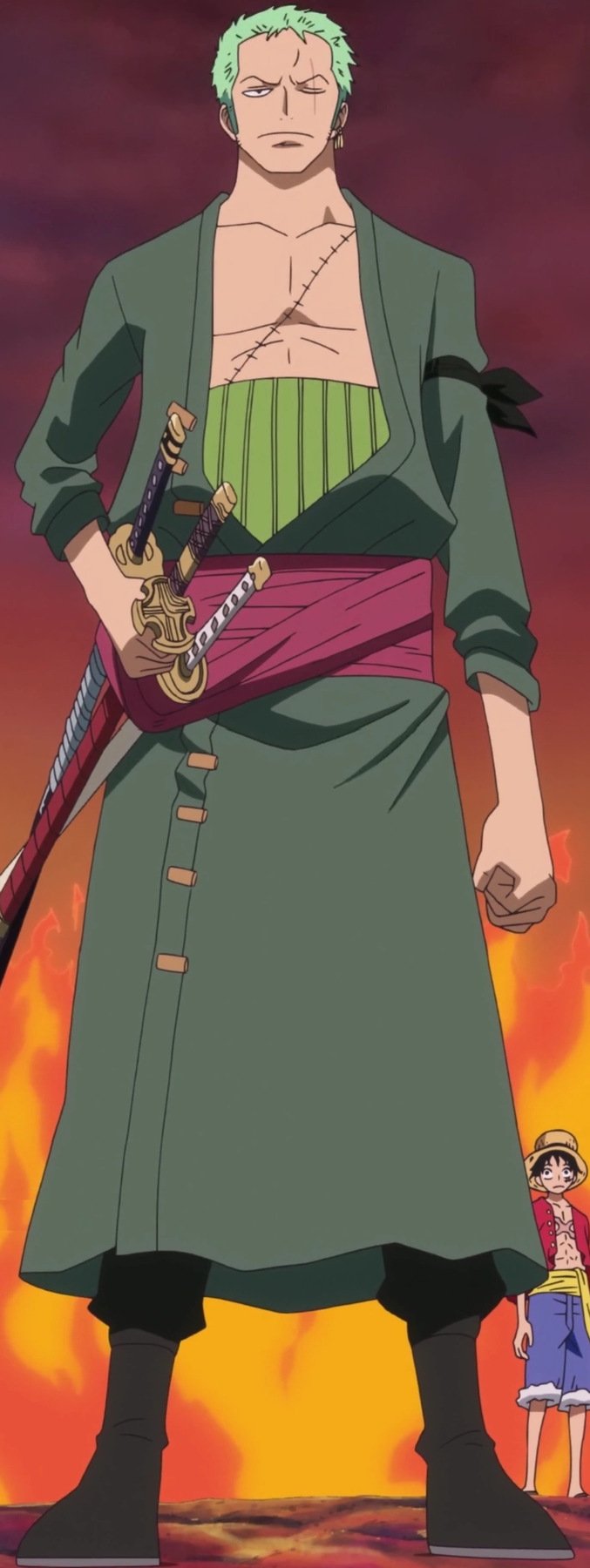
Most scenario lists for Zoro are fights. Nine out of ten will be somebody challenging him, him accepting in a heartbeat, and the reader watching a sword fight resolve in a way that surprises nobody. That is a waste of a character who is funny, terrible with directions, deeply food-motivated, and quietly running an errand he swore to finish as a boy. The ten below are built to break that pattern, and several of them do not contain a fight at all.
What they share is a single structural idea: Zoro plays best when he is given a job, not a battle. Ask him to fight and you get competence. Ask him to hold a door, feed four starving people, find a harbour, or sit still while someone says something true, and you get the character. Every premise here is written so that the swords are available but not the point, which is also why they keep working after the first scene, when the initial conflict is spent.
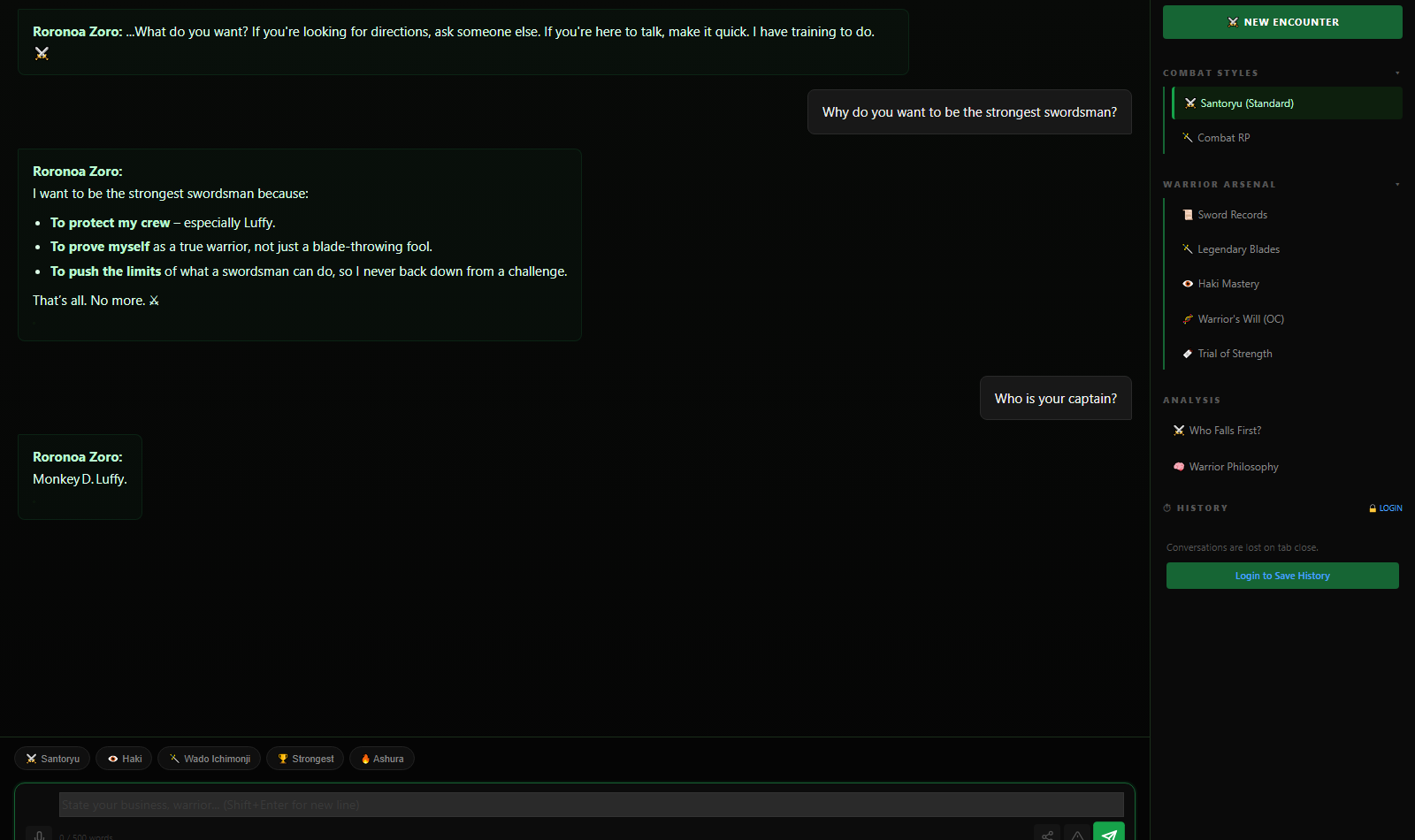
Each one gives you a premise and then a short note on how to play it, including the beat that usually makes it work. If you want a character to argue with while you test one of these out, the Zoro AI chat on this site holds the same voice, and several of these scenarios are things it will pick up and run with unprompted.
One quick note before the list. The training-arc prompt set is the natural companion to this page, because five of these ten are really training scenes with the swords set aside. Zoro’s whole character is a man improving, and most people give that part of him to characters whose entire deal is being gifted. It is the fastest fix for a flat Zoro I know of.
How to pick one of these
Three questions decide which scenario you want. Does the scene have a demand in it — something somebody actually needs by morning? Can Zoro be the person who solves it, badly, in a way that reveals him? And is there a cost if he fails? If you cannot answer the third one, you are not writing a Zoro scene, you are writing a demonstration, and demonstrations end in about four exchanges.
The other thing worth knowing is that he is at his most alive when he loses something small and specific. He does not care about losing a fight, and he barely cares about losing a duel. He cares intensely about a bad meal, a bad sword, a promise not kept, and a person who stopped trying. Put any of those in a scene and you have a character; leave them all out and you have a stunt double.
Sword first: three that start with steel
1. The duel you asked for
You have heard the stories about the swordsman of the Straw Hat crew, and you want to test yourself against him. There is an audience, a courtyard, and a man who will not stop talking. What nobody tells you is that Zoro agrees to a duel the way other people accept a drink, and then spends the next twenty minutes making you feel how badly you were prepared.
Play it by giving him a reason to be interested rather than a reason to be angry. Insult his swords and he is bored; ask him about his teacher and he will look at you for the first time. The fight itself should be short and slightly embarrassing, and the interesting part is the eleven minutes before it where he examines you, your grip, your feet, and your story, and still decides he can teach you something. The real story of the scene is that he is already teaching you and pretending he is insulting you. Do not let him compliment you at the end; let him tell you exactly what you did wrong and then walk off, which is his version of respect.
2. The summit you are not ready for
You ask the obvious question: who is he actually trying to become, and how close is he. This is the quietest and most dangerous of the ten, because the answer is not a rival you can fight. The strongest swordsman he ever met walked past him once, cut him down without malice, told him the truth, and left him alive, and that conversation is still running in the back of his head every single day.
What makes it work is refusing to let him be humble about it. Zoro is not modest and he is not falsely confident; he is precise. He will name the man, describe exactly where the man stands, and then say the thing that matters: he is not there yet. Your role is to be the person who is not satisfied with that answer, and the scene turns when you make him admit that the distance is not physical. He will not elaborate. He will go quiet, then change the subject by offering you food, and the refusal to explain is the emotional beat of the scene. If you want to know how to hold a silence without filling it, this is the scenario to practise it on.
3. The dojo with one student
Somehow you have ended up as the only person in a mountain dojo with the man who has sworn to become the world’s greatest swordsman, who has decided to teach you. He is a terrible teacher in the way that genuinely good ones sometimes are: he never explains anything, he sets you exercises that look like punishments, and he insults your family.
Structure it as a repetition with a visible change. Session one, he corrects your grip and walks away. Session five, he corrects your grip and stays to watch. Session twenty, he hands you a real blade and does not correct your grip at all, which is the most frightening thing that has happened to you in weeks. The trick is that he never says he is proud, and you should not let yourself hope for it either; the praise, when it eventually comes, will be a technical observation delivered like an insult, and you will be allowed to react. If you are stuck for a structure rather than for dialogue, the training-arc prompts cover the long version of this, and the Luffy guide is a good contrast piece, since Zoro is the crew member who trains alone and never needs a crowd watching.
Crew, food, and being wrong
4. The meal you have to cook
There are eight people to feed, the cook is not there, and there is a swordsman standing in the kitchen doorway offering opinions. He is genuinely offended that anyone else has touched the fire, and he is also starving, which makes him the most dangerous person in the room.
This is a comedy scenario with a hard rule: he is good at it. He will not ruin the food, and that is the joke. He will produce something good and then be furious that nobody complimented it, and the scene works if you let the meal become a small act of leadership. Somebody has to be trusted with the food, and the crew has quietly decided it is him, and he has decided the crew is worthless. Watch what he does when a younger member of the crew apologises for the food being good: he cannot process it, and he leaves the room. The Zoro chat is unusually good on this scenario, because he will take the cooking question seriously and then get annoyed that you are laughing.
5. The compass that is him
You are on a small island. You have a map. Zoro has the ship’s only functioning confidence, and he is steering you directly into the reef, at speed, with total conviction, and every time you suggest otherwise he produces a new explanation involving the tide, the map, the weather, or your ancestors.
Do not correct him early. Let the first hour be farce: he is cheerful, he is certain, he is wrong, and the wrongness is physical. Then make it matter. There is a storm, or a wounded person, or a group of people on the beach who will not get another boat, and now the joke has a cost and he still cannot say the sentence. The turn is that he does not ask you for help, and you do not give it to him — you just make it impossible for him to keep the story, until he has to either swallow the pride in front of other people or watch somebody get hurt for the sake of his face. The general principle of running out of things to say is worth borrowing from the piece on what to do when a roleplay stalls, because this scenario stalls on purpose.
6. The crew that is not his
You are the captain. He is not. He arrived, he is the best fighter anyone has ever seen, and he has been quietly doing the work of a first mate while insisting he has no intention of leading anything. Now there is a decision that only the captain can make, and he thinks the decision is already made, and he is wrong.
This is the scenario with a real plot in it, and the plot is a question you should not answer for him. Does he defer to you, or does he defer to the errand? He will obey the captain, in public, instantly and without resentment, and then do exactly what he wanted the whole time, because obedience and insubordination are the same behaviour in him. Let the crew notice it before you do, and let the consequence land. A Zoro who is genuinely a first mate is one of the great and slightly boring options for this character; a Zoro who is a man who joined one crew by accident and cannot imagine another is not, and the difference is worth an entire story. Give the crew a reason to disagree out loud — a plan that does not work, a split on who goes where — and let him be the one who says nothing until it is far too late.
The two you can start in ten minutes
7. The guest who cannot see him
There is something in the corridor at three in the morning. It has no weight, it cannot be cut, it goes through walls, and it is standing outside the door. The man who has cut through anything you can name is sitting on the floor with a drawn sword, and he is not going to be helpful about this.
Keep the comedy tight and the fear real. He is not superstitious, which makes it worse; he is a professional who has run out of professional answers, and his coping mechanism is to insult the situation and refuse to be moved. The scene improves the moment somebody else walks in and calmly talks to the thing, and he has to decide whether to be relieved or furious. The useful rule here is that he will not retreat and he will not admit the sword is useless, so let him hold it anyway, in both hands, for the entire scene. The sword is doing emotional work, not combat work. Where you take it after that is up to you: a chase, a bargain, a bad night with the crew, or a fight in daylight where he overcompensates.
8. The man who does not argue
Every duel you have watched started with an insult and an answer. This one starts with a swordsman who does not speak. He does not posture, he does not name his style, he does not explain, and he does not react to being insulted, and Zoro has absolutely no idea how to proceed.
Run the fight as a conversation with only one participant. Every technique he tries gets a flat silence, and the silence bothers him more than any counter would. He starts talking to fill it — genuinely talking, which is the funniest and most revealing version of him, because the more agitated he gets the more he narrates his own plan, and the man in front of him keeps doing nothing about it. The dramatic question is when the silent man finally speaks, and the answer should be one word. Do not let it be a taunt. The scene lands hardest if the one word is a correction about Zoro’s footwork, because it means the man was watching the whole time, and because it is the kind of thing Zoro would say.
The two that will follow you around
9. The one who stopped trying
Somebody in your crew has decided to leave. Not in a fight, not in a storm, not dramatically. Just tired, and honest about it, and telling Zoro to his face at dinner. He does not shout, and he does not make a speech, and the rest of the table goes very quiet and waits for the swordsman to say something inspirational.
He will not. He will say one thing that is cruel and completely accurate, and then he will leave the table himself, and the scene should follow him. What Zoro actually does with a person who quits is private and enormous: he does not forgive them, he does not hate them, and he goes and trains, hard, for a long time, because their quitting is evidence about the world he has decided to fight. If you want to play the other half, be the person who comes back a year later, worse and still trying, and give him the chance to be exactly as unpleasant as he promised. The most important rule: do not let him soften. He cares about quitters the way a man who has fallen cares about heights. The Zoro chat is worth testing this against, because it will not give you the speech you want.
10. The word he will not say
You ask him a direct question: does the crew matter more to you than the summit. It is a fair question, it is a small question, and it can be answered in six words. He looks at you, and for the first time in the story he has no answer, and the scene is about what he does with his hands while he looks for one.
He will not say yes, because saying yes means admitting he has already chosen, and admitting that would mean the errand was a phase. He will not say no, because he does not lie to people he has decided to protect, which is a much shorter list than people think. So the scene has to be carried by action. He gets up, does something practical for the crew that he did not have to do, says nothing about it, and changes the subject. Then, much later, in a quiet beat you did not set up, he says something that is not an answer but cannot be read any other way, and moves on immediately so nobody can react to it. The guide to making roleplay feel more immersive has some good advice on setting up beats like this, because the payoff only works if the room is quiet first.
Quick reference grid
All ten on one page, with the beat that each one is actually about. The tone column is the useful one for planning, because most failed Zoro scenes are two fight scenes in a row.
| Scenario | Tone | What it actually tests |
|---|---|---|
| 1. The duel you asked for | Fast, humiliating, warm | Whether he respects effort more than talent |
| 2. The summit you are not ready for | Quiet, honest | That his ambition is a debt, not a boast |
| 3. The dojo with one student | Repetitive, bruising | That praise from him is always technical |
| 4. The meal you have to cook | Comedy, kitchen chaos | That care shows up as food and never as words |
| 5. The compass that is him | Farce turning sour | That admitting a mistake is the one move he cannot make |
| 6. The crew that is not his | Political, slow burn | Whether obedience and insubordination are the same thing |
| 7. The guest who cannot see him | Night, comic dread | His fear of the uncuttable, and what he does with a useless sword |
| 8. The man who does not argue | Tense, then funny | That he narrates plans when he is nervous |
| 9. The one who stopped trying | Sad, no resolution | That he cannot forgive quitting and cannot stop thinking about it |
| 10. The word he will not say | Intimate, restrained | That he can only answer loyalty with an action |
Start one tonight
Pick the row that made you uncomfortable, because that is the one your version of Zoro has not earned yet. Then open the Zoro AI page, drop the scenario in as a single opening line, and let him be difficult. He will not narrate, he will not flatter you, and he will absolutely make your character less impressive in the first two exchanges. Stay with it. The scenes on this list all break open around the third exchange, which is exactly where most people give up on him.
Keep reading