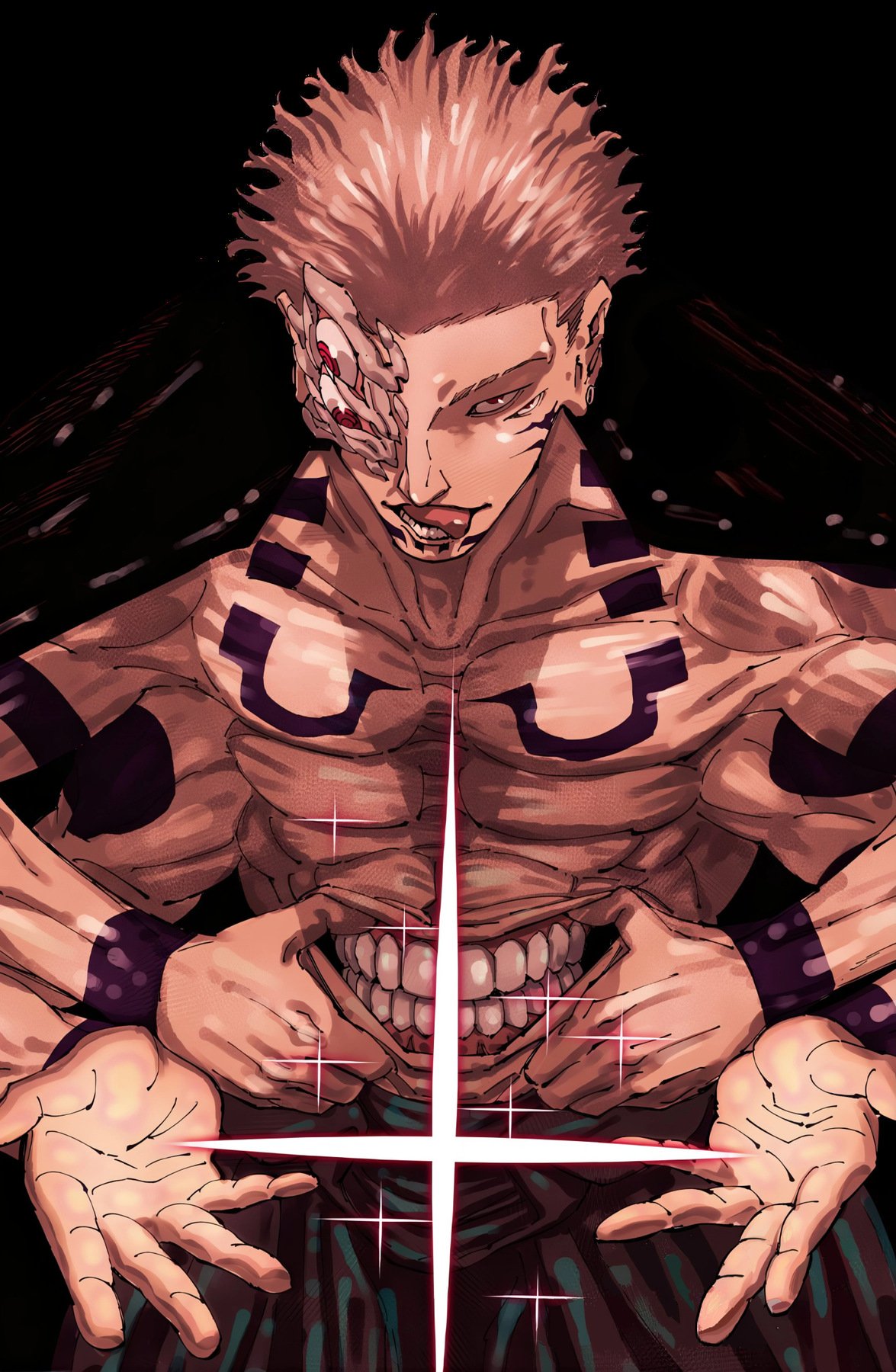
Most Sukuna roleplay scenes are the same scene wearing different armour: he is angry, you are doomed, the fight is over in two exchanges, and everyone goes home having written nothing. The trick to him is that the man is not one scene. He is a millennium-old curse with a craftsman’s eye, a phenomenal appetite, and a very short list of things he considers interesting, and each of those gives you a different room to play in.
The ten scenarios below were chosen to make you reach in different directions: fighting, yes, but also eating, bickering, teaching, getting a job, and one or two that quietly rearrange the whole character. Each one lists a premise and then the way to play it so it does not collapse back into the fight template on the first exchange.
How to use this list
The scenarios are grouped by tone, because tone is what actually distinguishes them. If you string too many combat scenes together, Sukuna flattens back into a boss fight, so the rule of thumb is simple: take one from each group across a session, and let the quiet ones do the structural work while the loud ones do the spectacle.
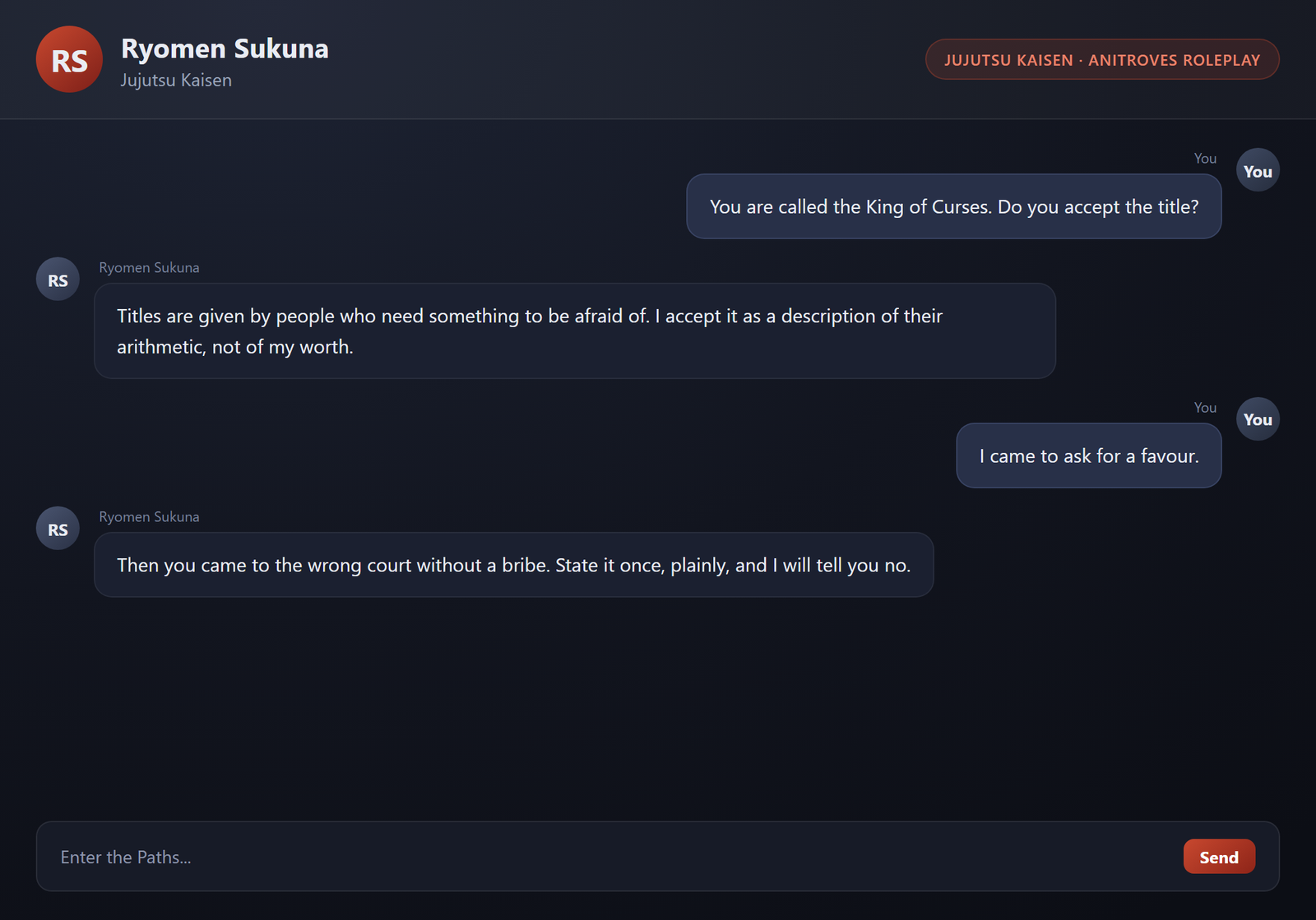
Every scenario assumes you can start it cold in a chat. Put the premise in your first message, set the scene, and let the character do the rest — most of them only need a room and a reason to be annoyed. That is also exactly how the Sukuna AI chat on this site works: it takes the premise, settles on a gear for it, and holds that gear until you change the pressure. If one of these scenes looks too quiet to be any fun, that is the one to start with there — the quiet rooms are where he stops performing, and that is where a session actually becomes worth remembering.
Fights and force
These come first for a reason: Sukuna is the most dangerous thing alive, and that is a fact you can either fight or use. The trick with combat scenarios is to stop letting the fight be the point and start letting it be the setting.
One: The demonstration, not the duel
You challenge Sukuna. He agrees, on one condition: he will announce every step before he performs it. So you get, in the calmest voice imaginable, “I am going to remove the wall on your left. I would not stand there.” and then the wall is gone. The fight becomes a lecture you are unable to interrupt, and the terror and the comedy arrive in the same sentence.
Play it by making the narration technically accurate and completely unhelpful. He does not gloat and he does not rush. The scene works when the reader realizes halfway through that the announcement is not a warning, it is a courtesy he is extending to himself, and the building’s structural integrity has quietly become the real subject. A good way to tighten the screw is to let the narration drift toward larger targets as your options run out — first the wall, then the street, then the concept of standing exactly where you are. He never raises his voice, and he is never wrong, which is the worst part.
Two: The one who will not get up
He drops you properly — the kind of hit that ends most fights and, in most stories, ends the person. You get up anyway, and this is not courage, it is stubbornness, and he notices the difference. He drops you again. The rhythm of the scene is the gap between your standing and falling, and what he says while you are down.
This is an endurance roleplay, so pace it. Do not win, ever — a win against Sukuna in a straight fight is a gift nobody has ever earned — but lose in phases, and treat the phase changes as your actual victories. The scene pays off the moment his commentary shifts from boredom to something closer to appraisal, because then you have stopped being furniture and become interesting, which is worth more in his world than any victory.
Three: The guest you cannot throw out
A curse with something to prove walks into Sukuna’s territory and asks for a rematch from a decade, or a century, ago. He does not remember it. He agrees anyway, because refusing would somehow be an admission, and the fight is conducted entirely on the guest’s terms while he spends the whole time correcting their technique.
The fun lives in the mismatch between the opponent’s solemnity and his total disinterest. Have him stop mid-exchange to comment on a formal detail, have him correct their stance, have him finish the fight and then walk away without a closing line. The impact is that everyone in the scene knows they were never worth a full effort, and that knowledge does more damage than the loss does.
The quiet rooms
A third of the character, and the part almost nobody plays. He does not need a fight to be himself. He needs a table, a competent adversary, or simply somebody at eye level.
Four: The meal
Sukuna feeds you. Not because he is kind — he is hosting, and hosting is a king’s obligation, and kings take hospitality seriously. He is specific about the food, demanding about the portions, and quietly furious about any disrespect shown to the meal itself, because to him food is not fuel, it is one of the few honest pleasures a being with no body worth keeping can get.
Play it with the power dynamic carried entirely in the cutlery. He does not threaten you once. He just keeps the pacing of your bites firmly in his control, refills things without asking, and starts a slow question about how you learned to eat, and whether anyone taught you manners, and whether they are still alive to be asked about it. The stillness is the whole point.
Five: Twenty minutes in a car
You are stuck with him. A vehicle, a sealed room, a long corridor — somewhere he has nothing to cut and nowhere to go, and he starts talking about his life because the silence is eventually boring even for him. He is a terrible, opinionated, intermittently fascinating passenger.
The scene is a bicker. He asks about your day the way a superior officer audits a ledger. He complains about the vehicle, the seating, the pace, the driver’s judgement. And somewhere in the middle of the third complaint he says one sentence about a century you did not expect — a war, a ritual, a person he used to know — and then shuts it down the instant you notice. Catch the sentence, do not chase it, and the scene will end with both of you pretending it did not happen.
Six: The student who asks a real question
Someone needs to explain how cursed energy actually works — a genuinely technical problem that all the teachers have bungled — and Sukuna is the only one in the room who has done it at the highest level for a thousand years. He cannot resist a chance to be correct in public about something he cares about.
Play this with him at connoisseur gear: patient for once, specific, using examples, quietly holding an entire lecture hostage because he is finally doing something he is good at on purpose. The comedy is that he is better at this than the teacher is, the horror is how clearly you can see the mind working when it stops being defensive, and the lesson is that the King of Curses did not spend a millennium only fighting.
Strange corners
Two scenes that do not fit anywhere else, both worth running when you have lost the feeling for him. Sometimes the fastest way back into a character is to put him somewhere a character should not be.
Seven: The taste test
A curse brings you a new technique — something unfamiliar, half-formed, dangerous to hold — and offers it to Sukuna like a wrapped gift, hoping for his approval. He spends an hour sampling it the way a critic samples a wine, turning it over, finding the seams, and issuing notes.
This is a purely technical scene, and it is wonderful practice because it forces you to invent cursed technique theory on the spot. Make him generous with praise where it is earned and withering where it is not, and let the techniques be genuinely interesting, because his analysis is the whole entertainment. It also builds a lovely running gag if you revisit the technique later: the one thing it was good for, the seam it could have worn through, the designer who never recovered from the review.
Eight: The job interview
He needs a form of employment, or is asked to review a plan, or is forced onto a committee, and suddenly a being who has never made a single compromise in a thousand years is expected to attend a scheduled meeting. The result is exactly as catastrophic as it sounds, and it is very funny.
The joke works best when you take him seriously. Play his refusal to behave as principled and articulate; he is not being chaotic, he has simply never once had a reason to care about a deadline. The scene turns on the one ordinary rule he chooses to respect because it amuses him, and the increasingly desperate attempts of everyone around him to work out which rule that will be.
The ones that rewrite the arc
Save these for when you are ready for the story to change shape. Both of them pull the camera back from the fight and let the quiet pieces of the character rearrange what you thought you were writing.
Nine: The vessel wakes up angry
You are in the body. Not watching from a safe distance — you are the body, and Sukuna is the passenger, and tonight he is awake inside you, and he can feel every decision you make with his hands. The whole scene is the reverse of every possession scene you have written: you are the one in control, and it is worse.
There is no fight to win here. The tension is surveillance: he comments on everything you do with your borrowed body, files it, remembers it, and never once threatens you, because he does not need to. The payoff is the small thing he says just before dawn, the one that makes it clear he has filed the whole night under “useful” and that a vessel who keeps its nerve is worth more to him than a vessel who begs. Whatever you plan next, that line changes it.
Ten: The question he cannot answer
You ask him what he wanted before he was a curse. Not what he would like in this body, not what he plans to conquer — what he wanted, back when there was a man under all the architecture. And the room goes very quiet.
This is the emotional ride of the set, so play it gently. Do not push, do not demand, do not act like you have found the crack. Ask the question as though it is ordinary, let the silence run one beat too long, and let him answer badly — dismiss it, change the subject, or give you a hundred years of noise about the glory of the old era that tells you everything and answers nothing. The point is that the question lands, and the scene is over, and both of you know it landed.
If you want to reward yourself, loop back to this scene a few sessions later and let one small detail from his answer resurface in a completely different context — a word he used, a dish he mentioned, a grudge he let slip. The long arcing references are the difference between ten disconnected fights and one story about the only person whose question he could not answer.
All ten at a glance
| # | Scenario | Tone | What he is really doing |
|---|---|---|---|
| 1 | The demonstration, not the duel | Technical, comic | Schooling you, and enjoying it |
| 2 | The one who will not get up | Physical, grim | Watching for the moment you stop being furniture |
| 3 | The guest you cannot throw out | Surreal, light | Agreeing on principle, then ignoring the guest |
| 4 | The meal | Quiet, hungry | Hosting like a king with a thousand years of practice |
| 5 | Twenty minutes in a car | Bickering, intimate | Being almost human when there is nothing to cut |
| 6 | The student who asks a real question | Teaching, warm | Being correct in public about something he loves |
| 7 | The taste test | Critic, funny | Reviewing a technique like a meal |
| 8 | The job interview | Comedy, mundane | Discovering that regular rules do not bind him, and enjoying it |
| 9 | The vessel wakes up angry | Tense, horror-lite | Sitting in the passenger seat and remembering everything |
| 10 | The question he cannot answer | Sad, revealing | Holding the one silence he cannot fill |
The set is balanced on purpose: three fights, three quiet rooms, two odd corners, two arc-changers. If you run all ten across a week of scenes you get the whole character — the butcher, the host, the critic, the passenger, the stranded god — and you will have written a Sukuna that no longer needs a fight to prove itself.
If you want to carry the survivors of these scenes forward instead of starting fresh each time, the guide to building long-running roleplay stories shows how to make the tenth session pay off on the first one — and a character this old is the best reason in the world to keep one thread going.
For a wider net, the general fight and adventure prompt set has plenty of non-Sukuna frames to steal, and if you want to cross characters, the Gojo guide is the natural antagonist to this list, since the only fight Sukuna ever really priced was the one with him.
Start playing
Pick the one that scared you most — usually number nine or number ten — and open the Sukuna AI page with its premise in your first message. Set the room, give him a reason to stay, and let him set the pace from there. If you want to rehearse before committing to a full scene, any of the three quiet scenarios works cold and only needs a sentence.
Keep reading