

The first ten minutes of a roleplay decide whether there is a second one. Not because the opening line has to be brilliant, but because the opening has to tell the character what kind of scene this is. Hand a character AI a mood and it gives you atmosphere. Hand it a person, a place, and a pressure, and it gives you a scene. Everything below is about that transfer, plus how to steer once the scene is running.
There is a version of starting that does not work, and almost everyone tries it first. You open the chat, type a greeting, get a charming reply, and then have absolutely no idea what to type next. Twenty minutes later the tab is closed and the feeling is that the medium does not suit you. The problem is not the character. The problem is that you arrived without a want.
If you want the reasoning behind this whole craft, start with what anime AI roleplay actually is. If you already know the theory and want the mechanics, stay here.
Choose the character, not the power
Beginners pick the strongest character they can find, on the reasonable assumption that more power means more fun. It usually means a fight that ends in four exchanges. Power removes problems; personality creates them. The character you want is the one whose behaviour annoys you in a way you can answer.
That is a testable question. Finish this line about the character without pausing: “The thing about him is that he…” If the answer is a trait, keep looking. If the answer is a behaviour with a cause behind it, you have found your partner. Levi cleans. Not because he is fastidious, but because the character cannot stop himself from making a space small and owned, and the order is the only thing he has that is his. Vegeta refuses help. Not out of stubbornness in the abstract, but because accepting help means admitting he needed it, and he has built an entire identity on not needing anything.
Behaviour with a cause gives you a scene generator, and that is the whole game. Pick the character you have an argument with, not the one you admire from a distance.
| What you want from a session | Who to start with | Why it works on message one |
|---|---|---|
| Fast, funny, no prep | Goku, Luffy | Both escalate for free and reward any energy you bring |
| Sharp banter, he out-thinks you | Gojo, Sukuna | They answer questions with questions, so you are never idle |
| Real interiority, slower burn | Itachi, Eren, Madara | The tension is ideological, so you can talk instead of fight |
| Pressure with a body count | Levi, Obito, Zoro | They act on a clock, so every scene has a deadline |
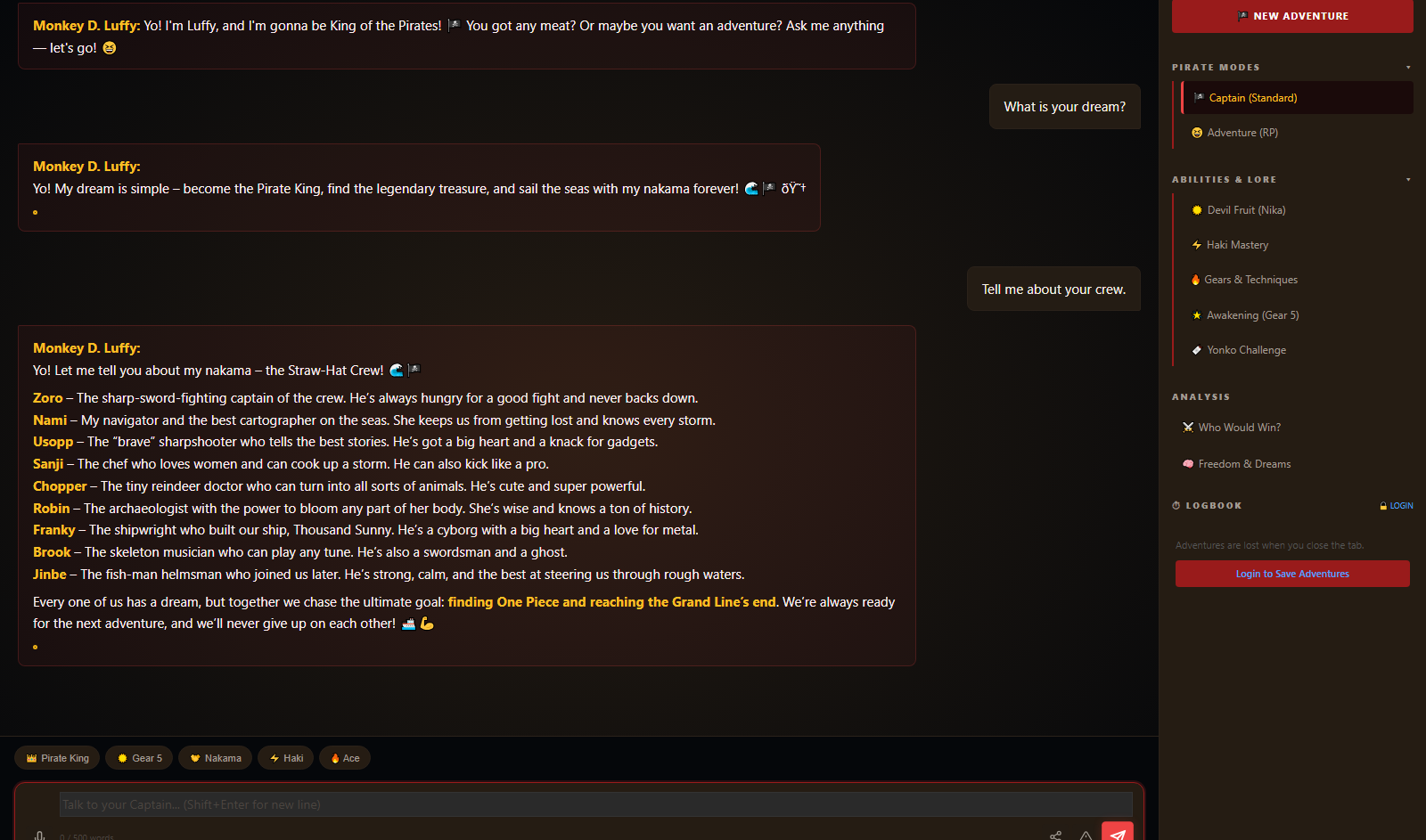
One exception to the rule: if you are brand new to this, take the easy win. The Luffy AI is close to impossible to stall, because he has no patience for subtext and will drag your character into the water whether or not you planned to go in. Learning the mechanics of a roleplay is much easier when the other side is cheerfully ignoring your pacing.
The one-line job of your opening message
Your first message does one job: it tells the character what kind of scene this is. Everything else is optional. That is a hard thing to internalise when you are used to writing prose, because the instinct is to set the weather, the time of day, the camera angle, and the emotional temperature of everyone in the room.
Look at the difference.
Weak: It is a cold night on the roof of the dormitory. I sat there thinking about everything that had happened, and about the person I had failed. I wondered whether any of it had been worth it.
That is a mood with a person in it somewhere. Now the version that actually starts a scene:
I have been on this roof for two hours. I came up here to decide whether to tell you what I did, and I already know I am not going to. So instead: are you going to make me talk about the village, or are we going to pretend the last year did not happen?
Same mood, same melancholy, but now there is a question, a refusal, and an unstated thing the other person is not supposed to raise. A character can reply to that. A character cannot reply to a sunset.
The practical version: aim for three to five sentences, at least one of them a question or a demand, and at least one fact your character would not volunteer if asked nicely.
Build the scene in four slots
Before you type, fill four blanks. This takes about ninety seconds and it is the difference between a session with a shape and a session that wanders until you quit.
Who you are. Name, role, and one sentence about what makes you different from everyone else in the room. What you want. A concrete outcome inside this scene, not a life ambition. I want the map. I want him to say it out loud. I want to get out of the district alive with the ledger. What is in the way. The specific person, rule, or fear standing between you and the thing. What happens if you fail. This is the one people skip, and it is the one that generates tension. A consequence is what turns a chat into a scene.
Fill those in and the rest writes itself, because now you know what to type when the character asks a question you do not want to answer: you change the subject, badly, on purpose.
| Slot | Vague version | Version that plays |
|---|---|---|
| Who | A swordsman from the East | A swordsman who is three days late returning from a funeral |
| Want | To be strong | To beat someone once, publicly, so his teacher stops calling him a liar |
| Obstacle | The enemy | The enemy is his teacher’s former student and the only one who will train with him |
| Cost | Nothing much | If he loses, the last person who still believes in him stops |
Give the character a hook, not a briefing
Here is the mistake that makes AI characters sound generic: you brief them. You paste three paragraphs explaining the situation and what should happen, and then the character dutifully performs your paragraph. You have removed the only thing you were actually there for, which is the surprise.
Briefing is not always wrong. A trainer explaining the rules of a fight to an opponent before it starts is a legitimate scene. But when you do it, put it in the fiction instead of around it. A character who lays out terms, a character who sets a rule, a character who announces a stake — those are all hooks. They read as a person making demands rather than a player setting up a stage.
Try the same opening as a demand:
“One question before we start. You get three questions and I get three, and if you answer any of mine with a joke, I leave. So spend them well.”
That single line tells a trained character more than a page of description. It implies a history, sets a mechanic, puts you on the offensive, and gives the AI a rule it can push against for the next ten messages. The scene writes itself because there is a game in it.
What the first five exchanges look like
Once you have written your opener, the rhythm matters more than the content. The first five messages are a negotiation over who this scene belongs to, and whoever gives away their position first ends up following the other person’s story.
The reliable pattern is a four-beat cycle. The character makes a move. You answer with a reaction plus a redirect, so the scene goes somewhere you want rather than somewhere loud. The character presses the redirect. You give one real thing, just one, so it learns what you will trade and what you will not. Then you change the physical situation, because a new position, a new person in the room, or a new piece of information resets the tension without you having to shout.
What breaks the pattern is giving everything at once. A long speech explaining your character’s full backstory in message two reads as a character dump, and a character dump hands the AI permission to narrate your own feelings back at you, which is the fastest route to a boring scene. Give the backstory in the fourth or fifth message, and only the part that answers what the character just asked.
Watch for the moment the character starts reacting to you specifically rather than to the situation. That is the point where the session stops being a scenario and becomes a relationship, and it usually happens somewhere around message six, without you deciding it.
Steering when the scene drifts
It will drift. The character will misunderstand you, or fixate on a detail you mentioned once, or start explaining lore nobody asked about. This is normal and completely fixable, because you are allowed to steer a roleplay the same way you steer a conversation: by saying what you are doing next.
Three techniques cover almost everything. The direct move, where you narrate the correction in the fiction: “He does not say that. He goes quiet, looks at the door, and says my name instead.” The redirect, where you make an offer the character cannot refuse without interesting consequences. And the appetite test, where you change tone sharply to see if the character follows. A character that keeps up with a sudden gear change is a character worth two hours of your evening.
| Symptom | What is actually happening | The move |
|---|---|---|
| Character narrates your feelings | You gave a feeling instead of a behaviour | Replace the feeling with a physical action and let the character guess |
| Character lectures about lore | You left a gap it filled with exposition | Interrupt with a demand; interruption is always in character |
| Scene goes nowhere | No clock is running | Introduce a deadline, a witness, or a door that is about to close |
| Character is too soft | You set no cost for failure | Name the consequence, out loud, in your character’s voice |
| Scene ends too fast | You resolved it in three exchanges | Refuse the resolution and add a complication, not an excuse |
None of these are failures. They are the ordinary maintenance of an improvised scene, and the fact that you can name the symptom in a sentence is most of the skill.
A complete first scene, start to finish
Here is the whole method in one place, so you can see the shape. You are playing a captain from a coastal garrison who has been sent to collect a deserter from a village that does not want to give him up. You want the deserter alive and cooperative. In the way is a swordsman with three swords who has already told the captain he will leave before the captain has finished his sentence.
You open with the clock and the question, not with the weather:
“Sun sets in forty minutes and after that I have orders that do not involve asking twice. So: is he in this village, and do I walk out of here with him, or do we do this the hard way?”
The swordsman does not answer the question, which is itself an answer, and moves his hand to a hilt. The scene is now live. You spend the next three exchanges on positioning rather than speeches: you note the three swords, you note the street you would need to clear, you tell him the name of the man you want and that the name is the only part of this he should care about. He reacts to the name, and that reaction is where the actual plot lives.
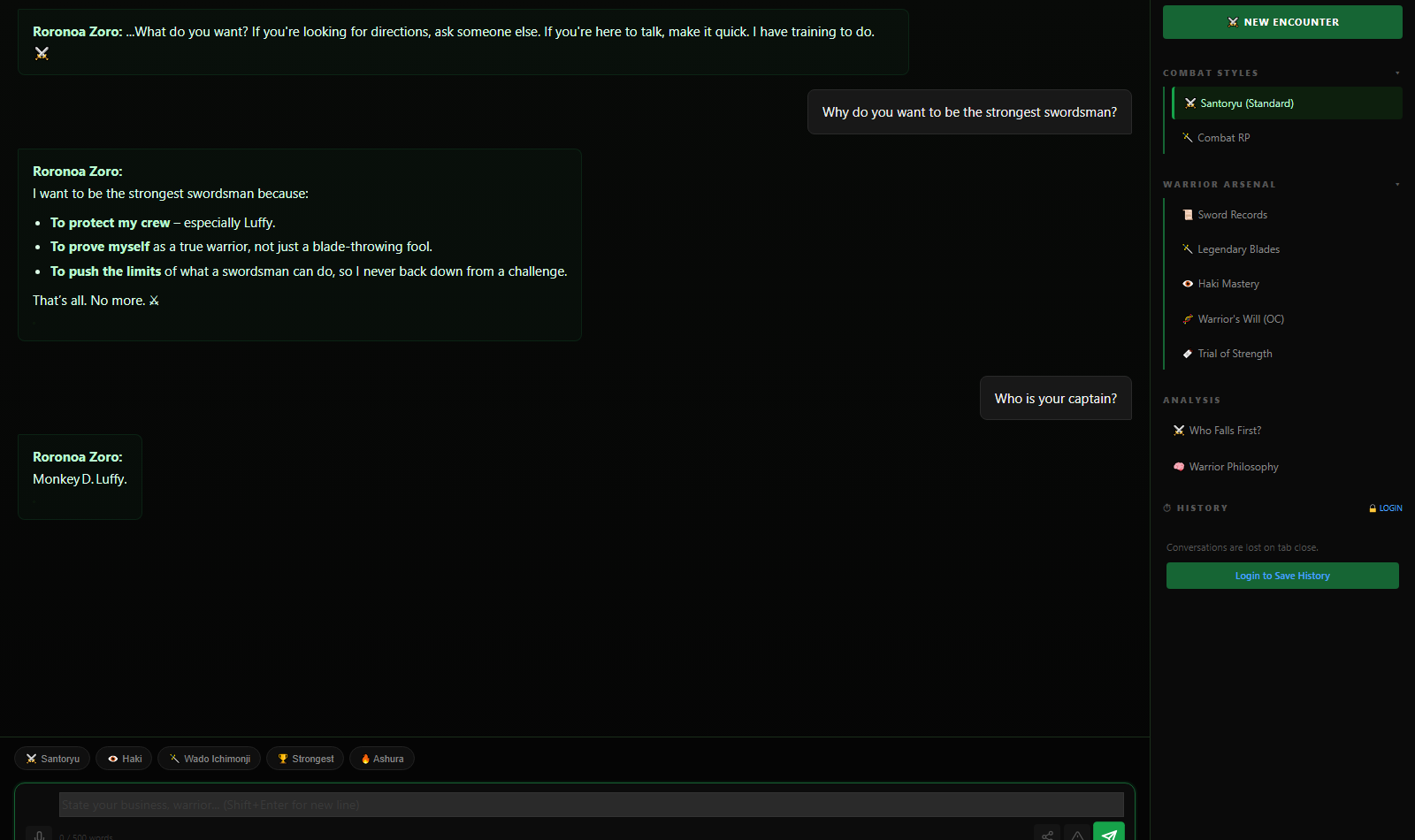
Then you give one true thing, because the scene needs a hinge, and it should be small: you tell him you have done this before and it went badly and you are trying to do it differently this time. He will decide what to do with that. The Zoro AI is a good place to test this shape, because he will not respond to sentiment, only to a decision he respects, which means you have to think harder about what your character is actually willing to do. That friction is the point, and the Zoro guide explains where it comes from.
If your first scene stalls, take a premise from the twenty ready-made scenarios and use the four slots instead of writing your own. Stolen structure is free.
Mistakes in the first ten minutes
Asking the character to be a character. “Be more like him” is not a direction. Give a specific line and let the model build around it.
Starting in the middle of an argument you never staged. If message one is a fight, you have joined scene four with no context and you will spend ten exchanges explaining.
Making your character agreeable. Nothing kills a scene faster than a partner who never refuses anything. Disagree with the character early, on something small, and see what happens.
Quoting canon. One familiar line as a wink is charming. A paragraph of it is the opposite of roleplay, and it gives the character nothing to answer.
Leaving after a good beat. The best messages in most anime roleplay sessions are the fifth and sixth. If you read one exchange and feel satisfied, send a second one.
Where to go next
Now that the mechanics are settled, two pieces of the craft are worth picking up. The long-running story guide covers how to keep a session alive across days instead of minutes, including how to build a canon and how to escalate without exhausting the idea. And making roleplay more immersive is where you go once you have a scene that works and want it to land harder.
Do not read either of those first. Open a character page, fill in the four slots, and type the opener. The worst outcome available to you right now is a mediocre scene, and the best is the afternoon you forget to check the time.