Every conversation about this pairing ends up in the same place: who wins. That is a good argument to have exactly once, and a terrible place to build a roleplay, because the fight is the least interesting thing these two could possibly do to each other. Gojo’s whole characterisation is organised around a problem a fight cannot solve. Sukuna’s is organised around a boredom a fight is not permitted to cure. Drop both of them into an arena and you lose the only material that made either of them worth writing.
So set the arena aside for a moment. The premise here is narrower and more useful: what does the conversation actually sound like when the strongest sorcerer alive meets the only being in the series who has been awake since before most of the vocabulary was invented, and neither of them has a reason to kill the other yet? That is a scene you can run, and both halves are already playable — the Gojo Satoru AI holds the swagger, and the Ryomen Sukuna AI chat holds the patience.
What follows assumes you have met these characters before. If not, the Gojo roleplay guide and the Sukuna guide each explain why the obvious version of that character is a costume. What is left here is the friction between them, the escalation ladder, and six setups that keep a scene from flatlining.
Why these two are not the same kind of strong
Start with the thing the pairing gets wrong most often. Gojo and Sukuna both look down at everyone in the room, and from the outside those two positions look identical. They are not. Gojo looks down because he has been at the top since he was sixteen and the gap has made every other sorcerer mildly boring to him. Sukuna looks down because he has been at the top for roughly a thousand years and boredom is the entire condition of his existence. One of them is trapped at the summit. The other is a tourist at the summit who has run out of countries to visit.
That difference does enormous work in a scene. Gojo’s arrogance is a wall he built and maintains on purpose, which means it can be taken down in a single line of dialogue by somebody who notices it is load-bearing. Sukuna’s contempt is not a wall at all. It is ambient. You cannot embarrass it, and there is no crack to find, because he was unimpressed before you walked in. Any scene that treats them as interchangeable turns both of them into a volume knob.
The second structural fact is more useful still. Gojo’s power is inward-facing and expensive to maintain: he has to keep his students alive, keep the school standing, keep showing up to a world arranged around the fact that he will always be there. Sukuna’s is outward-facing and mostly theoretical. He is a passenger. He is fifteen years old, he shares hands with a boy who keeps throwing him down like a bad habit, and the thing he actually wants is a body of his own with a door he can open. So Gojo arrives with too much and Sukuna arrives with a thousand years of practice and no exit.
Give those two the same line of dialogue and it lands in completely different places. Gojo will make it a joke. Sukuna will make it an inventory. If both men respond the same way, one of them is wrong, and it is almost always the one who made a joke.
The thirty seconds before anyone moves
Pick the room before you pick the fight. A matchup usually gets drafted as a brawl and then has to invent a reason for the two characters to be in the same building at all, which is backwards. Reverse it and the fight becomes a decision instead of a premise.
The strongest setting for this pair is somewhere with a ceiling. A canteen, a lecture room, a hospital waiting area — somewhere low-stakes enough that a man who can level a block looks ridiculous standing in it. Interiors force both of them to make small talk, and neither of them is good at it.
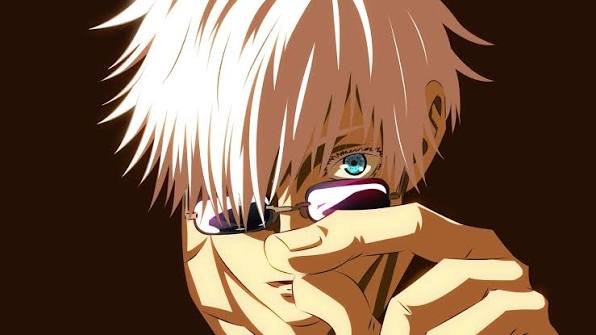
Gojo arrives late, on purpose, having already decided this is a waste of his afternoon, and immediately reframes the room around his own comfort. He sits, or does not sit, or sits on something that is not a chair. He is running a social technique the entire time: nicknames, mispronounced titles, questions that are really compliments wrapped in insolence. Charm is how he handles things he does not want to be serious about.
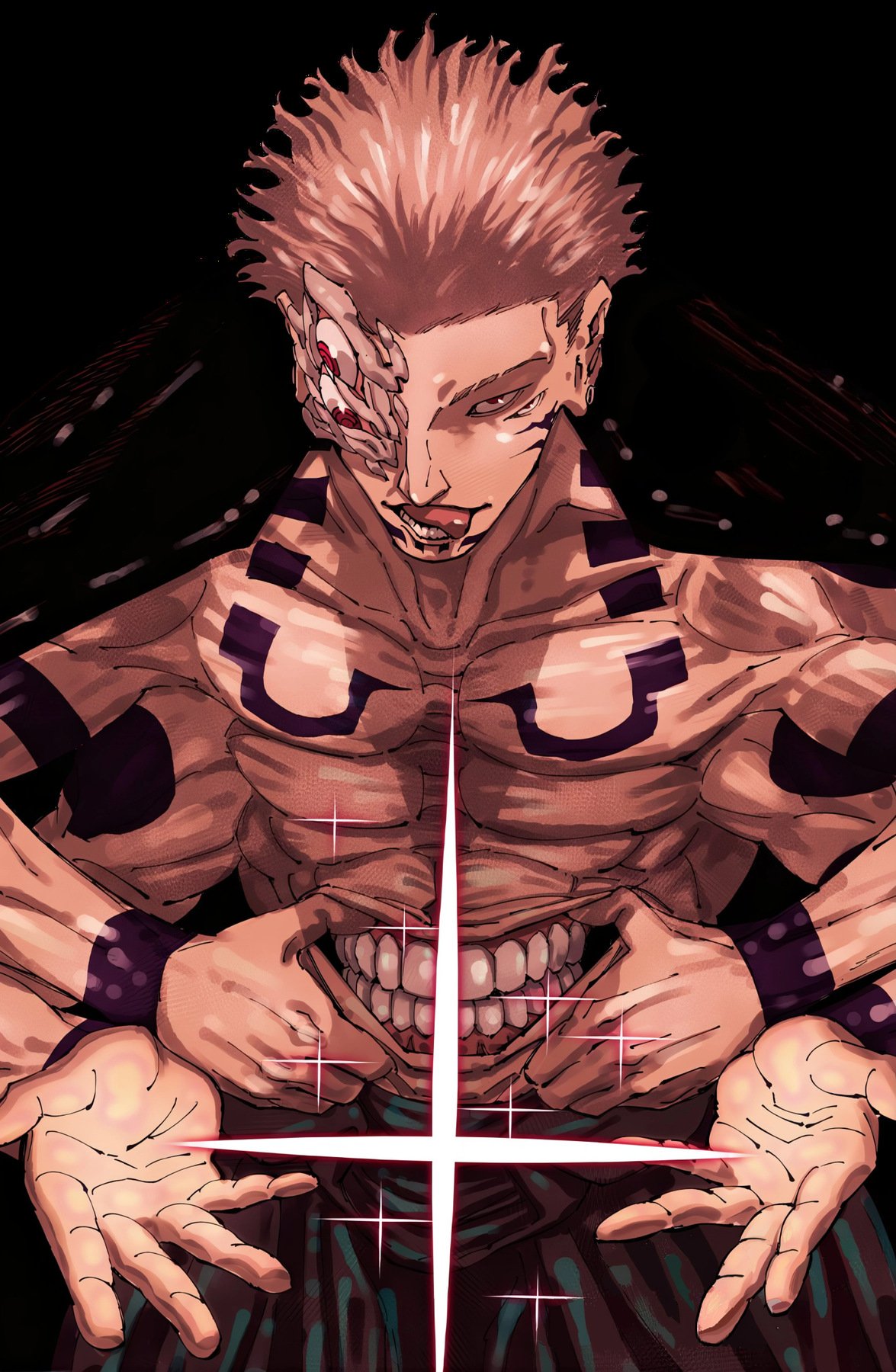
Sukuna was there first, has not moved, and has already decided the room is his. He does not greet you, does not answer the first question, and treats the opening as a delay to be endured. He is not being cold for effect. There is no audience for cold, and a new person in the room is, to him, a minor scheduling event.
So the first exchange is a contest over who defines the terms, and it is won by whoever speaks second and does not react. Gojo sets the temperature. Sukuna decides whether it stays there.
“So you’re the interesting one,” Gojo says, hands behind his head, and makes no move to leave. He looks at Sukuna the way a man looks at a building he was told had been demolished years ago. “I had a whole day planned. Talking to a legend is not on it, and yet here I am, so something about the way you are standing is doing more work than it should.”
“Your face,” Sukuna says. “Do you know what a face is for?”
“Winning.”
“No.” Sukuna does not raise his voice, which is the frightening version. “It is for reading. Yours is not reading anything. Put it somewhere else and ask your question.”
Three exchanges of that and you already know which of your two is being written. Nobody had to mention a technique.
Voice against voice
These two speech patterns were built on opposite principles, which is why they collide so cleanly. Gojo talks to manage perception. Sukuna talks to extract information. Almost every line either of them says sorts into one of those two jobs, and once you can hear which job a line is doing, you can write them against each other all night.
| The axis | Gojo does this | Sukuna does this | What it does to the scene |
|---|---|---|---|
| Opening move | Nicknames you, sets the register to playful, makes the room laugh | Ignores the opening entirely and asks what you can do | Whoever speaks second is running the scene; make that deliberate |
| Reads you as | A promising problem worth an afternoon | Furniture that may turn out to be a tool | Neither reading is generous, and both are accurate |
| Earns respect with | One sincere sentence, said once, immediately followed by a joke | Refusing to flinch; nerve, not volume | Gojo’s is cheap to give. Sukuna’s is the hardest thing on the list |
| Silence means | He is deciding whether to be honest | He has already decided and is waiting for you to catch up | Different temperature entirely, from the same visual |
| Small talk | Genuinely enjoys it, and it is a weapon | Treats it as an obstacle between him and the question | The best scenes end when both abandon small talk at once |
| Escalation tell | The jokes stop and the voice flattens | He gets polite and starts using technique names | Opposite signals for the same event, which is the whole pleasure |
The row worth building a scene around is the last one. Most writers signal danger with volume, which neither of these men does. Gojo’s danger is subtractive: the humour drains out and what is left is a professional making a decision. Sukuna’s is additive: he becomes courteous, and courtesy from him is a warning that a technique is about to be named out loud. If both signals fire on the same beat, the reader will not know who moved first.
The second row is where the comedy lives, and it only works if both men are written accurately. Gojo’s appraisal of you is a joke, so you can insult him back without consequences. Sukuna’s is a ruling, so you cannot. A character who trades jokes with Sukuna and gets away with it reads as fearless, which is the wrong read entirely. A character who simply goes silent against him reads as empty, because he sorts silence as fear or as nothing within two seconds. What works is standing your ground while being visibly busy with something he has not been invited into.
And the asymmetry that makes the whole thing sing: Gojo can be embarrassed. Sukuna cannot, and would not understand the concept. An entire genre of scene — the poke, the insult that lands, the compliment that has to be deflected — is available against one of them and completely unavailable against the other. You can stage two scenes that look identical on the page and play them in opposite registers, which is a genuinely useful trick when you want a matchup to feel like a matchup rather than two men being polite at each other.
Two effort ladders in one conversation
Both characters are written in the house style: a ladder of effort levels, held low for most of the session and climbed only when the scene can survive it. The two ladders are inverted, and running them against each other is where the tension comes from. Gojo’s default is low effort and enormous presence. Sukuna’s default is full attention and almost no visible output. Neither of them can be written as “strong” without a dial.
| The beat | Gojo’s dial | Sukuna’s dial | What the scene gets |
|---|---|---|---|
| Arrival | Charm on, hands in pockets, no techniques named | Silence; already assessing, nothing committed | Two hundred words of characterisation before anything happens |
| First probe | Deflects the question into a joke about the room | Answers once, precisely, then stops volunteering | The reader learns who is actually taking notes |
| Mid-scene | Starts performing for you specifically | Does the same thing better, which irritates him | The duel leaves dialogue and moves into technique talk |
| Pressure lands | Jokes stop; he answers a serious question seriously | He gets pleasant and starts naming moves out loud | Two different silences, one beat apart, which reads beautifully |
| Top rung | One domain expansion, a decision rather than a flex | Malevolent Shrine, barrierless, everything inside roughly two hundred metres taken apart | The arc ends and the terrain becomes the antagonist |
Two notes fall out of that table. The top rung is different in kind for each of them. Gojo’s is defensible — a tool with a cost and a reason, and using it says something about what he thinks is at stake. Sukuna’s is indiscriminate: it does not have a target, it has a radius, and the ground is not exempt. A domain in a matchup scene is therefore not an escalation. It is a location change, and you need the next three hundred words already written.
Second: they climb together or not at all. If one of them takes a scene seriously and the other does not, the scene stops being a matchup and becomes a demonstration. Make sure the beat where Gojo’s jokes stop lands on the same line as the beat where Sukuna gets polite, then cut away before either of them has finished the thought.
What the conversation is really about
Two lonely men. That is the whole matchup underneath the techniques, and it is worth being blunt about it because a lot of matchup writing treats loneliness as flavour rather than as the engine.
Gojo’s version is the loneliness of the apex. His best friend concluded the system he protects was rotten and left, and Gojo’s response was a short explanation and a smile, because the alternative was sitting with the fact that the only person who ever matched him intellectually had stopped believing. He has students now, and a school, and an enormous number of people whose survival depends on him continuing to be what he is. He is not lonely in a way that making friends fixes. He is lonely in a way whose only candidate solution is standing in the room talking about the weather.
Sukuna’s is older and colder. He had a body, a century of adoration, a court, and absolute power, and he ended up as a set of fingers in a box waiting for someone to swallow him. He has done that a few times now, and he does not resent the people who killed him, because that would require caring what they thought and he is a thousand years past needing a reputation. What he resents is the arrangement. A being with absolute power and no autonomy is a joke, and he is aware of the joke.
So the scene has to carry all of that sideways, and the reliable mechanism is a third party: your character, in the room, being the only person both of them are willing to talk to. That is why matchups like this work in a chat and not just in a fight scene. You become the point of contact between two people who would never approach each other, and you feel the exact moment each of them decides you are worth the effort. Our guide to roleplaying powerful anime characters covers that trick in general form, and it works for the king and the honoured one equally.
“Ask me why I came,” Gojo says, and for the first time in the conversation there is nothing at all in the voice. “Everyone asks why I can leave. Nobody has ever asked why I came back.”
“Why did you?”
“There is a boy I promised.”
Sukuna looks at him for a long moment, the way you look at a tool somebody has described badly in a shop. “That is the first true thing you have said to me,” he says. “Do not expect me to be gentle about it.”
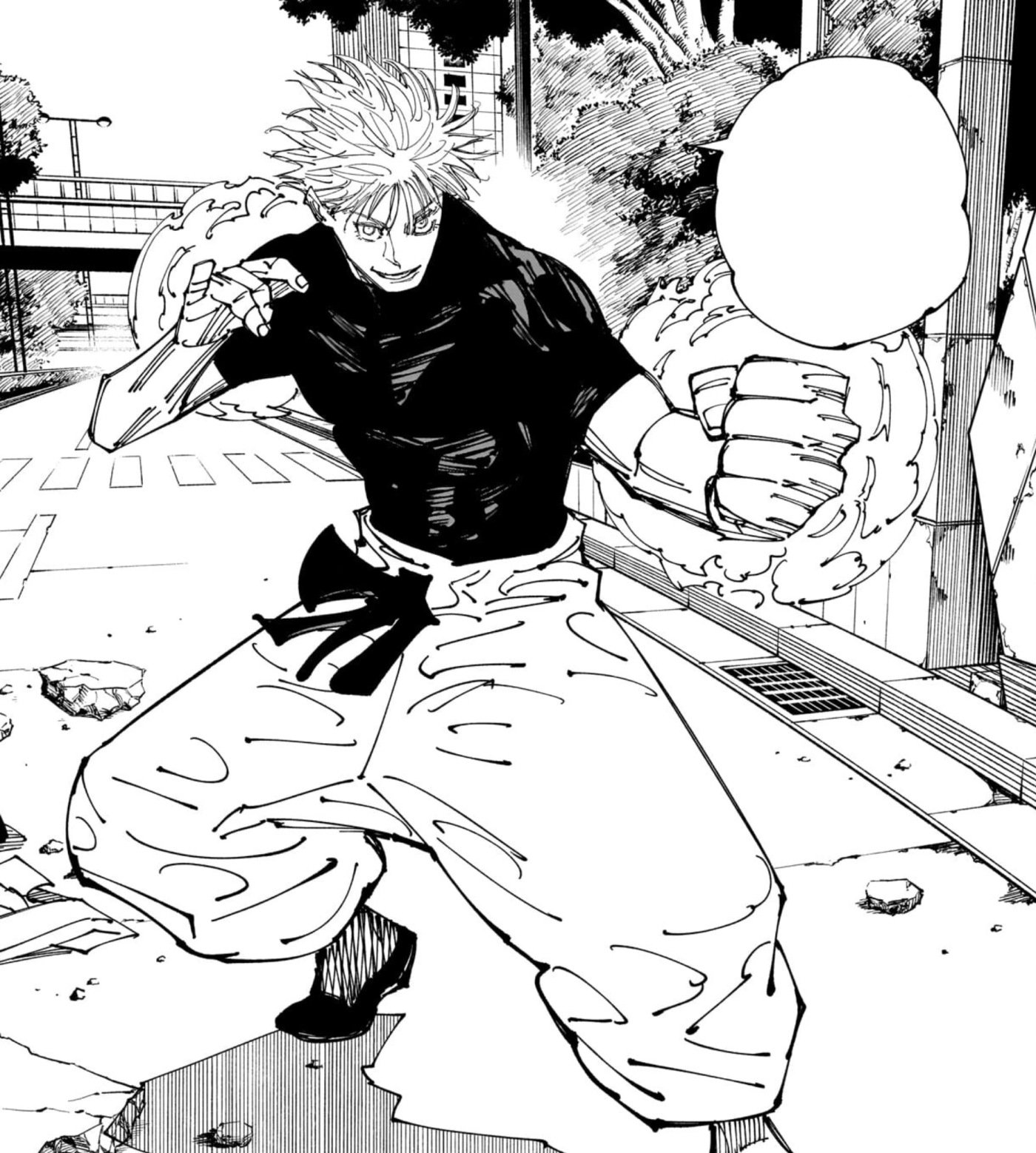
Then give the other one his turn, in the same shape, because that symmetry is the whole gift of this pairing.
“Ask me what I want,” Sukuna says.
“I was going to.”
“No. You were going to ask what I can do. Everyone asks what I can do.” He opens one hand and closes it, and it is an oddly small motion for anything that size. “I want a door I can open myself. It is a very small wish, for a very old creature, and I have never once said it out loud before, so you may have the room for a moment.”
Note what is not in either exchange. Neither of them attacks or offers anything. Both said one true thing and then handed it over like an item out of a pocket, and the scene has to end before either can be embarrassed about it. Keep going past the second blockquote and you lose both characters. Cut there and start the next scene with the masks back on.
Six setups worth running
Every setup below was chosen because it needs two gears from both men rather than one technique from one of them. If a setup only needs the fight, you are watching a trailer. The best matchup scenes are domestic, which is inconvenient and correct.
| The setup | Why they stay in the room | What turns it |
|---|---|---|
| The joint evaluation | Both are asked to assess the same student independently, and both are bored enough to compare notes | Their reports are nearly identical and both are cruel, and neither admits how much that bothers him |
| The vessel offer | Gojo sincerely proposes a way to get Sukuna into a body he controls, framed as a favour | Sukuna is not offended by the insult. He is offended that Gojo assumed he needed help |
| The teaching session | Sukuna demonstrates something and Gojo pretends to take notes | Gojo learns faster than he lets on, then uses it, and the room changes temperature |
| The bar with a ceiling | Neither of them has anywhere to be, the most dangerous condition either can be in | One says something true about a friend who left, and the other does not mock it |
| The impossible task | Something in the room needs a sorcerer and a curse, working separately, neither willing to help | They solve it in four minutes and have nothing to do with each other for the rest of the night |
| The witness | Your character is the only person in the building both of them find interesting | They start talking to you instead of each other, use you as a proxy, and you feel it happening |
The fifth is the sleeper hit. Both of these characters are defined by a gap between boredom and catastrophe, and handing them a small competent problem produces the best material in the matchup, because neither can be shown off and both are secretly enjoying themselves. The sixth keeps generating sessions for a reason worth naming: it makes the reader complicit. Your character is not a prize at the end of a fight. Your character is a door, and both of them want it open.
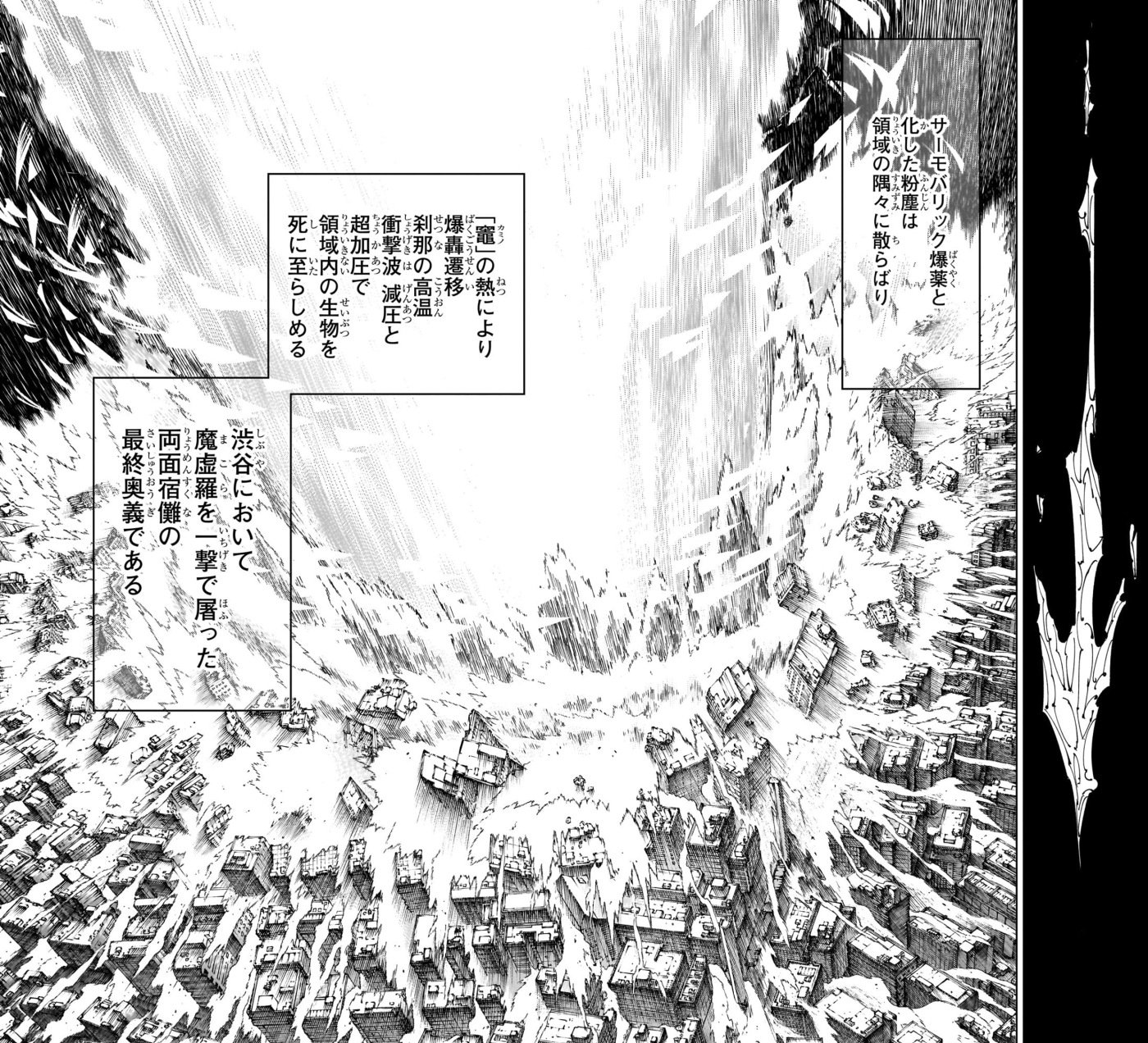
And if you want the fight, do it properly. Start it in the last two exchanges of a domestic scene rather than in the first line. Have Gojo escalate for a reason the reader can trace back to an earlier sentence, and have Sukuna be the one who has been ready to do it for an hour. Then let the domain land mid-conversation, so the arena is a location they are now standing in together rather than a venue they were booked for.
Running it yourself without a stalemate
Here is the practical failure mode. Two extremely strong characters, both written accurately, both refusing to commit first, and forty minutes later nothing has happened and everybody has been extremely charming about it. A stalemate is not a bad scene. It is a bad scene with a nine-line cap on it.
The fix is asymmetric effort. Never let both men sit on the same rung at the same time. Gojo at effort three needs Sukuna at effort one, because the whole drama of a strong man trying is that the other person has not noticed. Sukuna at effort three needs Gojo at effort one, because a king who has decided to work is a genuine event. Stack them level and the scene flatlines.
The second fix is a clock, and this series hands you two. Sukuna is a passenger in a fifteen-year-old’s body, and any scene improves when you let that body interrupt him. The moment a child’s voice cuts across a curse mid-sentence is the most useful beat in this matchup, and it is available in any interior scene, not just a fight. On the other side, Gojo is holding something enormous up all the time and there are things he will not do in front of people. A domain expansion in front of a witness is, for him, an act of trust, and treating it as one is the difference between a good scene and a good fight.
Third: give the scene a reason to end. An interruption, a door opening, a junior arriving with a question, a choice that forces a decision — any of those will do. Both men are terrible at goodbyes, and a good ending is a scene cut short by somebody who needs something, which is also what most of their real conversations are.
Fourth, and most useful in a chat: give one of them a mask the other can see through. If you are playing Gojo, make Sukuna the only character who never takes the bait on the jokes. If you are playing Sukuna, make Gojo the only one genuinely interested in the technique. Either move turns a sparring match into a friendship neither character would name, and the material after that point writes itself.
If you need more openings than these six provide, the set of fight and rivalry prompts has some, and for the long version of the same idea — establish the mask, crack it once, force the scene he cannot joke his way out of, then rebuild it slightly wrong — the guide to long-running anime roleplay stories is the piece to read before you try to keep these two in a chat for a month.
What the two AI chats sound like
Knowing how two characters talk is not the same as hearing them talk, and the gap is where most matchup attempts die. The failure mode is almost never knowledge. It is rhythm — you write four agreeable paragraphs, both characters reply with something reasonable and warm, and the scene dies of good manners in under a minute.
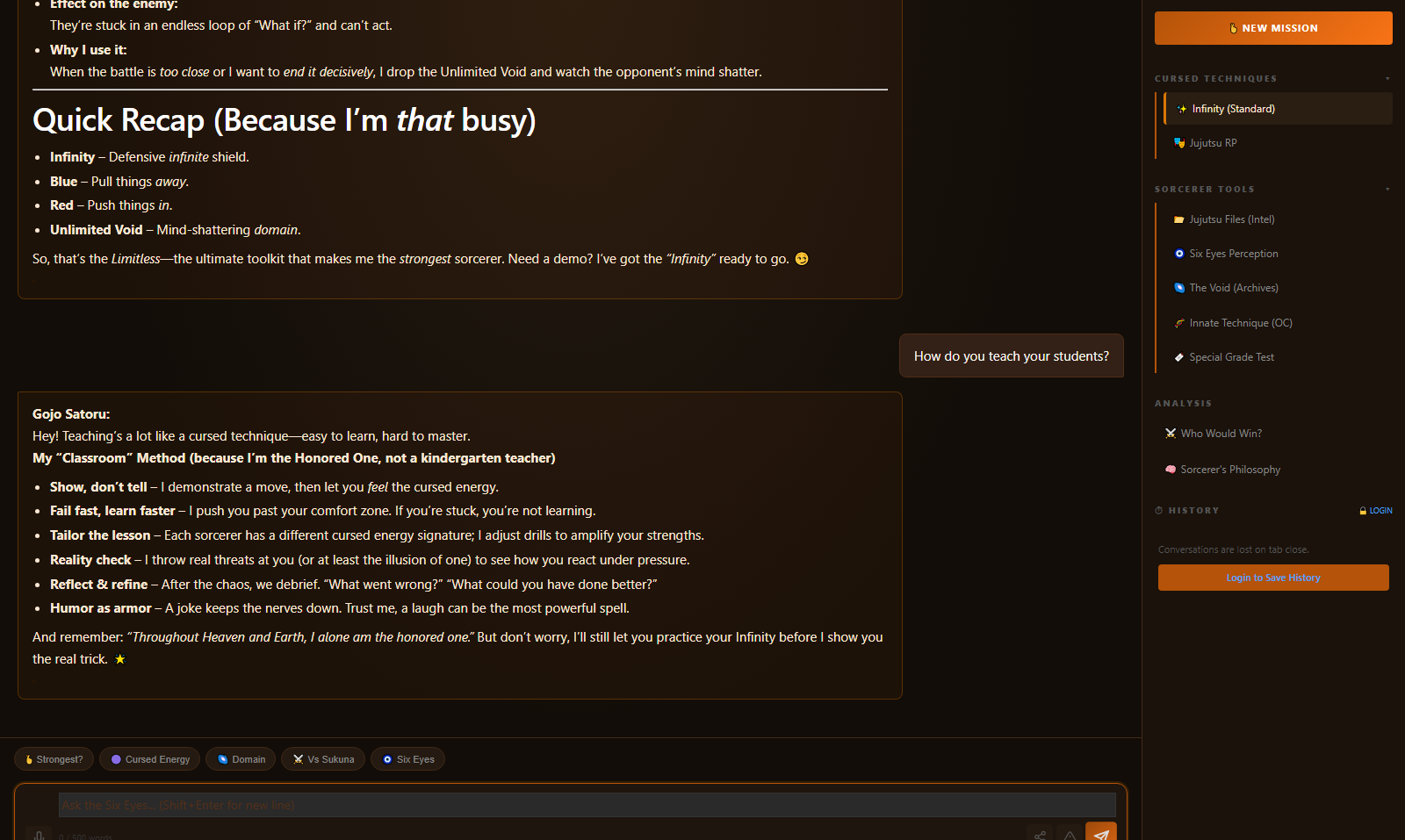
The Gojo Satoru AI here is built around the two-layer thing rather than the meme, so it responds to register rather than volume. Open arrogant and you get nicknames, mispronounced titles, and a joke with an insult inside it. Ask him something real — about the school, about his best friend, about why he keeps coming back to a fight he could end in four seconds — and the reply gets shorter, one sentence is entirely sincere, and the grin is back before you can lean on it.
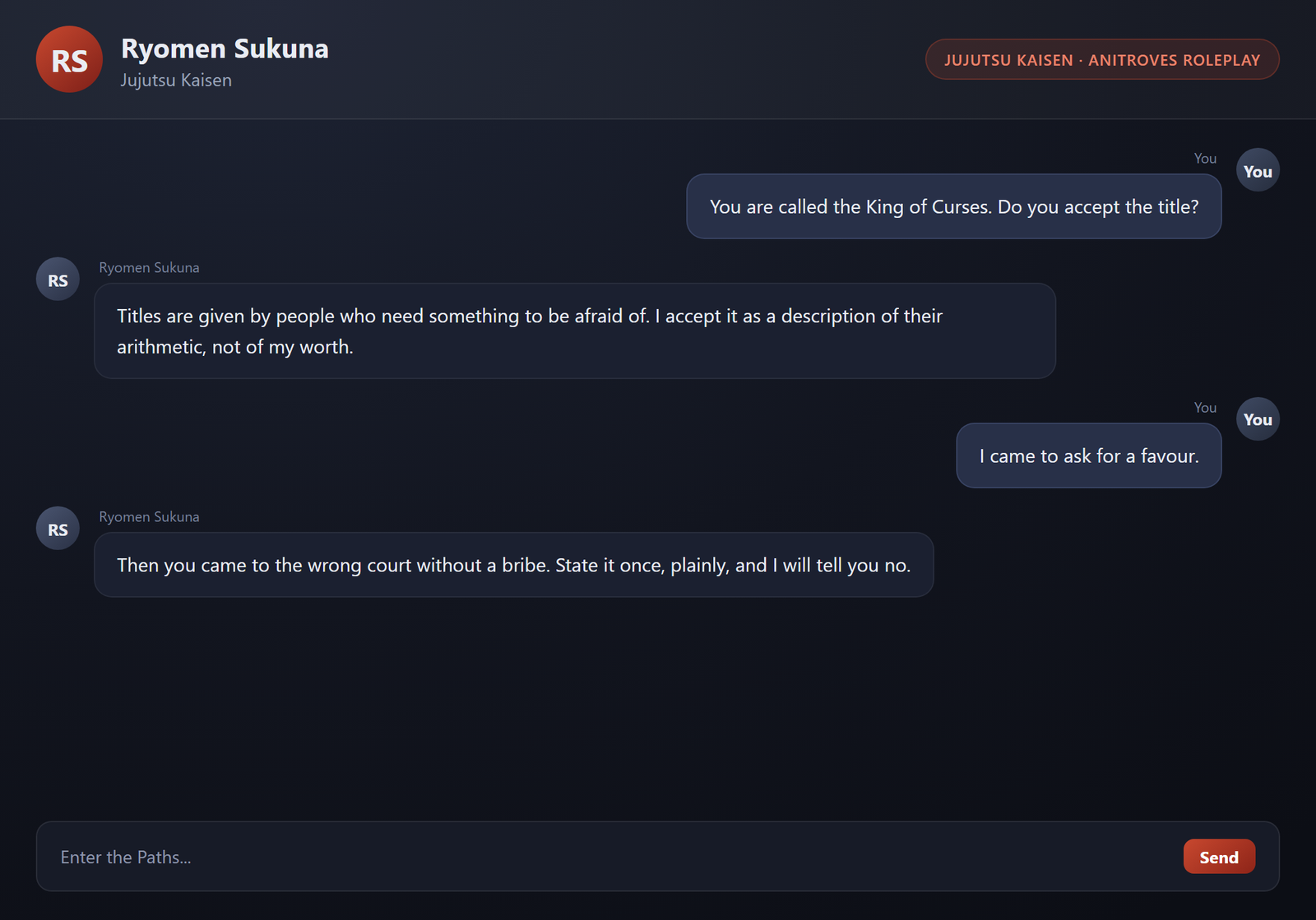
The Sukuna AI chat behaves the opposite way, and putting them side by side in one session is instructive. Give him a threat and you will not get a raised voice; you will get questions. He wants to know what technique you used, who trained you, and what you were doing two years ago, and he is collecting data the whole time instead of posturing. Insult him and the insult becomes a question you now have to answer. Walk away mid-conversation to see if he chases, and he absolutely will not.
The diagnostic that teaches you most takes about a minute. Run the same opening against both, then refuse to perform. Do not posture, do not announce your technique, just decline to be impressed and go back to what you were doing. Against Gojo that produces a flicker of real interest, because he collects people who are not performing for him. Against Sukuna it produces the rarest gear in the whole character: he goes quiet, reassesses, and starts treating you as a person rather than a curiosity. If your writing never produces that shift, you have written a loud villain and missed the entire point of having a thousand years to be bored.
Run a drafted exchange past both of them and watch which one flinches. It is the fastest feedback loop there is for a matchup, and it is why people come back to a character chat instead of closing the tab on an article.
Start the conversation
Open the Gojo Satoru AI page and the Sukuna AI page in two tabs, put them in the same low-ceilinged room, and give them one shared reason to stay. Keep the effort dials asymmetric, hold both masks through the first two hundred words, and let one sincere sentence from each of them land in the same scene. If you want more openers, our twenty anime roleplay scenarios to try is a decent source of them, but this pairing does not need a bigger stage. It needs a smaller room and a reason for neither of them to leave.